HG U8D4 Two Way Tables Dec5
star
star
star
star
star
Last updated about 1 year ago
19 Nsɛmmisa
1
1
1
1
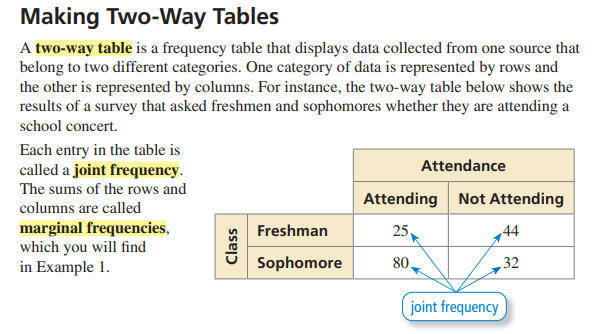
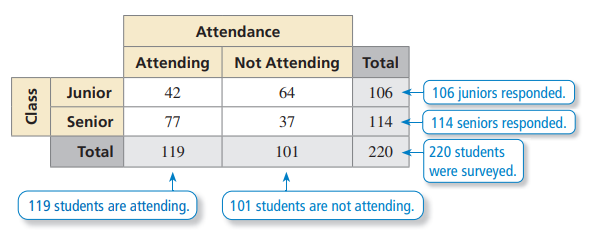
Two-Way Table to Frequency Table
Include totals
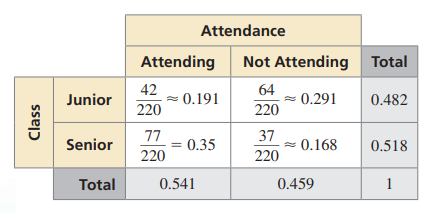
Convert to marginal relative frequencies.
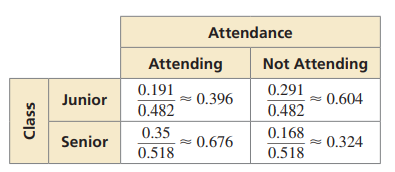
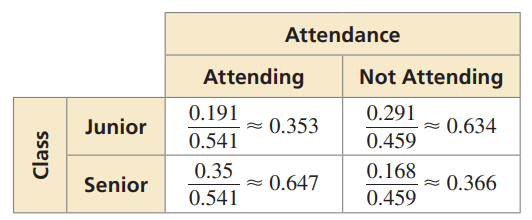
Convert to conditional relative frequencies for Juniors and Seniors.
P(A|J), P(A'|J), P(A|S) and P(A'|S).
Convert to conditional relative frequencies for attendance.
P(J|A), P(S|A), P(J|A') and P(S|A').
There are 16 juniors and 24 seniors on a debate team. Of those, 7 juniors and 19 seniors qualify for a state debate competition. Organize this information in a two-way table. Then find and interpret the marginal frequencies.
Convert to show marginal relative frequencies.
Convert to conditional relative frequencies for Juniors and Seniors.
Convert to conditional relative frequencies for if they qualified for the state competition.
More Ice Cream
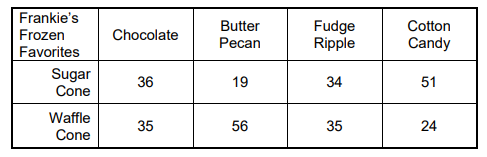
The retail and service industries are another aspect of modern society where probability’s relevance can be seen. By studying data on their own service and their clientele, businesses can make informed decisions about how best to move forward in changing economies. Below is a table of data collected over a weekend at a local ice cream shop, Frankie’s Frozen Favorites. The table compares a customer’s flavor choice to their cone choice.
C = Chocolate
B = Butter Pecan
F = Fudge Ripple
CC = Cotton Candy
S = Sugar Cone
W = Waffle Cone
Complete the table to help you answer the questions.
Find the following probabilities. Write the fraction (1st) and then the percent. Rounded to the nearest tenth.
P(C) =
Find the following probabilities. Write the fraction (1st) and then the percent. Rounded to the nearest tenth.
P(B) =
Find the following probabilities. Write the fraction (1st) and then the percent. Rounded to the nearest tenth.
P(F) =
Find the following probabilities. Write the fraction (1st) and then the percent. Rounded to the nearest tenth.
P(CC) =
Find the following probabilities. Write the fraction (1st) and then the percent. Rounded to the nearest tenth.
P(S) =
Find the following probabilities. Write the fraction (1st) and then the percent. Rounded to the nearest tenth.
P(W) =
By looking at the table and your calculations, would you say that there is a relationship between flavor and cone choice? Why or why not?
Same question...
Could you predict the cone choice from the flavor of ice cream?
Find the following probabilities. Write the fraction (1st) and then the percent. Rounded to the nearest tenth.
P(𝐶𝐶 ∩ W) =
Find the following probabilities. Write the fraction (1st) and then the percent. Rounded to the nearest tenth.
P(S ∩ B) =
Find the following probabilities. Write the fraction (1st) and then the percent. Rounded to the nearest tenth.
P(S|C) =
Find the following probabilities. Write the fraction (1st) and then the percent. Rounded to the nearest tenth.
P(S|B) =
Find the following probabilities. Write the fraction (1st) and then the percent. Rounded to the nearest tenth.
P(S|F) =
Find the following probabilities. Write the fraction (1st) and then the percent. Rounded to the nearest tenth.
P(S|CC) =
Find the following probabilities. Write the fraction (1st) and then the percent. Rounded to the nearest tenth.
P(W|F) =