A2 Transition metal chemistry 1

Last updated about 1 year ago
7 questions
1

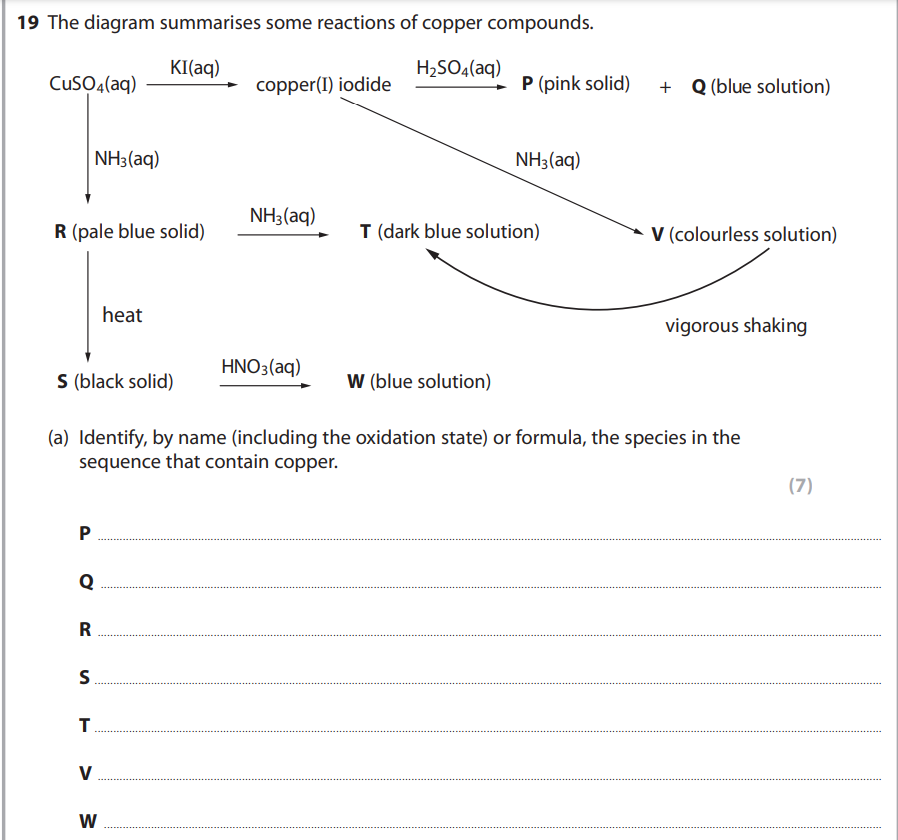
Copper Flow chart


Other Answer Choices:
copper(II) oxide / CuO
Copper (Cu)
1

T and V are the same type of chemical species. (i) Name this type of chemical species.

1


Explain why T is coloured while V is colourless. A detailed explanation of the fact that T is coloured is not required. (3)


The colour is due to transition of ______________ between split 3 d subshells / _____________ (1) 

in ___________ the d orbitals are partially filled so electron transitions are possible (1)
_________________
in __________ the d orbitals are full and so no (electron) transitions are possible (1) __________________
Other Answer Choices:
Cu(II)
[Ar] 4s¹ 3d9
Cu(I)
orbitals
electrons
[Ar] 4s¹ 3d¹⁰
1
(iii) Suggest an explanation for the change of V into T on shaking.

Cu(I) is _____________ to Cu(II) (1)  by ___________ in the air
Other Answer Choices:
reduced
oxygen
oxidised
1
(c) The reaction between copper(I) iodide and sulfuric acid is a disproportionation.

(i) Write the ionic equation for this disproportionation reaction.

2CuI → Cu+ Cu2+ + 2I−

State symbols are not required. (1)

(ii) Show that the reaction in (c)(i) is thermodynamically feasible.


Eo cell ( = _________ − _________ ) = (______ )_________ (V)

The reaction is feasable because Eocell is _____________
Other Answer Choices:
-
negative
0.15
0.52
positive
0.37
+
1
Example added to notes.
1
Chromium compounds and oxidation of alcohol


Eocell = EoR − EoL
1.94 = EoR − (−0.61)
EoR = 1.94 − 0.61= (+) _________ (V)
Therefore
The electrode system is number _______
(b) Write the overall equation for the reaction in the cell. State symbols are not required.
______ C₂H₅OH + Cr₂O₇₂− + ______ H⁺ ⇌ 2Cr⁺ + ______ CH₃CHO + ______ H₂O

c) Write the ionic equation for the reaction of the aqueous solution of E with dilute sulfuric acid.
2CrO₄₂− + 2H⁺ ⇌ Cr₂O₇2- + H₂O
___________ ___________
Other Answer Choices:
3
1.33
orange
28
8
7
3
yellow
6