Ɛhia
1
Ɛhia
1
Ɛhia
1
Ɛhia
1
Today you will read two book excerpts, or pieces, about Machu Picchu. An explorer named Hiram Bingham wrote the book in 1922. The first excerpt is from the book’s preface, or introduction. The second excerpt is from Chapter 17 of the book. After reading the excerpts, you will answer several questions based on the texts. Some of the questions have two parts. You should answer Part A of the question before you answer Part B.
Excerpt 1: From the Preface of Inca Land: Explorations of the Highlands of Peru, by Hiram Bingham
[1] This book describes parts of four of my journeys into Peru. Although my travels covered only a part of southern Peru, they took me into every kind of climate. My travels also forced me to camp at many different heights. I camped at very low heights when at sea level and at very high levels when in the mountains. On my journey, I had to cross the harsh and cold Andes Mountains. In the Andes, I experienced heavy snowfalls and low temperatures. I also had to wind my way through huge canyons into the dense jungles of the Amazon Basin. The Amazon Basin is as hot and humid a region as exists anywhere in the world. The Incas lived in a land of extremes. No deserts in the world have less vegetation than their deserts. No fertile tropical valleys have more plant life than their jungles. In Inca Land one may pass from glaciers to tree ferns within a few hours. Present-day writings about the last of the Incas illustrate this contrast. Historians shift rapidly from fact to fantasy and from observation to imagination in their writings. They also often omit important details and give confli ting statements. Because present-day writings are such a mix of fact and fantasy, the story of the Incas remains mysterious.
[2] Some wonderful pictures from an 1800’s explorer first interested me in a relatively unknown region of Peru. The area is sometimes called “the Cradle of the Incas.” I believe my photographs cannot compete with the imaginative pencil of such an artist. However, I hope that some of them may lead future travelers even farther into the Land of the Incas. I also hope my photographs inspire others to further explore the mysterious places mentioned in the stories
Part A: In paragraph 2 of excerpt 1, the author states he hopes that his photographs inspire others. What is the meaning of the word inspire?
Part B: Which phrases from paragraph 2 of excerpt 1 best help the reader determine the meaning of inspire? [Choose two.]
Part A: Based on "Inca Land: Explorations of the Highlands of Peru", what inference can be made about how the author felt about the stone walls at Machu Picchu?
Choose the paragraph from "Inca Land: Explorations of the Highlands of Peru" that provides evidence for the answer you selected above.
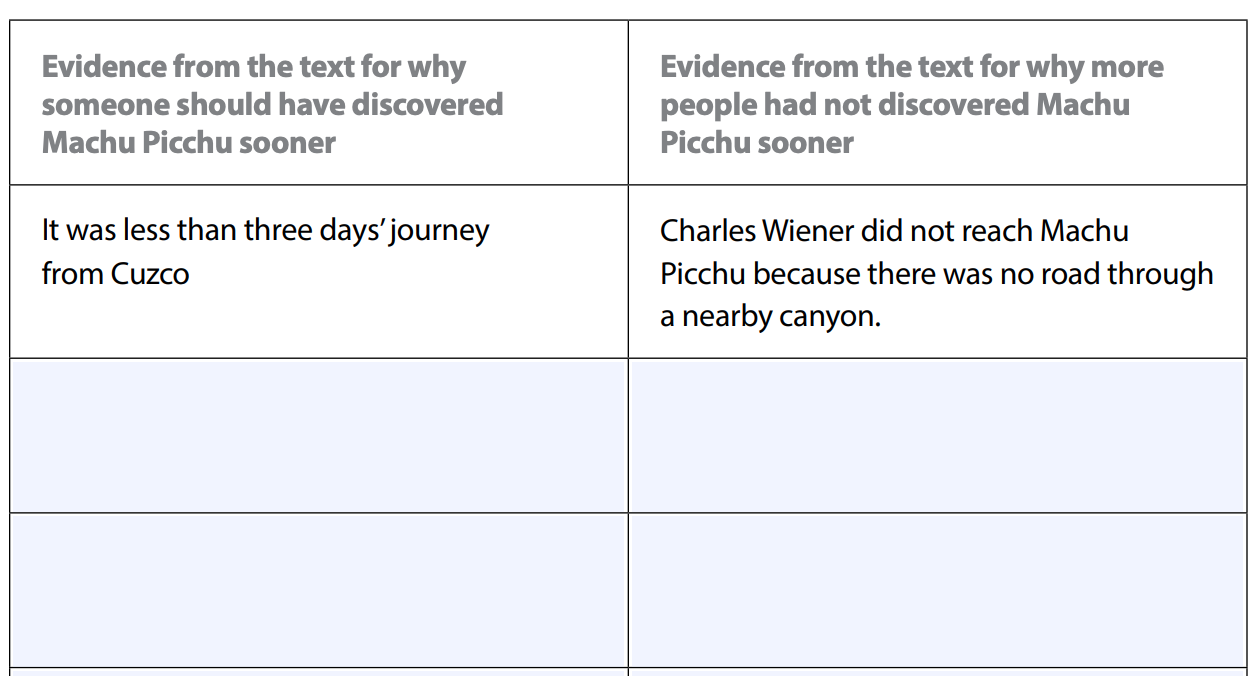
In the excerpts from Inca Land: Explorations of the Highlands of Peru, the author gives some reasons for why someone should have discovered Machu Picchu before the early 1900s and also gives some reasons for why more people had not discovered Machu Picchu sooner. The headings in the chart below list these two different ideas. Complete each row of the chart by writing facts and details from the text to support each idea
In the excerpts from "Inca Land: Explorations of the Highlands of Peru", the author gives one piece of evidence for the discovery of Machu Picchu. Copy and paste the sentence in the excerpt that best supports how we know when Machu Picchu was probably first discovered.
In paragraph 5 of the excerpt from Inca Land: Explorations of the Highlands of Peru, what is the meaning of the word spellbound?
Which point is the author supporting by including this sentence?