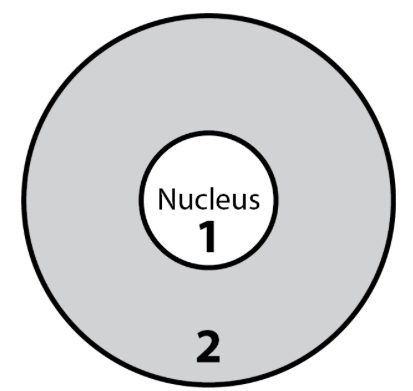
The diagram of an atom below shows two regions, the nucleus (1) and the area surrounding the nucleus (2).
The diagram of an atom below shows two regions, the nucleus (1) and the area surrounding the nucleus (2).
The diagram of an atom below shows two regions, the nucleus (1) and the area surrounding the nucleus (2).
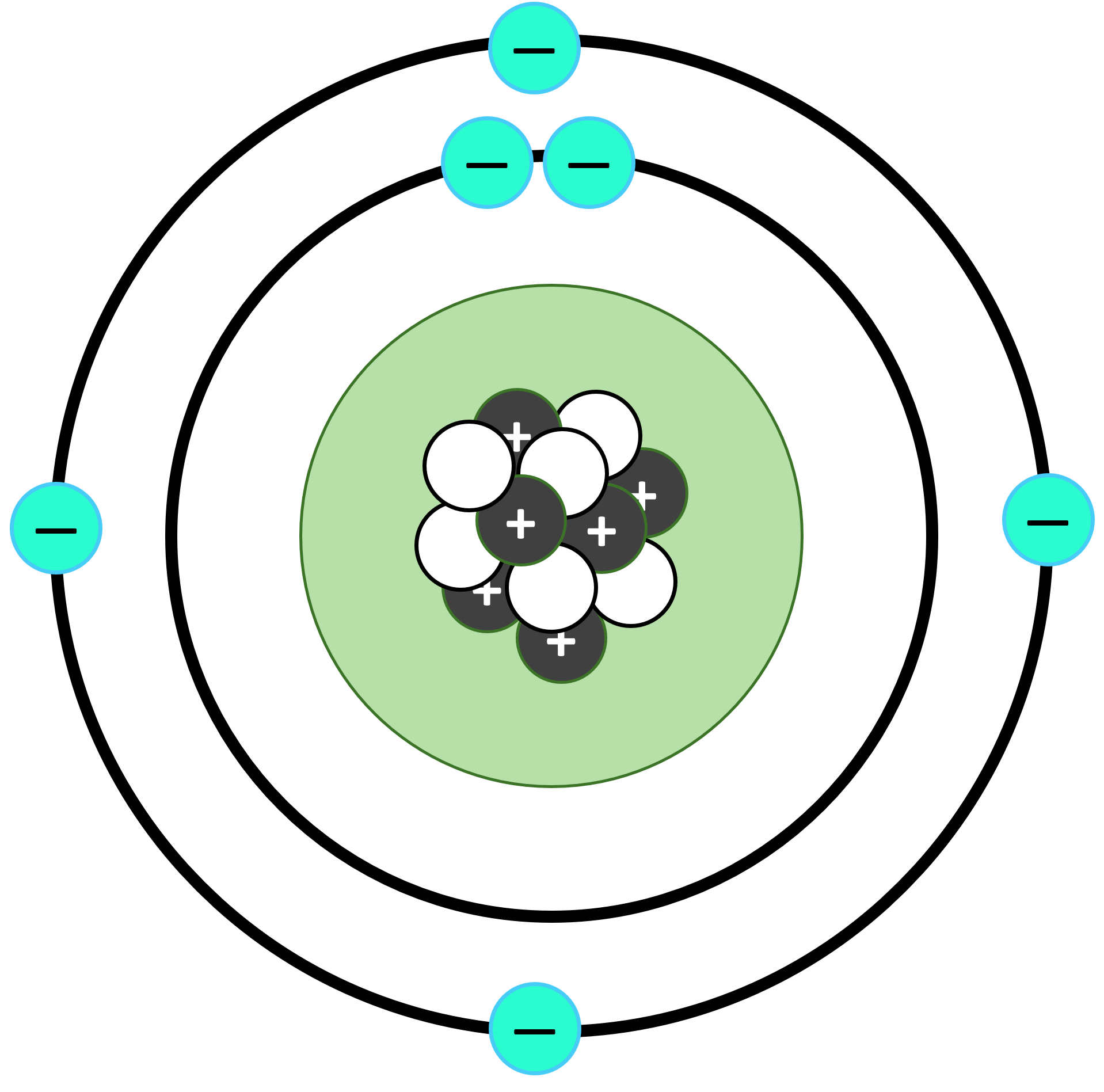
Atoms are because they have the same number of protons and electrons.
Protons have a charge, electrons have a , and neutrons are.
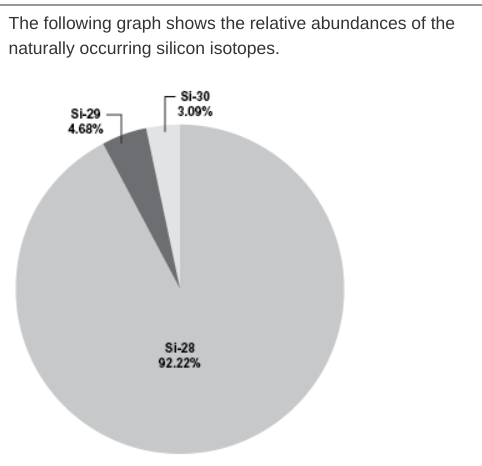
The estimated average atomic mass of Silicon could be amu because the abundant isotope is .
An atom has 7 protons, 7 electrons, and 8 neutrons. What is its atomic mass?
Given the isotope of Oxygen-18, how many neutrons does this isotope have?
Given the isotope of Carbon-12, how many neutrons does it contain?
Given the isotope of Chlorine-35, how many neutrons does it possess?
An atom of Carbon-13 (C-13) contains 6 protons. How many neutrons does this atom contain?
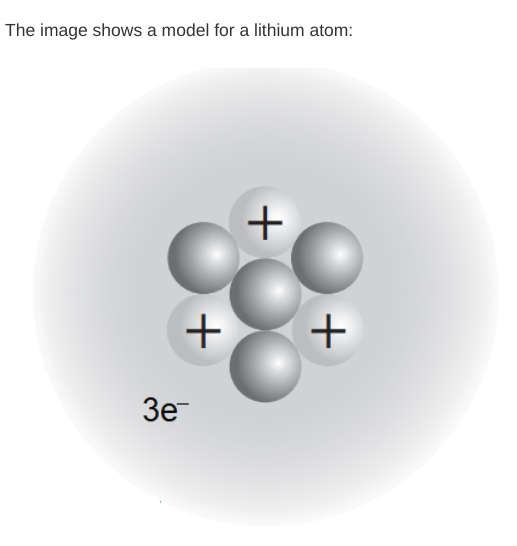
There are
If an atom has 17 protons, 18 neutrons, and 17 electrons, what is the mass of this atom?
Which particles have almost the same mass?
Which of the following represents a pair of isotopes?
An element has three naturally occurring isotopes: Isotope A (75% abundance, atomic mass 70 amu), Isotope B (20% abundance, atomic mass 71 amu), and Isotope C (5% abundance, atomic mass 72 amu). What is the average atomic mass of the element?