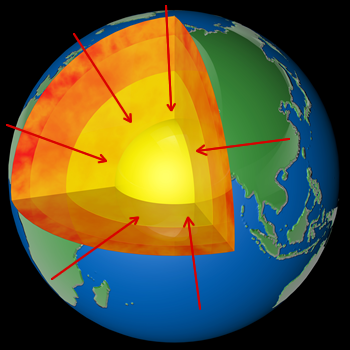
It is easy to see the landforms, oceans, and creatures on Earth's surface, but its internal structure is hidden below. The Earth is not all one consistent material inside. Instead, it is made up of layers. The Earth's layers are the crust, the mantle, the outer core, and the inner core. Each of the layers of the Earth is unique in terms of its composition, temperature, and thickness.
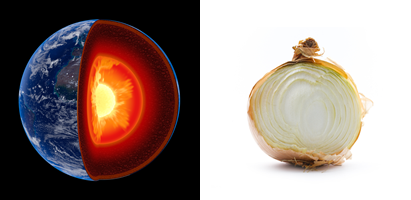
This cross-section of the planet reveals Earth's layers. The onion has an outer peel and inner layers. Similarly, the Earth has an outer surface and inner layers.
The Crust
Required
1 point
1
Question 1
1.
In comparing the structure of the Earth to the structure of an apple, which part of the apple is most similar to the Earth's crust?
Required
1 point
1
Question 2
2.
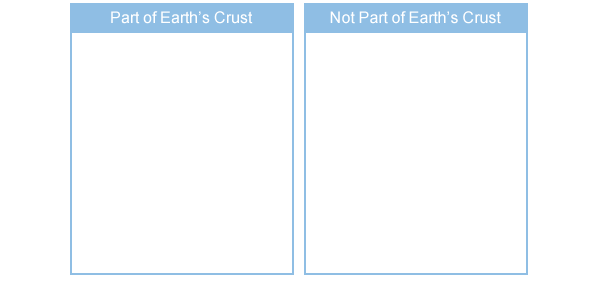
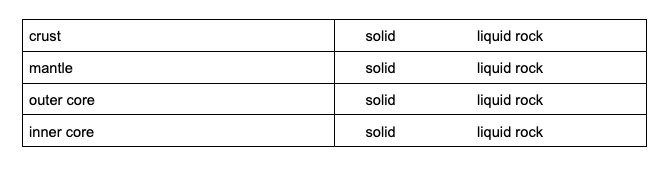
Sort these structures found on Earth into the correct categories.
Other Answer Choices:
There are two main types of crust: continental and oceanic. The continental crust is the part of the Earth's crust that makes up the continental land masses on Earth's surface. The oceanic crust is the part of the Earth's crust that is beneath the Earth's oceans.
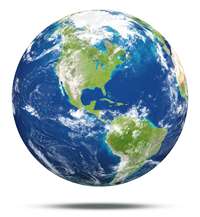
The Earth's surface is covered by continents and by oceans.
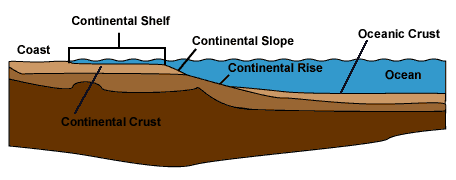
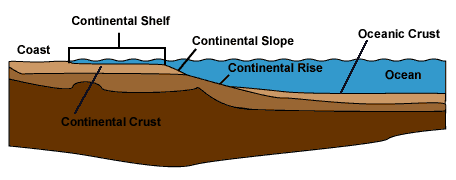
Continental crust is generally thicker than oceanic crust, but it is also less dense. It is the thickest in areas where there are mountains—up to 75 kilometers (over 46 miles) thick. The seven continents are made up of continental crust, but continental crust also extends beyond the coastlines of the continents. This underwater area is called the continental shelf. The water above the continental shelf is relatively shallow. After the continental shelf, the ocean floor begins to slope downward, and the water gets deeper. This is the continental slope. An area called the continental rise is at the bottom of the continental slope. It is where the continental crust ends and the oceanic crust begins. This change usually happens less than 100 km (62 miles) from shore.
This diagram shows the crust's transition between a continent's coast and the oceanic crust.
Oceanic crust is thinner than continental crust, and it generally has a thickness of 6-11 km (about 3-7 miles). Oceanic crust is also denser than continental crust. While continental crust is primarily made up of a type of rock called granite, the oceanic crust is primarily made up of a type of rock called basalt. The rock is covered with sediment that rests on the ocean floor.
Required
1 point
1
Question 3
3.
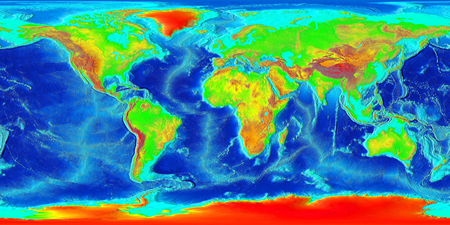
Which color marks the places on the map where the continental shelf is most likely found?
Required
1 point
1
Question 4
4.
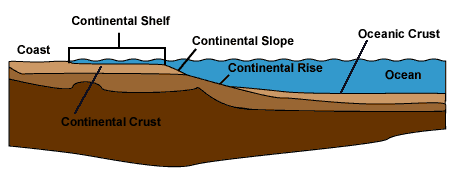
Where does continental crust change to oceanic crust?
Check for Understanding:
1. The Earth is composed of layers: the crust, the mantle, the outer core, and the inner core.
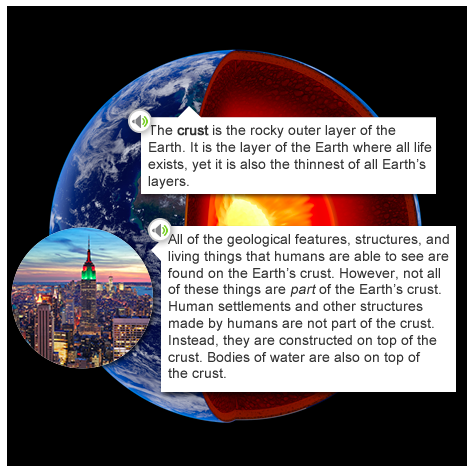
2. The crust is the rocky outer layer of the Earth. It is also the thinnest of Earth's layers.
3. There are two types of crust.
•Continental crust is thicker than oceanic crust and forms the seven continents.
•Oceanic crust is thinner than continental crust and is found beneath the five oceans.
•Continental crust transitions to oceanic crust beyond the coasts of continents.
The Mantle
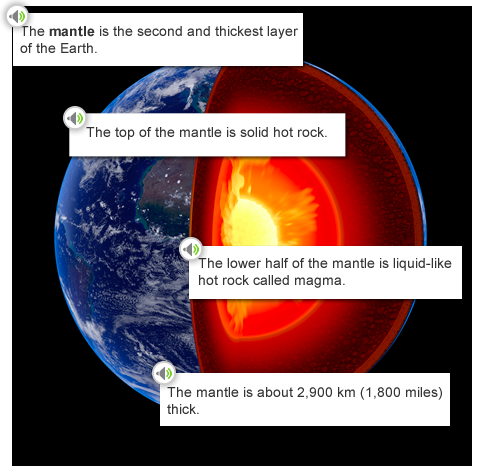
The mantle is very thick. As a result, the top of the mantle has different properties than the bottom of the mantle. The top of the mantle is solid, hot rock. Further down in the mantle, the high pressure and high temperatures mean that the rock can flow, which creates magma. The mantle ranges in temperature from 360°C to 2,500°C.
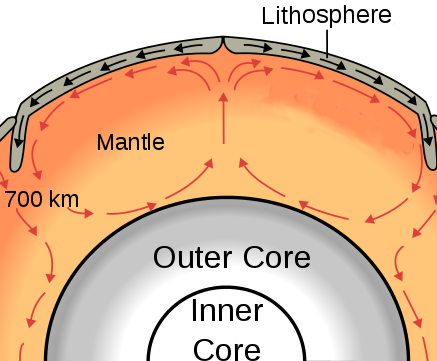
The lithosphere is the rigid outer section of the Earth that is made up of the crust and the upper mantle. The lithosphere is the hard and rigid outer layer of Earth, which is why the lower mantle is not included.
The material in the mantle does not stay still. Instead, convection currents in the mantle cause cooler rock to flow down and hotter rock to flow up. This movement continues constantly.
The mantle is always in motion thanks to convection currents. The hot, less dense liquid rock (or magma) rises, and the cool, more dense magma sinks.
Required
1 point
1
Question 5
5.
As magma moves up from the lower mantle, it becomes__________. As rock moves down from the upper mantle, it becomes__________.
Required
1 point
1
Question 6
6.
Complete this cause and effect diagram by selecting the statement that should
come next.
Magma moves upward from the lower mantle to the upper mantle. →
Required
1 point
1
Question 7
7.
__________cause material to move in the mantle.
Check for Understaning:
1. The mantle is the second and thickest layer of the Earth, below the crust.
2. Convection currents in the mantle cause cooler rock to flow down and hotter rock to flow up.
The Core
Required
1 point
1
Question 8
8.
The outer core is__________. The inner core is__________.
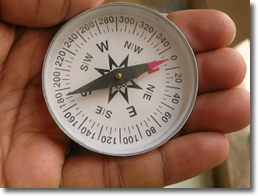
Many travelers use compasses to navigate. A compass's needle points north, which can help travelers figure out which way to go. Compasses work because of the Earth's magnetic field.
This compass's needle is pointing north.
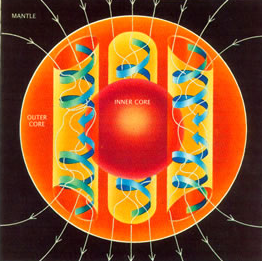
The Earth's magnetic field helps protect the planet from solar wind, or strong currents of particles that are released from the Sun's surface. Without the magnetic field, it would be difficult to live on Earth. Activity in the Earth's outer core helps to create the magnetic field. Like the mantle, the outer core has convection currents that move the matter that makes up the layer. These currents and the specific material that the outer core is made of cause the magnetic field.
This diagram shows how convection currents in the outer core produce the Earth's magnetic field.
Required
1 point
1
Question 9
9.
The__________and the__________have convection currents that__________the layers' matter. The convection currents in the__________are responsible for the Earth's magnetic field.
Required
1 point
1
Question 10
10.
Why is the Earth's magnetic field important?
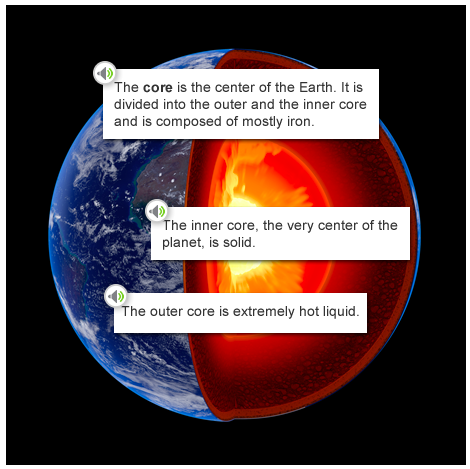
The Earth's outer core has temperatures of up to 5700°C, and the inner core has temperatures of up to 5400°C. With temperatures that high, one would expect both the outer and inner core to be hot liquid. However, gravity acts on all of the Earth's matter and creates so much pressure on the inner core that it remains in a solid state.
Gravitational force, represented by the red arrows, causes the inner core to remain solid.
Required
1 point
1
Question 11
11.
Pick the correct material for each layer.
Required
1 point
1
Question 12
12.
Put the layers of the Earth in order from the outermost layers to the innermost layers.
Other Answer Choices:
outer core
crust
inner core
mantle
Required
1 point
1
Question 13
13.
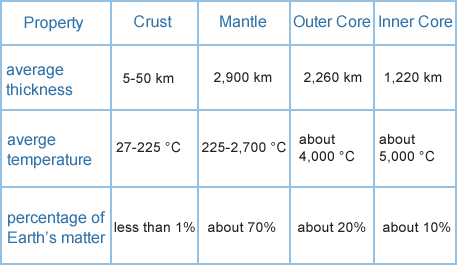
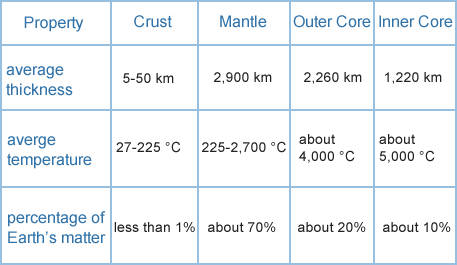
Take a look at the chart. Which layer of Earth is the thickest?
Required
1 point
1
Question 14
14.
Take a look at the chart. Choose the correct order of layers from coolest to hottest temperature.
Required
1 point
1
Question 15
15.
Take a look at the chart. Which layer makes up most of the Earth's matter?
Check for Understanding:
1. The Earth's core is divided into the inner and outer cores. The cores are made up of mostly iron and nickel.
2. The outer core is the liquid layer that is below the mantle and above the inner core.
3. Convection currents in the outer core create the Earth's magnetic field.
4. The inner core is the solid center of the Earth. The inner core is below the outer core.
5. The outer core is very hot liquid. The inner core is solid metal because it is under so much pressure.
The inner layers of the Earth are too deep, too hot, and are under too much pressure for scientists to physically travel to them. However, researchers are still able to learn about the layers of the Earth in other ways.
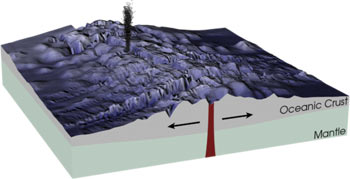
In some places on the ocean floor, there are cracks in the oceanic crust, and material from the mantle is pushed up onto the ocean floor. Once the mantle material spreads onto the surface of the sea floor, it cools, and scientists are able to study its composition and learn more about the mantle.
This image shows a crack in the oceanic crust that is allowing hot material from the mantle to spill out onto the ocean floor.
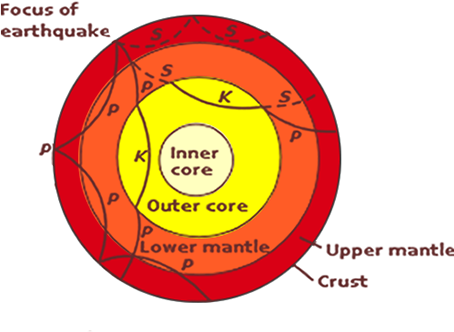
Scientists can also learn about the layers of the Earth by studying the vibrations, or seismic waves, produced by earthquakes. These waves travel through the layers of the Earth. Vibrations travel at different speeds through different substances.
This diagram shows how seismic waves travel at different speeds through the different layers of Earth. The waves travel out in many different directions from the focus of the earthquake, also known as its epicenter.
By studying how waves from vibrations move through the different layers and materials of the Earth, scientists can learn about those layers and materials. The waves are bent, sped up, or slowed down when they pass through the Earth's layers. The type of material affects the speed of the waves, and they can change direction when they reach a new layer. Scientists study the path and speed of these waves to identify where layers begin and end and what materials make them up. For example, scientists believe that the Earth's core is mostly iron. After they make these guesses, they can perform tests on those materials to see how they respond to extreme heat and pressure.
Required
1 point
1
Question 16
16.
If a seismic wave changes direction or speed as it is traveling through the Earth, what are the most likely explanations? (choose 2)
Required
1 point
1
Question 17
17.
Scientists study the layers of Earth by traveling between the layers.
Required
1 point
1
Question 18
18.
How can scientists study the inner layers of Earth? (choose 3)
Check for Understanding:
1. People cannot travel into the Earth's inner layers because there is too much heat and pressure. Instead, scientists study them from the surface.
2. Scientists learn about the Earth's layers by
•studying material that is pushed through the crust
•studying how vibrations from earthquakes travel differently through each layer
•testing the materials that they believe each layer is made of to see how heat and pressure change them
Required
1 point
1
Question 19
19.
What is the crust?
Required
1 point
1
Question 20
20.
What is the mantle?
Required
1 point
1
Question 21
21.
What are convection currents?
Required
1 point
1
Question 22
22.
What is the outer core?
Required
1 point
1
Question 23
23.
What is the inner core?
The Earth is made up of layers. From the outermost layer to the innermost layer, the Earth's structure is the crust, the mantle, the outer core, and the inner core.
The crust:
•is divided into continental and oceanic crust
•is thin and mostly rock
The mantle:
•has an upper section that is solid, hot rock
•has a lower section that is liquid-like, hot rock
•has convection currents that move hotter matter upward and cooler matter downward
The outer core:
•is made of very hot liquid that is mostly iron
•has convection currents that produce the Earth's magnetic field
The inner core:
•is solid because of the high pressure it is under
•is mostly iron
Scientists cannot travel to the center of the Earth because of heat and pressure. They study the layers of the Earth using different methods.
Required
1 point
1
Question 24
24.
Which layers of the Earth are solid?
Required
1 point
1
Question 25
25.
Which layers of Earth have convection currents?
Required
1 point
1
Question 26
26.
Which layer of the Earth is thickest?
Required
1 point
1
Question 27
27.
Convection currents in the mantle cause __________.