Log in
Sign up for FREE
arrow_back
Library

Ch11 & 12.4 Bio Cell Cycle, Mitosis, Meiosis (10/31/2025)

star
star
star
star
star
Last updated 7 months ago
74 questions
Required
1
Required
1
Required
1
Required
2
Required
1
Required
1
Required
1
Required
1
Required
1
Required
1
Required
1
Required
1
Required
1
Required
1
Required
1
Required
1
Required
1
Required
1
Required
1
Required
1
Required
1
Required
1
Required
1
Required
1
Required
1
Required
1
Required
1
Required
1
Required
1
Required
1
Required
1
Required
1
Required
1
Required
1
Required
1
Required
1
Required
1
Required
1
Required
1
Required
1
Required
1
Required
1
Required
1
Required
1
Required
1
Required
1
Required
1
Required
1
Required
1
Required
1
Required
1
Required
1
Required
1
Required
1
Required
20
Required
10
Required
1
Required
1
Required
1
Required
1
Required
1
Required
1
Required
1
Required
1
Required
1
Required
1
Required
1
Required
1
Required
1
Required
1
Required
1
Required
1
Required
10
Required
20
Question 1
1.

Question 2
2.

Question 3
3.

Question 4
4.

Question 5
5.

Question 6
6.

Question 7
7.

Question 8
8.

Question 9
9.

Question 10
10.

Question 11
11.

Question 12
12.

Question 13
13.

Question 14
14.

Question 15
15.

Question 16
16.

Question 17
17.

Question 18
18.

Question 19
19.

Question 20
20.

Question 21
21.

Question 22
22.

Question 23
23.
Following replication of its DNA, each chromosome contains two_______ , which are attached to each other by a centromere.
Question 24
24.
The full sequence of events that occurs in a cell from one mitotic division to the next is called the _______ .
Question 25
25.
Microtubules that extend from the poles of a cell to the centromeres during cell division are called _______ .
Question 26
26.
During cell division, plant cells form a new_______ in the center of the cell.
Question 27
27.
In eukaryotic cells, _______ takes place after the nucleus divides.
Question 28
28.
After a new nuclear membrane forms during telophase of mitosis, the_______ divides, resulting in two cells.
Question 29
29.
Collectively, the time spent in G1 + S + G2 is called _______ .
Question 30
30.
In mitosis, anaphase follows_______ .
Question 31
31.
Chromatin coils up into short chromosome rods during _______ .
Question 32
32.
During normal mitotic cell division, a parent cell having four chromosomes will produce two daughter cells, each containing _______(#) chromosomes.
Question 33
33.
Control of the cell cycle occurs at three main _______ , one before S, another before M, and another before cytokinesis.
Question 34
34.
Due to an error in DNA cells start dividing uncontrollably and create a malignant _______ .
Question 35
35.

Question 36
36.

Question 37
37.

Question 38
38.

Question 39
39.

Question 40
40.

Question 41
41.

Question 42
42.

Question 43
43.

Question 44
44.

Question 45
45.

Question 46
46.

Question 47
47.

Question 48
48.

E.C. Biology - The only science where multiplication and  _______  mean the same thing.
Question 49
49.

Question 50
50.

Question 51
51.

Question 52
52.

Question 53
53.

Question 54
54.

Question 55
55.

Discuss the advantages and disadvantages of asexual and sexual reproduction. How does the reproductive strategy influence an organism’s chances for survival? (20 points)

Question 56
56.

What is cancer? How does it occur? Why is it difficult to cure? (answer each question specifically)

Question 57
57.

Question 58
58.

Question 59
59.

Question 60
60.
The cells resulting from meiosis in either males or females are called _______
Question 61
61.
A reciprocal exchange of corresponding segments of DNA is called _______ .
Question 62
62.
The process called
_______ guarantees that the number of
chromosomes in gametes is half the number of chromosomes in body cells.
Question 63
63.

Question 64
64.

Question 65
65.

Question 66
66.

Question 67
67.

Question 68
68.

Question 69
69.

Question 70
70.

Question 71
71.

Question 72
72.
When discussing sets of chromosomes, mitosis results in two _______  daughter cells that have the same genetic makeup. Meiosis results in four _______  cells that are all genetically different from each other.
Question 73
73.

Discuss the advantages and disadvantages of asexual and sexual reproduction.

Question 74
74.

Compare and contrast the process for asexual cell division with the process for making gametes. Include a) cell cycle and b) M phase specific characteristic descriptors.

In order to fit within a cell, DNA becomes more compact by
A. breaking apart into separate genes.
B. extending to form very long, thin molecules.
C. wrapping tightly around associated proteins.
D. being enzymatically changed into a protein.
Chromatids are
A. dense patches within the nucleus
B. bacterial chromosomes.
C. duplicate halves of a chromosome.
D. prokaryotic nuclei.
A protein disk that attaches two chromatids to each other in a chromosome is called a
A. chloroplast
B. centromere
C. gamete
D. centriole
Which of the following is not a true difference between the chromosomes of eukaryotes and those of prokaryotes
A. Eukaryotic chromosomes are linear, while those of prokaryotes are circular.
B. Eukaryotic chromosomes are found free in the nucleus, while those of prokaryotes are attached to the cell membrane.
C. Eukaryotes usually have more than one chromosome, while prokaryotes have only one chromosome.
D. Eukaryotic chromosomes contain DNA, while prokaryotic chromosomes contain a different form of genetic material.
The stage of the cell cycle that occupies most of the cell’s life is
G1
M
G2
Interphase
Cytokinesis
The phase of mitosis that is characterized by the arrangement of all chromosomes along the equator of the cell is called
A. telophase
B. metaphase
C. anaphase
D. prophase
A spindle fiber is a specialized form of
A. microtubule
B. flagellum
C. cilium
D. chromosome
As a result of mitosis, each of the two new cells produced from the original cell during cytokinesis
A. receives a few chromosomes from the original cell.
B. receives an exact copy of all the chromosomes present in the original cell.
C. donates a chromosome to the original cell.
D. receives exactly half the chromosomes from the original cell.
In plant cells, cytokinesis occurs when
A. the chromosomes make exact copies of themselves.
B. spindle fibers are formed.
C. a new cell wall forms.
D. osmotic pressure is too low.
A typical human cell contains 46 chromosomes. After mitosis and cytokinesis, each of the two new cells formed from the original cell
A. has 23 chromosomes
B. grows new chromosomes from existing DNA
C. has a complete set of 46 chromosomes
D. none of the above
Why do cells do mitosis?
A. to stay small
B. to repair the organism
C. to replace dead cells
D. all of the above
Cancer is
A. sped up mitosis
B. sped up meiosis
C. slowed down mitosis
D. slowed down meiosis
What causes cancer?
A. genetics
B. mutations
C. carcinogens
D. not stopping at the checkpoints
E. all choices
What happens at the G2 checkpoint if there are errors in the DNA?
A. cytokinesis
B. replication
C. apoptosis
D. autotomy
E. mitosis
One difference between cell division in plant cells and animals is that plant cells have
A. centrioles
B. centromeres
C. a cell plate
D. chromatin
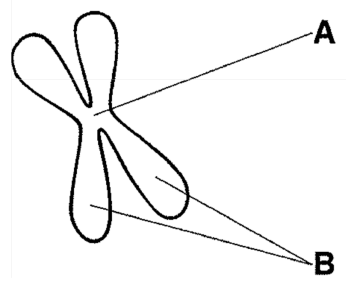
The structure labeled A is called the
A. centromere
B. centriole
C. sister chromatid
D. spindle
Which event occurs during interphase?
A. The cell grows
B. Centrioles appear
C. Spindle fibers begin to form
D. Centromeres divide
Which pair is correct?
A. G1 phase, DNA replication and growth
B. G2 phase, preparation for mitosis
C. S phase, cell division
D. M phase, cell growth
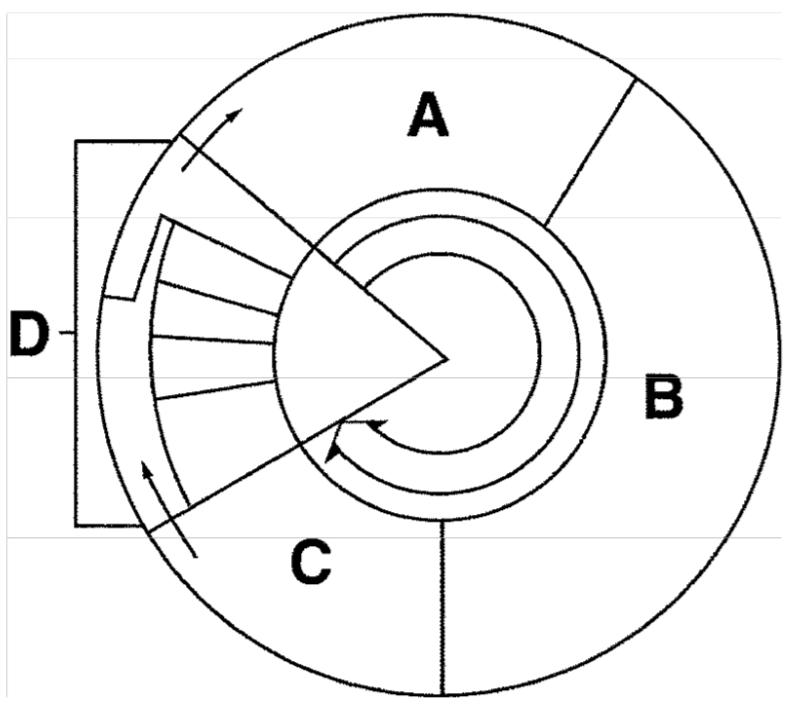
Cell division is represented in the figure by the letter ____.
A
B
C
D
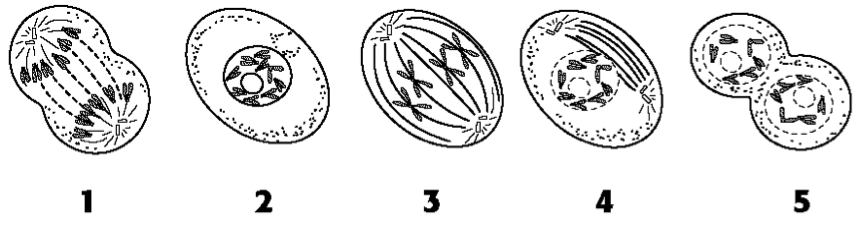
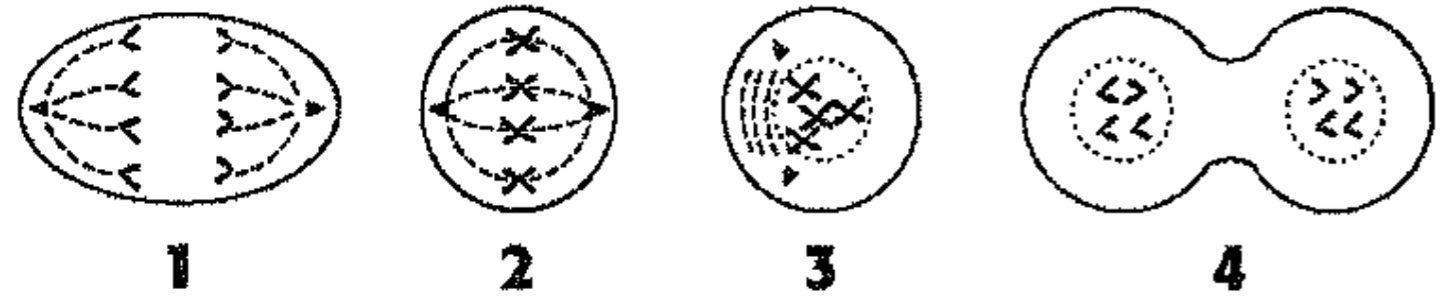
Refer to the illustration above. During which stage do the centromeres divide?
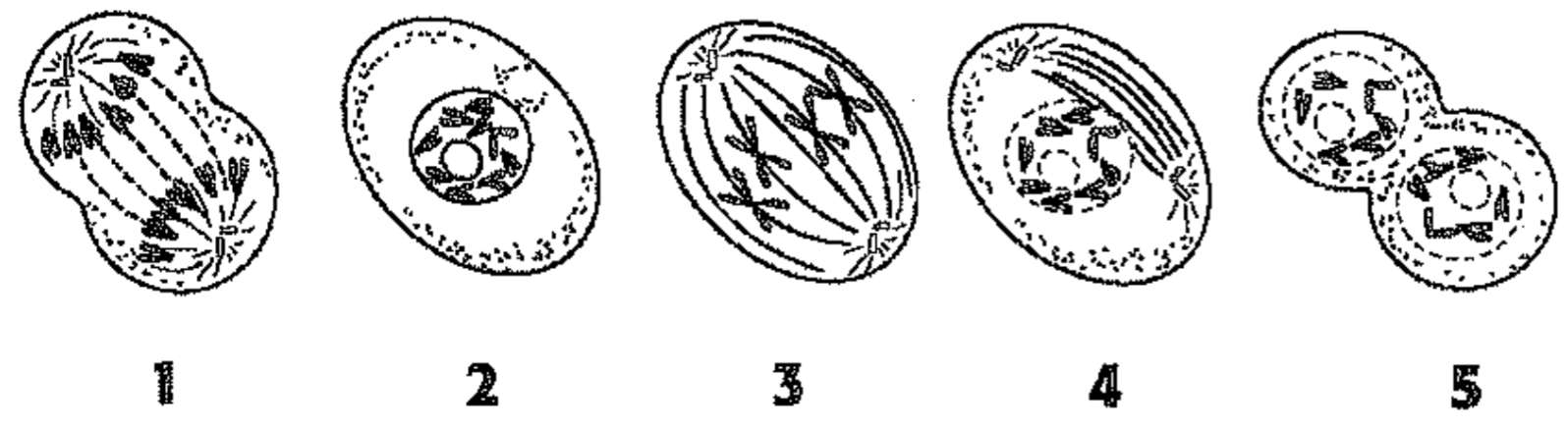
1
2
3
4

Refer to the illustration above. Which of the following correctly indicates the order in which these events occur?
A. 1, 2, 3, 4, 5
B. 3, 2, 1, 4, 5
C. 2, 1, 3, 4, 5
D. 4, 3, 1, 5, 2
E. 2, 4, 3, 1, 5
What phase does a brain cell enter after cytokinesis?
A. G1
B. Prophase
C. G0
D. G2
E. S
Which stage of interphase is DNA replicated?
A. G1 Phase
B. G2 Phase
C. S Phase
D. G0 Phase
What percent of a cells life is spent in M Phase?
50%
90%
10%
30%
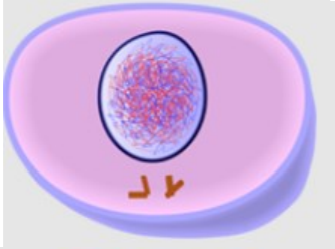
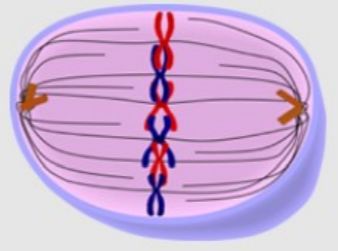
Which phase of mitosis is this?
A. interphase
B. cytokinesis
C. anaphase
D. metaphase
E. telophase
F. S phase
G. G2 phase

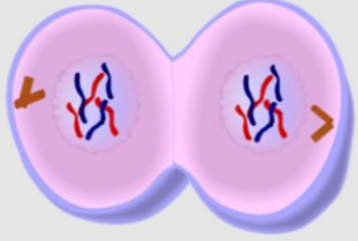
Which phase of mitosis is this?
A. interphase
B. cytokinesis
C. anaphase
D. metaphase
E. telophase
F. S phase
G. G2 phase
H. prophase

Which phase of mitosis is this?
A. interphase
B. cytokinesis
C. anaphase
D. metaphase
E. telophase
F. S phase
G. G2 phase
H. prophase
If the chromatin is not distinguishable as a chromosome, what stage is it?
A. interphase
B. cytokinesis
C. anaphase
D. metaphase
E. telophase
F. S phase
G. G2 phase
H. prophase
An embryonic stem cell that can develop into any type of cell except extraembryonic is
differentiated
multipotent
pluripotent
totipotent
specialized
C. elegans, a round worm, starts making cuticle cells at 8 divisions. How many cells?
16
64
256
512
1024
2048
If you started studying one human dividing skin cell in a culture, how many would you have after 48 hours?
8
2
3
4
16
32
256
What does the G1 checkpoint verify before S phase?
environment
organelles
cell size
organism's need to replicate
all choices
What is the surface area to volume ratio of a 4cm cube?
3:1
96:64
2:3
3:2
Which treatment of cancer would be most effective?
A. A drug that kills only slow dividing cells
B. A drug that kills only very small cells
C. A drug that kills only rapidly dividing cells
D. A drug that kills all of the cells in your body
Cyclins
A. are external growth factors
B. regulate programmed cell death
C. initiate cell division
D. all of the above
Which of these accurately describes a difference between cancer cells and normal cells?
A. Cancer cells divide less frequently.
B. Cancer cells lack the ordered arrangement of normal cells.
C. Cancer cells have a consistent size and shape.
D. Cancer cell nuclei are always small and rounded in shape.
Humans and other animals regulate cell growth and cell division. Nerve cells do not divide again once they have developed. What other cell category does not divide once mature?
A. skin cells
B. blood-producing cells
C. muscle cells
D. digestive tract cells
E. liver cells
The rate at which materials enter and leave the cell depends upon the cell's
A. volume
B. weight
C. mass
D. speciation
E. surface area
F. nucleus size
If a cell has 12 chromosomes, how many chromosomes will each of its daughter cells have after mitosis and cytokinesis?
4
6
12
24
Which statement does NOT describe external regulatory proteins?
A. They can speed up or slow down the cell cycle
B. Growth factors are one form of external regulatory proteins
C. Some can cause cells to stop their cell cycles
D. They respond to events occurring inside the cell
2n means...
A. 23 chromosomes within a cell
B. 46 chromosomes within a cell
C. two copies of each chromosome within a cell
D. one copy of each chromosome within a cell

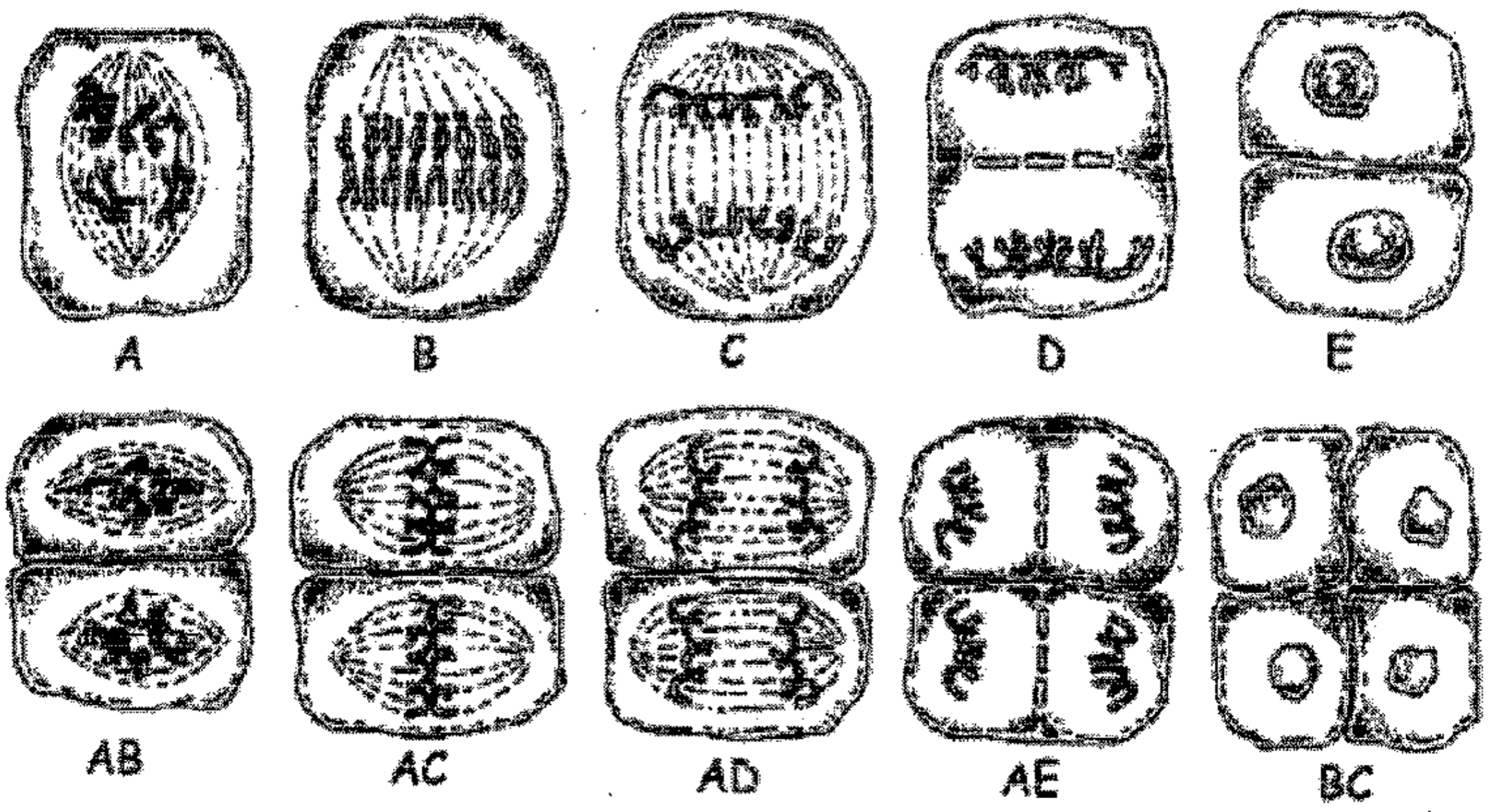
Stage in meiosis immediately after centromeres break _____
A
C
E
AD
BC
Separation of homologues occurs during
mitosis
meiosis I
meiosis II
fertilization
Diagrams 1 and 2 show cells from an organism with a diploid number of 4.
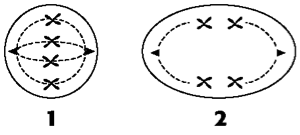
Refer to the illustration above. Which of the cells will be a diploid cell at the completion of division?
1
2
both
neither

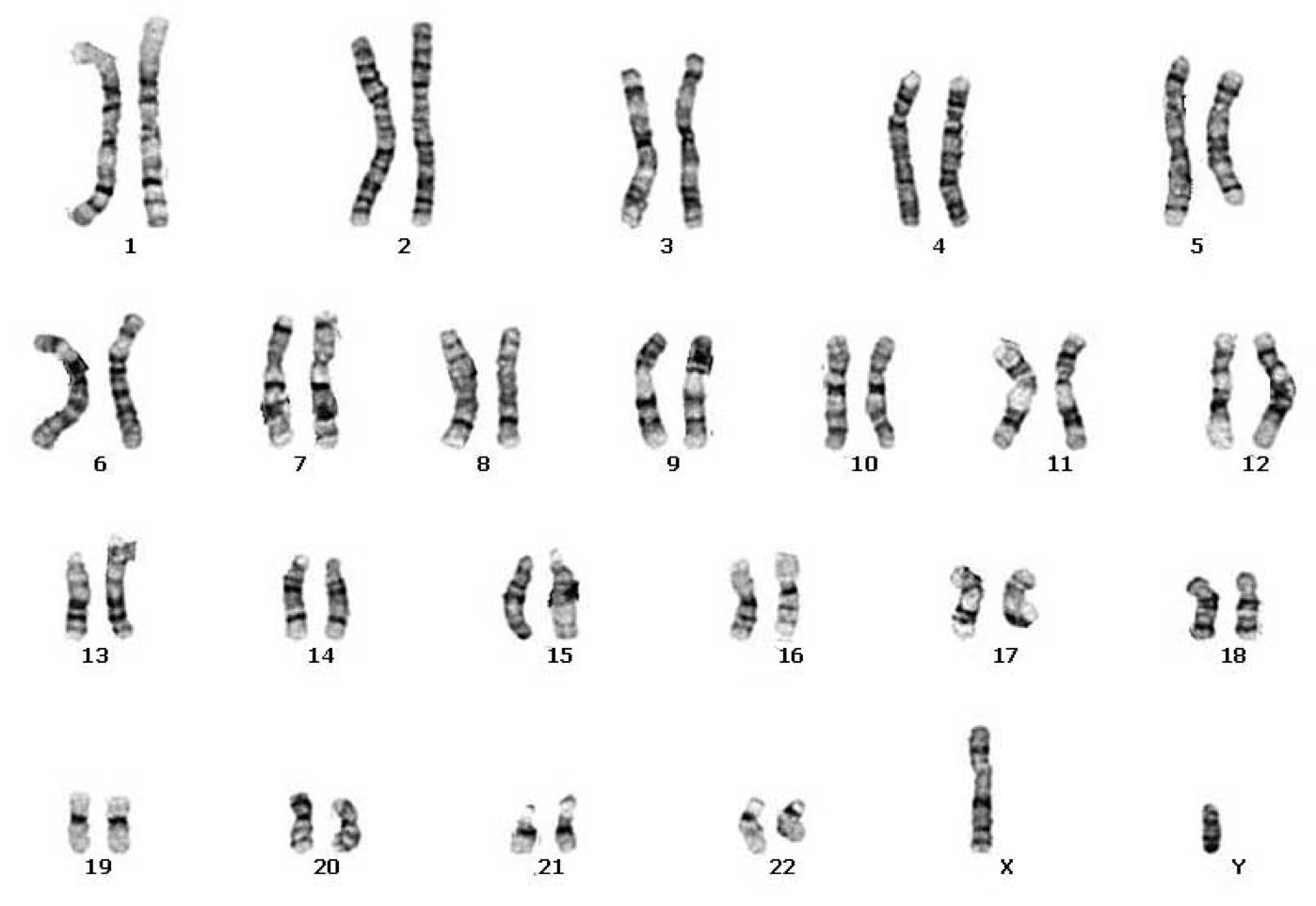
A picture of a cell’s chromosomes is called a(n)...
pictograph
chromograph
karyotype
genetic map

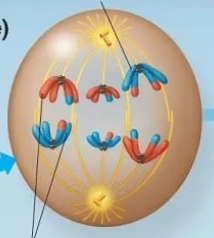
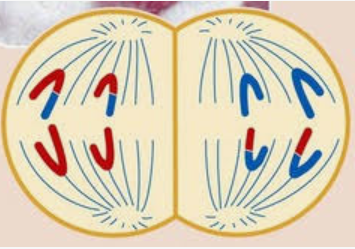
Which phase of meiosis is this?
A. Prophase I
B. Prophase II
C. Anaphase I
D. Anaphase II

What are separating in this picture?
sister chromatids
DNA
Sister chromosomes
homologous chromosomes
Crossing over occurs in
Prophase of Mitosis
Prophase I of Meiosis
Prophase II of Meiosis
Metaphase of Mitosis
What causes cancer?
genetics
mutations
carcinogens
not stopping at the checkpoints
all choices
Why go to all of the extra steps and possible errors involved in sexual reproduction?
Produces the union of two gametes
Allows for genetic variability
Evolution
Variety of genes available to an organism may produce
The correct answer includes all of the listed reasons
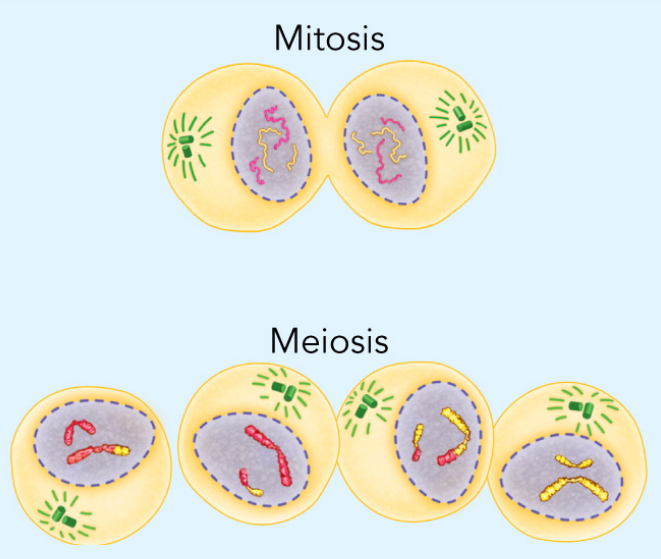
Unlike mitosis, meiosis results in the formation of
two genetically identical cells
four genetically different cells
four genetically identical cells
two genetically different cells

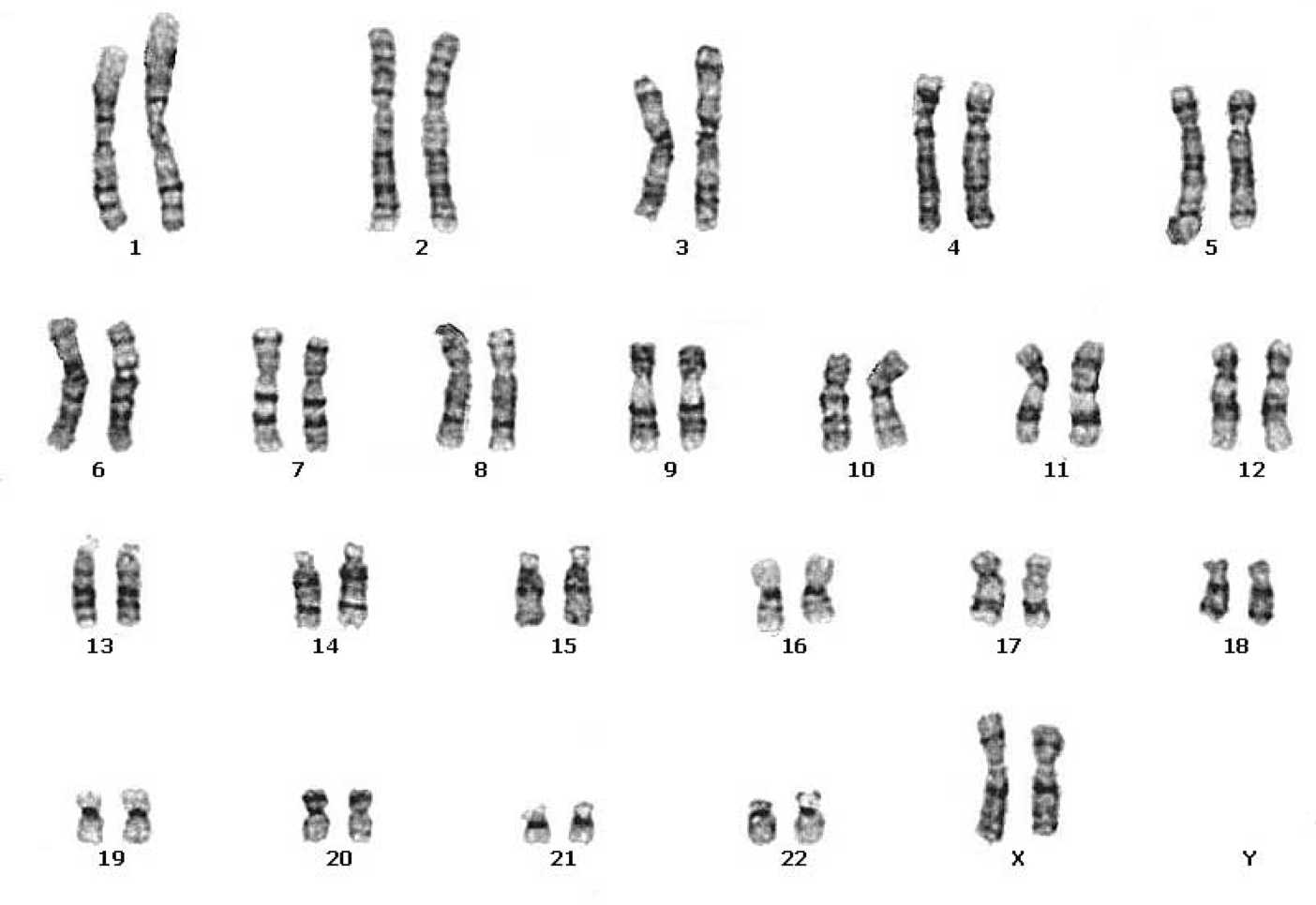
The image shows the
DNA of an autosomal male cell
chromosomes of a female gamete
genetic information of a female body cell
male homologous pairs of chromosomes

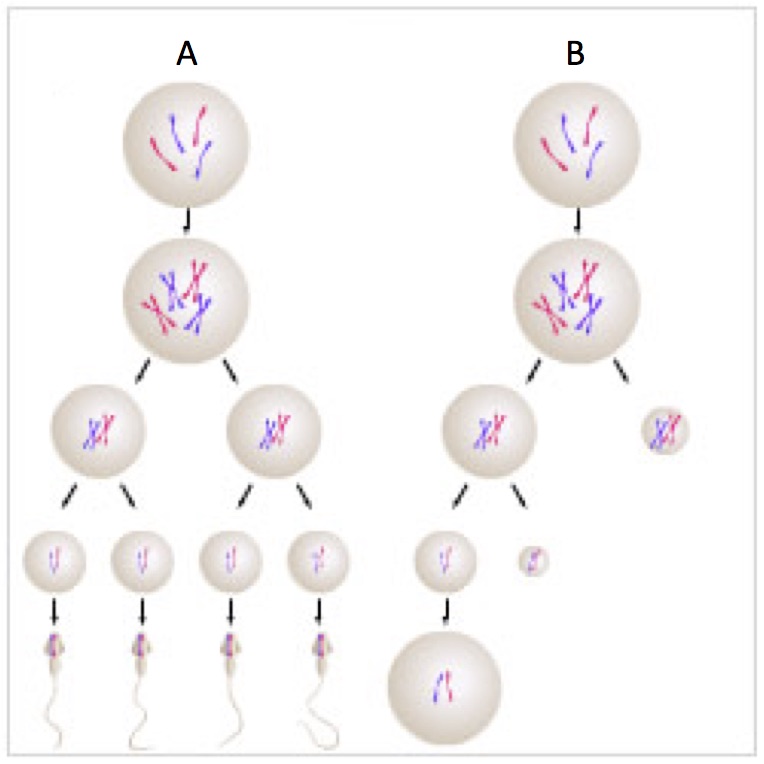
Process B occurs in the female_____
Following menopause
At puberty
Before birth
In early childood
at fertilization