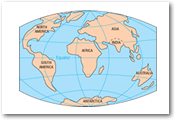
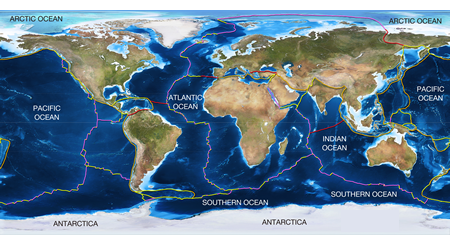
This image shows Earth's continents. What do you notice about their shapes?
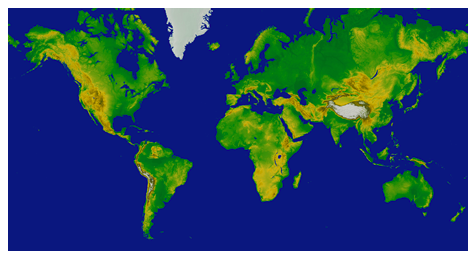
Observe the map of the Earth's continents. Do you think they ever could have fit together like a puzzle?
This image shows Earth's continents. What do you notice about their shapes?
Observe the map of the Earth's continents. Do you think they ever could have fit together like a puzzle?
Answer the question from above: Do you think the continents could have fit together like a puzzle?
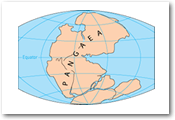
In 1912, Alfred Wegener first developed the theory of continental drift. As a geologist, he spent a great deal of time learning as much as he could about Earth's history and structure. What he found was remarkable: the continents looked like puzzle pieces! Wegener hypothesized that millions of years ago, Earth's continents formed a single supercontinent, which he named Pangaea. While scientists were initially skeptical of Wegener's theory, over time, evidence was discovered that clearly supported his hypothesis.
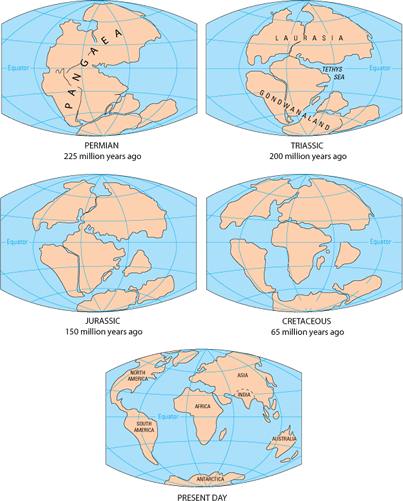
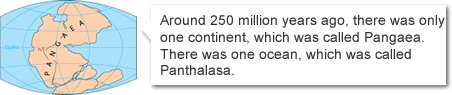
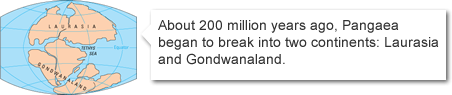
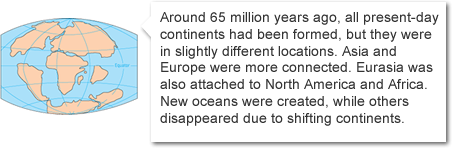
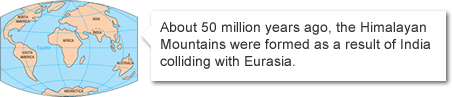
This image shows how the super continent Pangaea has broken up over time due to continental drift.
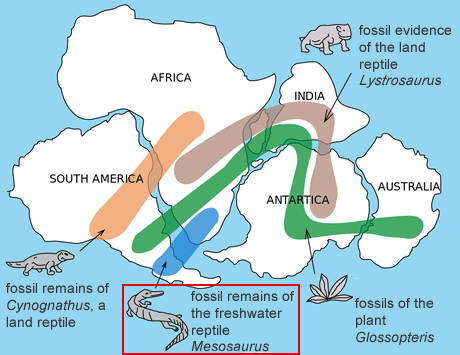
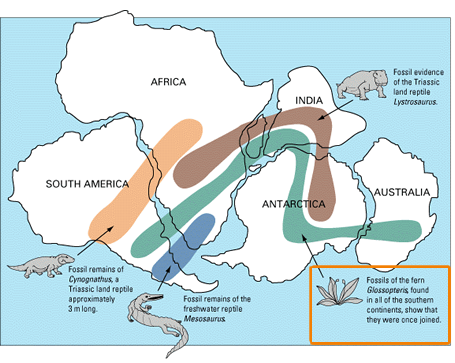
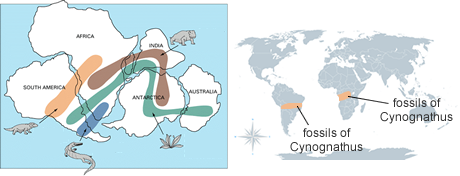
One piece of evidence that supported Wegener's hypothesis came when geologists discovered that rocks on the east coast of South America matched rocks on the west coast of Africa in terms of age and composition. According to the theory of continental drift, Africa and South America were connected originally, and this discovery provided proof. Geologists found matching plant and animal fossils in both South America and Africa as well. For example, fossils of Mesosaurus, a reptile, were found on both continents. Since it would have been impossible for Mesosaurus to travel across an entire ocean, it was concluded that the continents must have previously been joined to allow for Mesosaurus to live on both.
One of the animals whose fossil record supports the theory of continental drift is a reptile called Mesosaurus. Mesosaurus lived in freshwater. Fossils of Mesosaurus were found in both South America and Africa.
Some scientists were still not convinced. How can huge continents move? In the 1960s, new evidence was found. During a routine mapping of the ocean floor of the Atlantic Ocean, an underwater mountain chain was found. On both sides of the mountain chain, the ocean floor was moving. This was due to a process called sea-floor spreading. Sea-floor spreading provided evidence for the theory of how the continents moved.
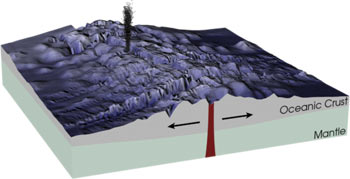
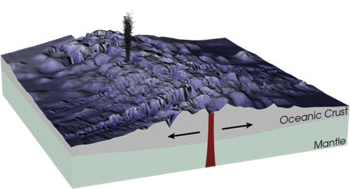
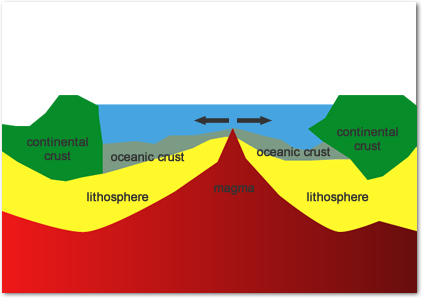
During seafloor spreading, magma rises up from the mantle. It cools and hardens to form new crust.
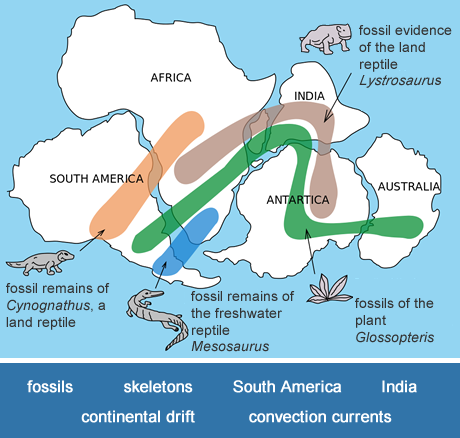
Alfred Wegener developed the theory of. This theory states that Earth'swere once joined as a single landmass calledand have since moved apart.
Which of the following are clues that support the theory of continental drift? (choose 3)
The fossil record supports the theory of . It supports this theory because of the same animals and plants have been found on separate continents. The colored areas of the map show where fossils of specific plants and animals were found. For example, Mesosaurus was found in Africa and .
Check for Understanding:
1. The theory of continental drift states that the continents once formed a single landmass and have drifted apart over time.
2. Pangaea is the name of the supercontinent that all of Earth's continents at one time formed.
3. Fossil evidence supports the theory of continental drift.
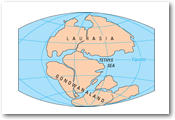
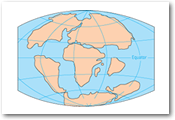
Using evidence from different scientific fields, scientists have constructed maps showing the movement of the continents over time. Over millions of years, the single landmass of Pangaea became the seven separate continents shown on maps today.
Arrange the maps in chronological order to match the time period they represent
| Draggable item | arrow_right_alt | Corresponding Item |
|---|---|---|
| arrow_right_alt | present day | |
| arrow_right_alt | 65 million years ago | |
| arrow_right_alt | 300 million years ago | |
| arrow_right_alt | 200 million years ago |
From the beginning, all scientists accepted Wegener's theory of continental drift.
Check for Understanding:
1.Alfred Wegner, a German geologist, proposed that the “puzzle pieces” of the different continents had once fit together as a single landmass.
2. Around 300 million years ago, the continents were joined together in a supercontinent called Pangaea.
3. Continental drift is the idea that continents have moved across Earth’s surface over time.
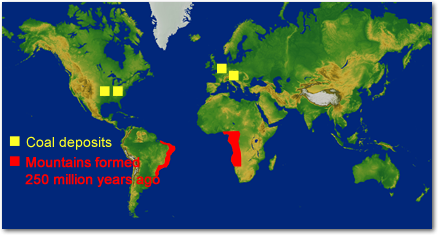
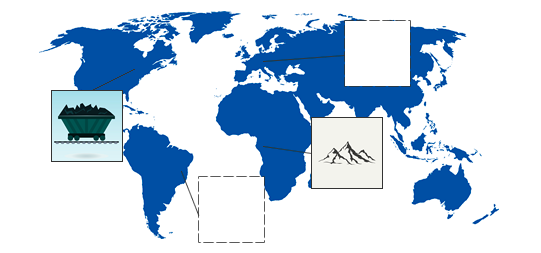
At first, scientists were skeptical of Wegener’s theory of continental drift. Over time, evidence was discovered that supported his hypothesis that the continents were moving. One piece of evidence that supported Wegener’s theory of continental drift was the existence of landforms of a similar age on different continents. Scientists noticed that mountain ranges in South America and Africa were formed during a similar time period. Additionally, coal fields in Europe and North America contained coal of a similar age.
Scientists also found evidence in fossils that supported Wegener's theory of continental drift. For example, fossils of Glossopteris, a type of fern plant, have been found in Africa, South America, Australia, India, and Antarctica. In order for the seeds from this plant to be distributed across several continents, scientists believe the continents must have been joined together at some point.
Scientists have found fossils of land bearing animals and plants on multiple continents. This suggests the continents were once joined together.
A continent’s climate gets warmer the closer it moves toward the Equator. A continent’s climate gets cooler the closer it moves toward the poles. Fossils of tropical organisms have been found near the poles. This indicates that the continent has drifted toward the poles over time.
What might scientists conclude based on this map? (choose 2)
Drag the coal bed and similar mountain range to the appropriate positions on the map.


Check for Understanding:
There are two main features of evidence that support the theory of continental drift: land features and fossils.
1. Land features that appear in different continents are of a similar age, suggesting that the continents have shifted over time.
2. Fossils of the same species have been found on different continents around the world, suggesting that those continents were once closer together.
3. Remains of tropical organisms have been found in cold regions, suggesting that the continents may have been in different parts of the world a long time ago.
Even though there were many pieces of evidence to support Wegener’s ideas, they were still pushed aside because he could not explain how the continents were able to move. However, in the mid-1900s scientists discovered new information that helped them understand how the continents had drifted. At this time, scientists began mapping the ocean floor. They found that not all of the ocean floor was flat and smooth. In parts of the sea floor, there were under-water mountains called mid-ocean ridges. Mid-ocean ridges are giant mountain ranges that run along the ocean floor. Some of these mountain ranges are longer than any mountain range found on the Earth’s surface.
Mid-ocean ridges form along cracks in the oceanic crust. Rock samples from the sea floor showed that the youngest rock is closest to the ridge, and the oldest rock is the farthest away from the ridge. Scientists realized parts of the sea floor must be moving if older rocks are constantly pushed outward. Scientists wondered if the sea floor movement could explain Wegener’s theory of continental drift.
The sea floor is moving, similar to a conveyor belt, as new rocks are pushed away from the ridge.
In order to explain why the sea floor was moving, scientists proposed a process called sea-floor spreading. Sea-floor spreading occurs when magma rises through the cracks in a mid-ocean ridge, cools, and hardens to form new oceanic crust. During sea-floor spreading, the midpoint of the ridge breaks, and two pieces of oceanic crust move in opposite directions as new crust is created. The older oceanic crust moves farther away from the mid-ocean ridge as new oceanic crust is formed.
Oceanic crusts are moving away from the mid-ocean ridge on both sides as new sea floor is created near the midpoint of the ridge.
Mark the following statements as true or false.
Mid-ocean ridges form along cracks in the oceanic crust.
Mid-ocean ridges are shorter than all of the mountain ranges found on Earth.
The youngest rocks are closest to the mid-ocean ridge.
Determine which part of the ridge is oldest and youngest.
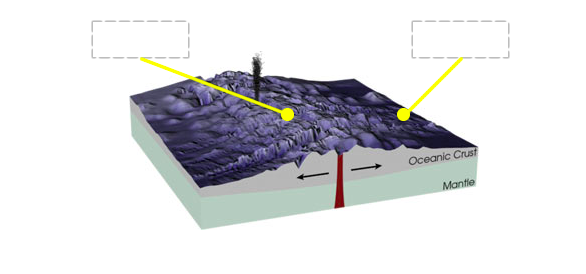
Scientists have found evidence of sea-floor spreading from rock formations, magnetic patterns, and by dating rock samples. Drilling into the ocean and using radioactive dating are two ways that scientists have been able to get rock samples. It has been discovered that older rocks are located farther away from ridges, and newer rocks are located closer to the ridges. This provides evidence that new sea floor is expanding as the older crust is pushed away from the ridge.
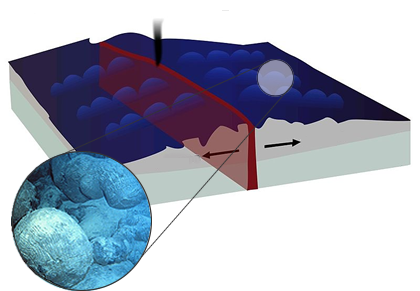
Scientists have discovered rocks with pillow-like shapes, called pillow basalts, near the bottom of mid-ocean ridges. Rocks take this unusual shape when molten material hardens immediately after erupting under water. During sea-floor spreading, the molten material erupts out of the cracks near the mid-point of the ridge. Once this molten material cools down, it hardens and becomes part of the oceanic crust. As new crust forms, the older crust is pushed away from the ridge.
Pillow basalts can be found near the bottom of mid-point ridges. The size of these pillow basalts can range from 10 centimeters to a few meters.
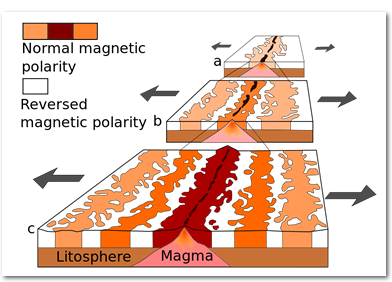
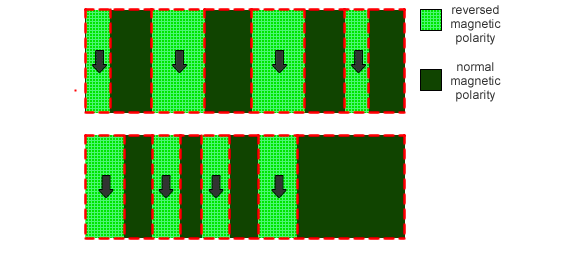
Magnetic striping is another piece of evidence of sea floor spreading. Magnetic material inside the molten rocks line up in the direction of Earth’s magnetic poles. These patterns reverse themselves when Earth’s magnetic poles reverse. Scientists have found that the patterns of these magnetic strips on each side of the mid-ocean ridge are a mirror image of each other. These areas with identical patterns show that the crust is spreading on both sides of the ridge at the same rate. This is evidence that new oceanic crust is created at the mid-point of the ridge, and that older crust is pushed away as new crust is forming.
The magnetic north and magnetic south switch directions during a geomagnetic reversal. A geomagnetic reversal occurs once every 100,000 to 1,000,000 years.
Using the patterns of the magnetic material in rocks, determine the location of the mid-ocean ridges. (Pick one in each row)
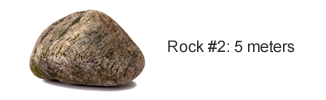
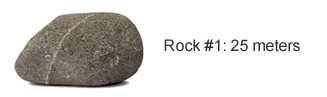
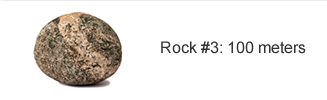
Arrange the rocks from youngest to oldest (youngest on the top) by using the distances from the mid-ocean ridge.
Check for Understanding:
1. Mid-ocean ridges are giant mountain ranges that run along the ocean floor.
2. Sea-floor spreading occurs when magma rises through the cracks in mid-ocean ridges, cools, and hardens to form new oceanic crust.
3. Sea-floor spreading helps explain why continents move as the oceanic crust expands.
4. Scientists have found evidence of sea-floor spreading from ocean material, magnetic strips, and drilling samples.
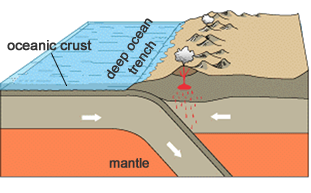
Sea-floor spreading is constantly creating new oceanic crust. But if the oceanic crust is continually expanding, it would seem as though the Earth should be constantly growing larger. However, this is not the case because deep-ocean trenches prevent the oceanic crust from expanding indefinitely. Deep-ocean trenches are canyons that make up the deepest part of the ocean floor. In deep-ocean trenches, older crust is destroyed through a process called subduction.
Subduction is the process in which oceanic crust becomes dense enough to sink beneath a deep-ocean trench and become part of the mantle. When new oceanic crust is formed, it is very hot. As it cools down, the crust becomes denser and sinks deeper. Eventually, with the help of gravity, it is dense enough to sink below a deep-ocean trench and back into the mantle. Sea-floor spreading and subduction work together to create and destroy oceanic crust.
Since older oceanic crust is always sinking back into the mantle, and new oceanic crust is always forming at mid-ocean ridges, the ocean floor is continuously renewed. It takes about 200 million years for a rock to form near a mid-ocean ridge, move away from the ridge toward a deep-ocean trench, and become dense enough to sink back into the mantle.
The size of an ocean depends on how fast crust is created at a mid-ocean ridge and how fast the crust is destroyed near a deep-ocean trench. There are some oceans that have fewer deep-ocean trenches. These oceans are creating new oceanic crust at a faster rate than the trenches are destroying oceanic crust. As a result, these oceans are expanding.
The Atlantic Ocean is expanding around five centimeters per year. The oceanic crust is created at a faster rate than what is destroyed near a deep-ocean trench.
Which of the following explain why oceanic crust sinks below deep-ocean trenches? (choose 2)
How long does it take for the new oceanic crust to form at the mid-ocean ridge, move across the ocean, and then return to the mantle?
Checking for Understanding:
1. Deep-ocean trenches are canyons that make up the deepest part of the ocean floor.
2. Subduction is the process in which oceanic crust becomes dense enough to sink beneath a deep-ocean trench and return to the mantle.
• Oceanic crust cools as it moves away from the mid-ocean ridge.
•.As the oceanic crust cools, the oceanic crust becomes denser and sinks deeper.
• The oceanic crust will become denser, and with the help of gravity, will sink deep enough to go beneath the deep-ocean trench and into the mantle.
Pangaea is __________.
Continental drift is __________.
What is a mid-ocean ridge?
Sea-floor spreading __________.
What are deep-ocean trenches?
Check for Understanding:
1. In the late 1800s, Alfred Wegener proposed that continents formed a single landmass called Pangaea over 300 million years ago.
2. Continental drift is the movement of continents across Earth's surface over time. There is evidence that continental drift has occurred:
• Similar land features such as coal fields have been found in North America and Europe.
• Fossils of same species have been found on multiple continents.
• Remains of tropical organisms have been found in cold regions, and glacier striations have been found in warm regions.
3. During the process of sea-floor spreading magma rises through the cracks in the mid-ocean ridges, cools, and hardens to form new oceanic crust.
• Deep-ocean trenches are deep canyons where oceanic crust sinks back into the mantle.
• The process of creating new oceanic crust and the crust going back into the mantle takes around 200 million years.
Which map shows what Earth would have looked like 300 million years ago?
Which of the following is evidence that the continents have moved over time?
Mid-ocean ridges form along cracks in the oceanic crust. The rocks located close to mid-ocean ridges are __________, and the rocks farther away from mid-ocean ridges are __________.
Which of these steps does NOT happen during the process of sea-floor spreading?
According to continental drift, how long did it take for the continents to move from a supercontinent to the present day locations?