24LR7.2.5: Plate Tectonics

Last updated about 1 year ago
22 questions
The Earth's surface is constantly in motion. In different parts of the world, Earth's oceans and continents are moving closer together, away from each other, and sliding past one another. All of these movements occur on the rigid, outermost layer of Earth called the lithosphere. The lithosphere is not one solid piece of rock; rather, it is broken into several pieces, called tectonic plates. A tectonic plate is a section of the lithosphere that consists of continents, parts of ocean, or both.
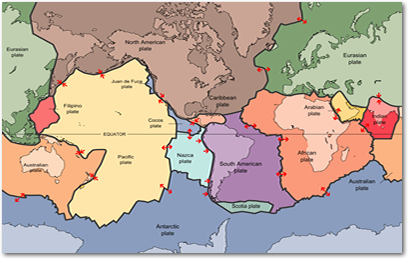
This map shows how Earth's lithosphere is broken up into different plates. Each color represents a different plate. The plates are different sizes and shapes. Some are much larger and cover a greater area.


Although Earth's plates move each year, their movements are very slow. Tectonic plates move anywhere between 1 cm and 24 cm per year. Scientists have determined that forces deep within Earth cause the tectonic plates to move. The theory of plate tectonics explains that Earth's plates are in constant movement.

Plates float on the molten rock of the mantle. Since Earth's plates fit tightly together, the movement of one plate affects the movement of other plates. While the movements of Earth's plates are often not immediately noticeable, these movements cause lasting changes to Earth's surface. Some changes are slow, such as the creation of valleys or mountains. Some changes are fast, such as an earthquake.
Required
1

The lithosphere is broken up into __________ which are constantly __________.

Required
1

How do you think the molten rock of the lower mantle affects the movement of Earth's plates?

Required
1
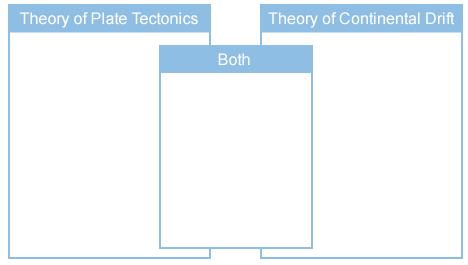
Drag the correct statements into each box that supports each theory.
Other Answer Choices:
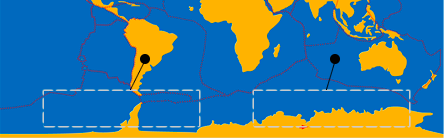
Earth’s lithosphere is divided into pieces called tectonic plates. Tectonic plates are giant, irregular slabs of rock that make up the Earth’s lithosphere. Tectonic plates vary in shape, size, and thickness and fit together with the plates that surround them. Some tectonic plates are made up of oceanic crust, while others are made up of continental crust. Some, including the South American plate, have both oceanic and continental crust. While oceanic crust is thinner than continental crust, it is denser. In contrast, continental crust is thicker and less dense.

The South American Plate contains parts of the Atlantic as well as the South American continent.


According to the theory of plate tectonics, the tectonic plates that make up the lithosphere are constantly shifting. They move at different speeds and in different directions. However, these movements are difficult to notice during a short span of time. Tectonic plates only move about 2.5 centimeters per year. Over time, these slight movements can make a significant impact on Earth’s surface. The theory of plate tectonics states that the plates’ movements are responsible for creating earthquakes. Plate movement can also create new landforms, such as the mountains that are created when plates collide over the course of millions of years.


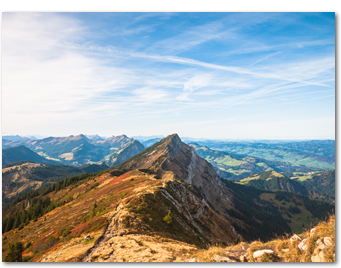
The Alps were created over 20 million years ago as the Eurasian Plate collided with the African Plate.
Required
1
Tectonic plates are parts of the__________that move at different speeds and in different directions.__________is thinner but denser than__________.
Required
1
Which parts of the tectonic plates are thicker and less dense, and which parts are thinner and denser?
Other Answer Choices:
thinner but dense
thicker but less dense
Check for Understanding:

1. Tectonic plates are giant, irregular slabs of rock that make up the Earth’s lithosphere. The movement of tectonic plates is responsible for creating landforms and earthquakes.

2. Tectonic plates move at different speeds and in different directions. Tectonic plates vary in shape, size, and thickness and fit together with the plates that surround them.

3. The theory of plate tectonics states that continents have moved over time because they are on plates, which are in constant slow motion.
What causes the massive plates on Earth's surface to constantly be on the move? Two main forces cause Earth's tectonic plates to move: gravity and convection currents.
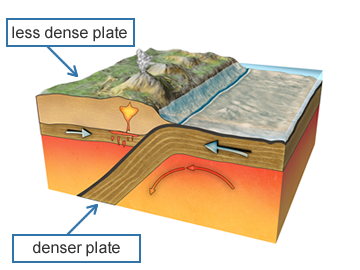
Gravity comes into play when two plates meet and the denser of the two sinks below the other. The sinking plate then proceeds to drag the rest of the plate downward.


Gravity forces the denser of two plates to sink downward. This process can occur at plate boundaries.


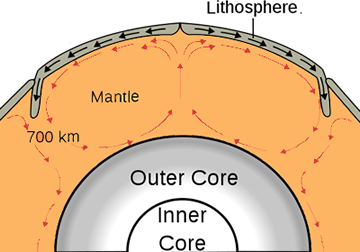
Convection currents are another force that causes the movement of plates. The circular motion of hot, less dense magma rising and cold, denser magma sinking causes the tectonic plates to be pushed and pulled.


Tectonic plates are moved by the convection currents that occur in the Earth's mantle.
Required
1

Which of the following correctly describe the causes of plate movement? (choose 2)

Check for Understanding:

1. Plate tectonics is a theory that explains the structure of the Earth's crust and the movement of its plates over the mantle.
•A tectonic plate is a section of the lithosphere that moves on top of the mantle.

2. A plate may include parts of an ocean, a continent, or both.

3. Earth's tectonic plates are constantly moving, but they typically move at an extremely slow rate.

4. Plates move by floating on the lower mantle, which is composed of magma.

5. The two forces that cause plates to move are gravity and convection currents.
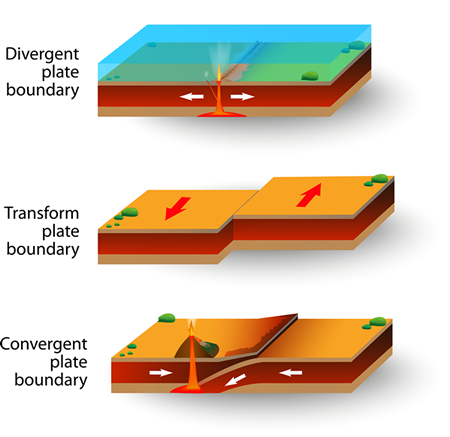
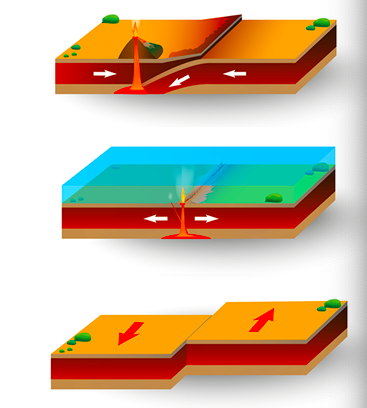
The areas where two or more plates meet are called plate boundaries. These plate boundaries are the sites where major changes to the Earth's surface occur. There are three main types of plate boundaries: divergent, transform, and convergent.


Divergent plate boundaries form when two plates move away from each other. They create tension between the two plates as they pull apart. This type of plate boundary occurs on the ocean floor as well as on land and cause the mid-ocean ridge and new sea-floor.

Transform plate boundaries form when two plates slide past one another. Similar to the motion of a pair of scissors, a force called shearing is at work as plates glide past one another, causing the rock to break and form new ridges or valleys. This boundaries causes earthquakes.

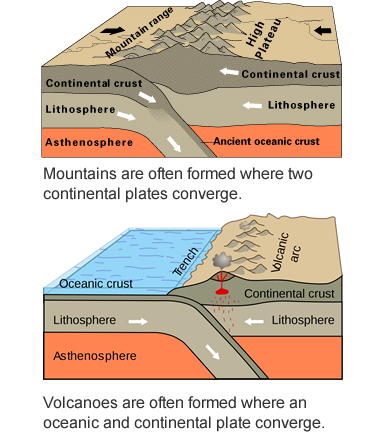
Convergent plate boundaries form when two plates move toward one another and collide. The rocks are compressed or squeezed as they come together. When two continents converge it causes mountains. When an oceanic plate and a continental plate converge it causes volcanoes, trenches, and a subduction zone.
Required
1
Categorize the facts for each type of boundary.
Other Answer Choices:
pulls apart
creates sea floor spreading
creates subduction zones
creates earthquakes
creates trenches
creates volcanoes
creates mountains
plates slide past each other
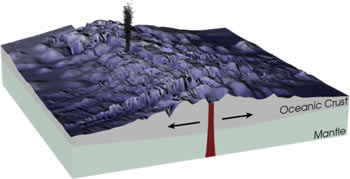
One example of plate boundaries can be found at the bottom of the ocean, where seafloor plates are moving apart. Magma from the mantle is being pushed toward the surface, which causes a divergent plate boundary. This process is called seafloor spreading. The magma pools on each side of the crack and cools to form a mid-ocean ridge. This underwater mountain range marks an area of brand-new ocean floor and supports the theory that Earth is in constant motion.


Mid-ocean ridges are formed at divergent plate boundaries. As this image shows, seafloor plates move in opposite directions as magma flows up from the mantle.


Another example of how plate boundaries change Earth's surface is the creation of mountains and volcanoes. Mountains are commonly created at convergent plate boundaries between two continental plates. Volcanoes are created at convergent plate boundaries where an oceanic plate meets a continental plate.

Required
1
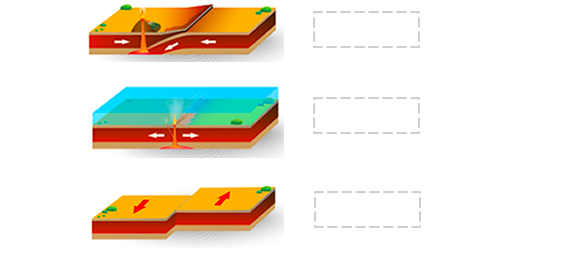
Match the name of each plate boundary with the image that correctly represents it.
Other Answer Choices:
transform
divergent
convergent
Required
1
There are__________types of plate boundaries. A plate boundary is a site where a change to Earth's__________occurs. A__________boundary occurs when two plates move toward one another.__________can form at this type of plate boundary. A__________boundary occurs when two plates move away from one another. A result of this type of plate movement is__________. A__________boundary occurs when two plates slide or grind past one another. A __________ occurs at this type of boundary.
Required
1

At which type of plate boundary is a mountain range most likely to form?

Required
1

Identify the divergent boundary.

Required
1

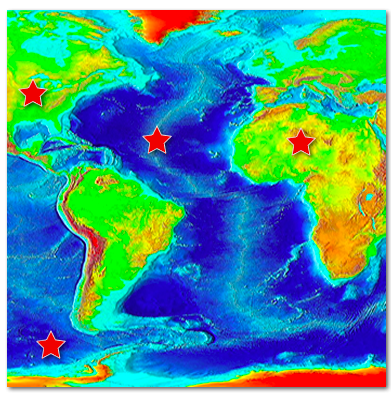
Select the area of the map that shows new ocean crust being formed.

Required
1
Continental and Oceanic_______________ plate boundaries are the result of two___________ coming together. Generally, land from one of the plates is pushed up and the other plate is pushed underneath. At the site of this activity,______________ can form.
Other Answer Choices:
volcanoes
rivers
transform
rocks
divergent
hurricanes
convergent
plates
Check for Understanding:

1. Plates can meet at any of three types of plate boundaries: divergent, convergent, and transform.

2. At a divergent boundary, two plates spread apart from each other. Sea floor spreading is an example of what changes occur at a divergent plate boundary.

3. At a convergent boundary, two plates move toward each other. Mountain formation is an example of a change that occurs on Earth's surface at a convergent plate boundary.

4. At a transform boundary, two plates slide past one another in a back-and-forth motion.
Required
1

What is Pangaea?

Required
1

What is a tectonic plate?

Required
1

What is the theory of plate tectonics?

Required
1

What is a plate boundary?

Required
1

A divergent boundary __________.

Required
1

A convergent boundary __________.

Required
1

A transform boundary __________.

Required
1
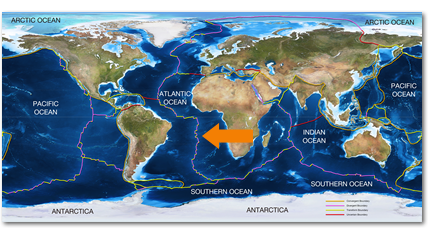
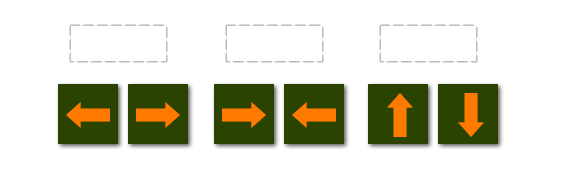
The arrow below represents the movement of tectonic plates at a plate boundary. Determine which type of landform or activity would most likely result from the movement of these plates.
Other Answer Choices:
mid ocean ridge
mountain
earthquake
1
Convection currents in the mantle are created as __________parts of the mantle sink and push the __________parts of the mantle towards the __________.