Lesson 7.2 Following a Healthy Eating Pattern
star
star
star
star
star
Last updated 4 months ago
8 questions
Required
10
| Draggable item | arrow_right_alt | Corresponding Item |
|---|---|---|
Dietary Guidelines | arrow_right_alt | United States government recommendations for forming patterns of eating that will promote health, reduce risk of chronic disease, and meet nutrient needs |
MyPlate food guidance system | arrow_right_alt | foods that provide vitamins, minerals, and other health-promoting components and have little saturated fats, added sugars, and sodium |
nutrient-dense foods | arrow_right_alt | United States government system that helps people put the Dietary Guidelines into practice |
malnutrition | arrow_right_alt | condition that results from people not eating the right amounts of nutrients |
overnutrition | arrow_right_alt | condition that results from people not taking in enough nutrients for health and growth |
undernutrition | arrow_right_alt | condition that results from people eating too many foods that contain high amounts of added sugar, solid fat, sodium, refined carbohydrates, or too many calories |
Required
10
Guidelines for Forming a Healthy Eating Pattern
A _______ includes foods that supply the amounts and types of _______ your body needs to be healthy. Knowing which nutrients your body needs and in what amounts will help you get adequate nutrition.
The _______ (USDA) and _______ (HHS) publish the Dietary Guidelines for Americans to help people make good food choices. The USDA and HHS revise these guidelines every five years to make sure the guidelines reflect the most recent research. The Dietary Guidelines provide recommendations for forming eating patterns that will promote health, reduce risk of chronic disease, and meet nutrient needs (Figure 7.11).
A healthy eating pattern requires that the foods you choose are _______ . The Dietary Guidelines define nutrient-dense foods as foods that provide _______ , _______ , and _______ components and have little saturated fats, added sugars, and sodium.
The added _______ found in some foods are called empty calories. These sugars and fats are called empty calories because they supply few, if any, nutrients to a person’s diet.
_______ are a measure of the energy in a given amount of food. It is not bad to eat calories—as long as they come in _______ foods. Of course, even these good, healthy foods can be harmful to your health if you eat too much of them at a time.
Required
10
MyPlate Food Guidance System
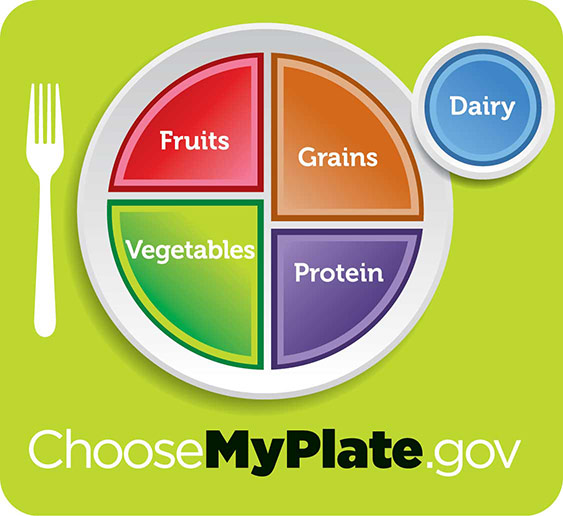
In 2011, the USDA created the MyPlate food guidance system to help people put the Dietary Guidelines into practice. The _______ is designed to remind people about the proportion of different foods they should eat at a meal (Figure 7.12).
Food Groups
The MyPlate graphic includes the five food groups: _______ . Oils are not included on the MyPlate graphic because _______ are not considered a food group. Oils are, however, a necessary part of a healthful diet.
Fruits
Foods in the _______ are often good sources of _______ that many diets lack. These foods can be high in vitamin C and folic acid (a B vitamin). Some are rich in the _______ . Fresh, frozen, canned, and dried fruits, as well as fruit juices, are included in this group.
Grains
The _______ includes foods made from _______ , or other cereal grains. Grains provide _______ , _______ and minerals, and some amino acids. Foods in the grains group are either whole grains or refined grains.
Whole grains contain the entire grain kernel (Figure 7.13). Refined grains have been processed to produce a finer texture and improved shelf life, and no longer contain the whole kernel. Examples of whole grains are brown rice, oatmeal, whole-wheat bread, and wild rice. Examples of refined grains include couscous, crackers, and white bread.
Vegetables
Most foods in the _______ are naturally low in _______ . They are important sources of many nutrients such as potassium, fiber, folic acid, and vitamins A and C. Vegetables come in many types and are often very nutrient dense (Figure 7.14). Vegetables may be fresh, frozen, canned, dried, raw, cooked, whole, cut up, or juiced.
Dairy
The _______ includes many foods that are high in calcium. Examples of these foods are _______ , such as cheese and yogurt. You should choose foods in this group that are _______ options. Dairy foods are often good sources of potassium and protein. Many are fortified with _______ , which helps the body use calcium.
_______ coconut, soy, rice, almond, and cashew alternatives, as well as _______ products, are included in the dairy group as options for people who are lactose intolerant. Lactose is a sugar found in cow’s milk. Some people have difficulty digesting milk that has this sugar. In addition to calcium-fortified milk alternatives, people can drink lactose-free cow’s milk.
Required
10
Protein Foods
The _______ includes _______ , _______ , _______ , _______ and _______ , _______ , processed soy products, and nuts and seeds. Including a variety of protein foods in your meal plan each week improves your nutrient intake and supplies health benefits. The Dietary Guidelines recommend that you include at least eight ounces of _______ in your meal plan each week.
In addition to protein, foods in this group may supply vitamins such as _______ , _______ , _______ , B6, and vitamin E. Some foods in this group have the needed _______ . Some seafood contains fats that may work to reduce the risk of heart disease (Figure 7.15). Plant-based proteins are often rich in fiber.
Some animal-based proteins are high in _______ . As you have read, these substances may increase the risk for _______ . For this reason, you should select lean or low-fat cuts of meat and poultry.
Required
10
Oils
_______ are not considered a food group, but they do provide _______ and must be included in your diet. Oils are naturally present in many _______ . The oil is often extracted from a food source and sold as liquid oil. These oils are then used for _______ . For instance, olive oil is extracted from olives. Other examples are corn oil and canola oil. Avocados, nuts, and some fish are _______ of oils that are typically included in the diet.
Because they are _______ , oils are usually liquid at room temperature. _______ , however, are not oils and come from animal sources. Saturated fats commonly found in the diet include butter, milk fat, beef fat, pork fat, and poultry fat. Saturated fat in the diet may contribute to such serious conditions as _______ .
Required
10
Poor Nutrition
A _______ plan is an important part of maintaining your health and reducing your risk for certain diseases. A healthy personal dietary plan can also help you _______ related to _______ , or malnutrition. Malnutrition is a condition that results from people not eating the right amounts of nutrients. Undernutrition and overnutrition are forms of malnutrition.
Undernutrition
One form of malnutrition is _______ . Undernutrition is a condition that results from people not taking in _______ for health and growth.
_______ is especially important for _______ . The bodies of children and teens undergo a large amount of _______ . Children and teens need to be sure to get enough nutrients for that growth and development to be healthy. Children who do not receive enough nutrients may never reach their full height. _______ can also lead to serious and even life-threatening health conditions. Examples are brain damage, vision impairments and blindness, and bone deformities.
Overnutrition
Although many people think about poor nutrition in terms of not getting enough nutrients, it can also be caused by eating too much of some nutrients. This type of _______ is often a result of eating too many foods that contain high amounts of _______ , _______ , _______ , refined grains, or simply too many calories.
Foods high in solid fats, added sugars, refined grains, and sodium are believed to be linked to a variety of _______ . For instance, as the amount of sodium a person consumes goes down, so does the person's blood pressure. Maintaining a _______ reduces the risk of heart and kidney diseases.
Required
10
Skills for Following a Healthy Eating Pattern
To maintain your health, you should follow a _______ . The requirements for a healthy eating pattern change across a person’s life span. Today, you have different _______ needs than you did when you were a child. Your nutritional needs also will continue to change as you grow older. The skills in the following sections can help you follow a _______ pattern.
Choosing Nutrient-Dense Foods
A healthy eating pattern includes a variety of _______ in appropriate amounts. The foods you eat should provide _______ , and other substances that either contribute to adequate nutrient intake or have positive health effects. _______ foods have little or no saturated fats, added sugars (sugars that do not occur naturally in foods), refined starches, or sodium (salt). _______ are often less nutrient dense than fresh foods. Figure 7.18 shows ways you can include more _______ foods in your eating pattern.
Limit Added Sugars, Saturated Fats, and Sodium
Consuming too much _______ , _______ , and _______ can increase risk for heart diseases, obesity, and _______ . People should consume less than 10 percent of their calories from added sugars and less than 10 percent of their calories from saturated fats. People should also limit sodium intake to no more than 2,300 milligrams per day and ideally no more than 1,500 milligrams. To compare, most people in the United States consume more than 3,400 milligrams each day.
Eating Breakfast Every Day
Eating a _______ every day is very important. People need a _______ to give them energy, improve concentration, and help provide the nutrients they need to grow. To put together a nutritious breakfast, use whole grains, lean protein foods (like eggs, lean meat, or nuts), low-fat dairy products, and fruits and vegetables. For example, you might make a smoothie, oatmeal with fruit, or a whole-grain tortilla with vegetables and salsa.
Required
10
Understanding Nutrition Facts and Food Labels
To help consumers make good choices about what they eat, the _______ any food sold in a package to include a _______ (Figure 7.19). Nutrition Facts labels show the nutrients in each serving of the food. They also indicate how much of the recommended daily value of that nutrient is in the serving. The information on these labels is scientifically tested and proven so you can rely on it.
When you are _______ , compare and contrast food labels for their nutrition and calorie content. If a food does not have packaging with a nutrition facts label, such as produce or a restaurant meal, you can use online _______ to view nutrition and calorie content.
Sometimes _______ describe a particular food using a specific claim about its health benefits. For example, a food label might describe a food as “_______ ” or “organic.” Organic foods are those produced without the use of _______ , pesticides, or other artificial chemicals. To use these terms, the food must meet certain criteria established by the _______ .
Some foods come from _______ (GMOs). GMOs are living things that have undergone changes to genetic material (DNA). This technology allows the transfer of certain genes from one organism to another. The goal is to create plants and crops with more resistance to disease, more _______ , and better taste. Foods produced using this technique are often called GMO foods. _______ foods are those without genetically modified ingredients. Many countries require the labeling of GMO foods so people know whether the foods they buy have been altered.