Preskoči na glavni sadržaj
Prijava
Sign up for FREE
arrow_back
Biblioteka

Collaborative Assessment: Wind Patterns & the Coriolis Effect

star
star
star
star
star
Posljednje ažuriranje over 1 year ago
12
1
Pitanje 5
5.

Directions: Answer the following question using your critical and creative thinking. If you would like more support, you may work with a partner.

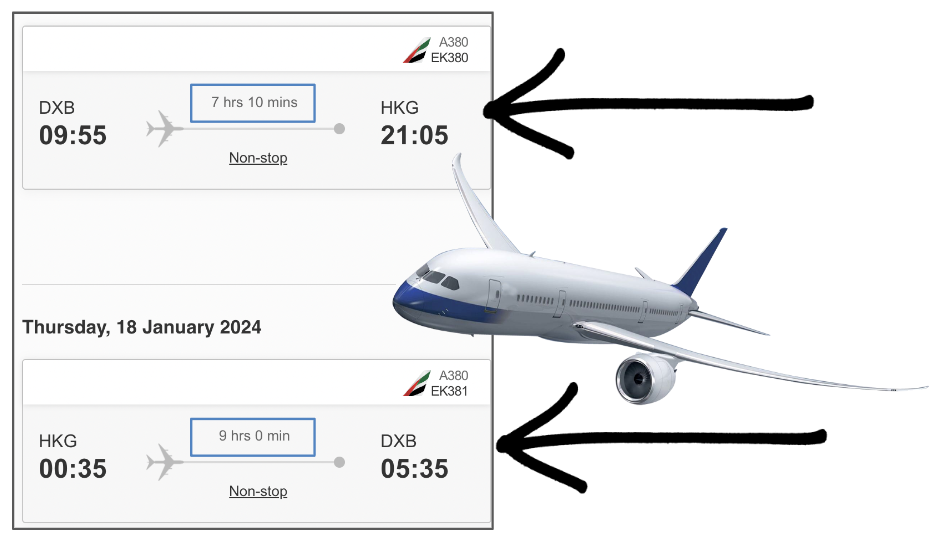
TASK: Take a look at the Dubai (DXB) - Hong Kong (HKG) flight timings below.

Notice how DXB - HKG takes 7 hours and 10 minutes, but the return flight takes 9 hours?

Given that in both flight, the same distance is travelled why do you think travel time is so different?
1
1
1
1
Question 1
00:50
keyboard_arrow_down
5
Question 2
01:43
keyboard_arrow_down
5
Question 3
02:42
keyboard_arrow_down
6
Question 4
03:16
keyboard_arrow_down
4
Pitanje 7
7.

Annotate the following and then annotate

10
Pitanje 10
10.

A) High pressure systems bring with them what type of weather?

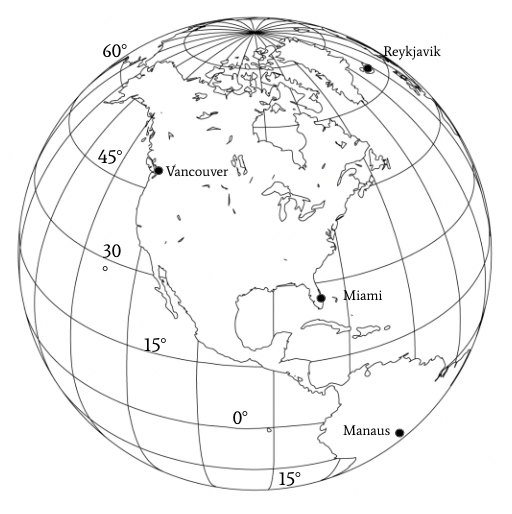
C) Which location has the longest circumference?

E) Which cell is located between 30° and 60°?

G) Westerlies occur as air travels from ______ to _______

H) The ITCZ is located in a

6
Pitanje 11
11.

Define each region as being a predominantly high pressure zone or low pressure zone.

  1. Equator:

  2. 30° North and South:

  3. Horse Latitudes:

4
Pitanje 12
12.

For each, determine whether it predominantly experiences SE trade winds, NE trade winds, Westerlies, or Easterlies.

  1. Reykjavik:

  2. Miami:

Pitanje 1
1.

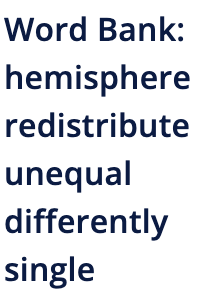
Different parts of the earth heat up with the equator receiving more radiative heat from the Sun than the poles.

And the purpose of global circulation is to this heat. If the Earth did not rotate & was a simple land mass with no oceans, we would have a circulatory cell in each hemisphere. Hotter air would rise at the equator and flow toward the poles. The air would sink as it cools & then return towards the equator.

But the distribution of land and ocean & the speed of the Earth's rotation make this circulation system more complicated, giving us a 3 cell pattern which exists in both the northern and southern .

Pitanje 2
2.

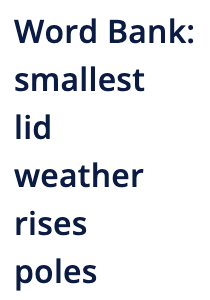
The largest cells are the Hadley cells. At the equator, the warmer less dense air . It rises to a height of about 18 km and spreads out underneath the tropopause.

The tropopause acts as a tot the lowest part of the atmosphere, which contains all of our . The warm air spreads out towards the gradually cooling and sinking as it moves, before descending to the surface and flowing back to the equator.

The cells are the polar cells. Cold, dense air descending in the polar regions flows at lower levels to about 60o to 70o North or South. As the air leaves the polar regions it starts to warm and rise, returning to the poles at high levels.

Pitanje 3
3.

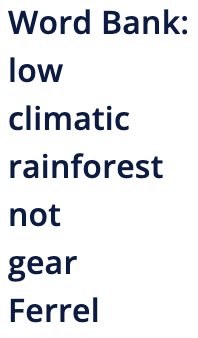
Between the Hadley and Polar cells are the cells. Unlike the other cells, the Ferrel cells are driven by temperature. These cells flow in the opposite direction to the Hadley and Polar cells acing like a .

These circulating cells not only transport heat from the equator to the poles but also result in semi-permanent areas of high and low pressure due to the rising and descending parts of the circulation cells giving us our zones.

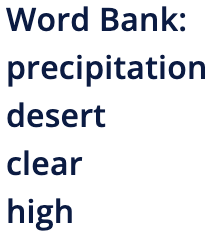
Where air is rising an area of pressure is created, so these areas see much more rainfall. This is why the largest areas of are found near the equator & why the UK has a relatively wet climate.

Pitanje 4
4.

Where air is descending an area of pressure forms giving largely skies and little rainfall, which leads to the regions. But not all deserts are hot.

Antarctica sits under the descending branch of the Polar cell and is also classed as a desert. With more falling in the Sahara, Antarctica is the largest and driest desert overall.