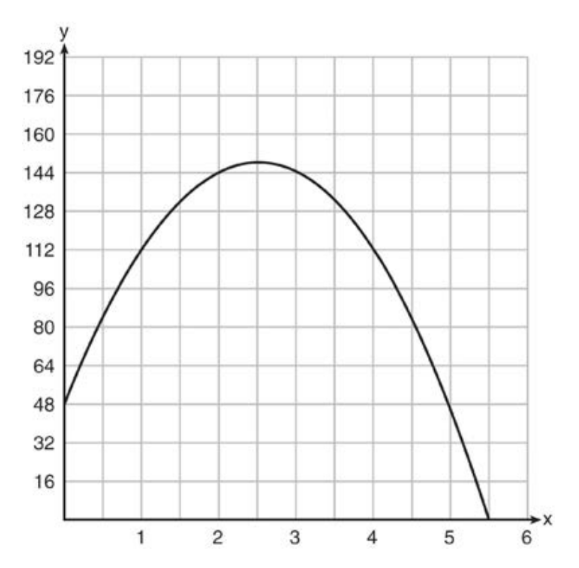
A ball is thrown into the air from the edge of a 48-foot-high cliff so that it eventually lands on the ground. The graph below shows the height, y, of the ball from the ground after x seconds.
For which interval is the ball's height always decreasing?
The expression
represents the height, in meters, of a toy rocket t seconds after launch. The initial height of the rocket, in meters, is
The height of a ball Doreen tossed into the air can be modeled by the function
, where x is the time elapsed in seconds, and h(x) is the height in meters. The number 5 in the function represents
A ball is thrown into the air from the top of a building. The height, h(t), of the ball above the ground t seconds after it is thrown can be modeled by
How many seconds after being thrown will the ball hit the ground?
Morgan throws a ball up into the air. The height of the ball above the ground, in feet, is modeled by the function
where t represents the time, in seconds, since the ball was thrown. What is the appropriate domain for this situation?
A ball was launched into the air, and its height above the ground was recorded each second, as shown in the table below.
Based on these data, which statement is a valid conclusion?
The height of a rocket, at selected times, is shown in the table below.
Based on these data, which statement is not a valid conclusion?
Ian throws a ball up in the air and lets it fall to the ground. The height of the ball, h(t), is modeled by the equation
with h(t) measured in feet, and time, t, measured in seconds. The number 3 in h(t) represents
Paul launched a ball from the top of a bridge. The function,
models the trajectory of the ball, where f(x) represents the height of the ball, in feet, and x is the time elapsed since the ball was launched.
Which of the following best describes the domain of the function that represents the trajectory of the ball that Paul launched?
Consider the function
Which of the following are true about the function. Choose three statements.
Consider the function
Which of the following are true about the intercepts of the graph of the function?
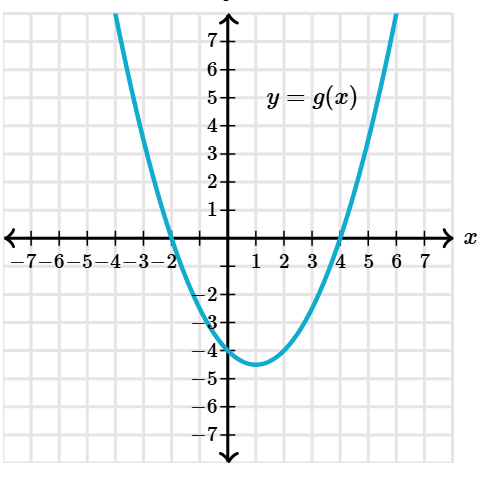
Consider the function below.
What is the interval of decrease?
A soccer ball is kicked from the ground with an initial upward velocity of 90 feet per second. The equation
gives the height h of the ball after t seconds.
Find the maximum height of the ball. (Round to the nearest hundredth)
A soccer ball is kicked from the ground with an initial upward velocity of 90 feet per second. The equation
gives the height h of the ball after t seconds.
How many seconds will it take for the ball to reach the ground? (Round to the nearest hundredth)
Ava is jumping on a trampoline. Her height h at a time t can be modeled by the equation
Would Ava reach a height if 14 feet?