Week 8 Brilliant Buffers
star
star
star
star
star
Last updated almost 2 years ago
10 Nsɛmmisa
complete parts one and two using the information.
Part three is an opportunity to stretch yourself !!!!!
complete parts one and two using the information.
Part three is an opportunity to stretch yourself !!!!!

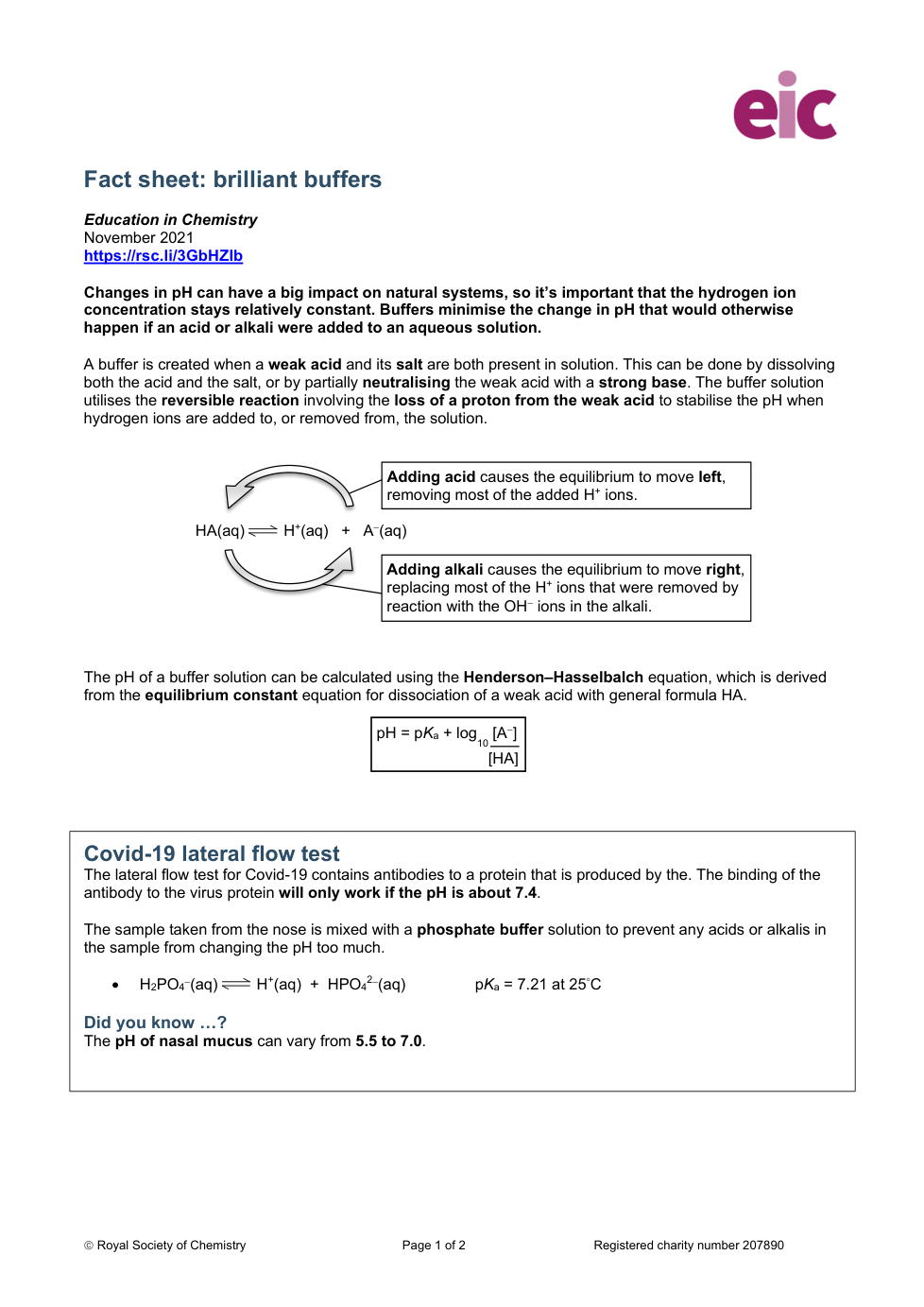
Calculate the hydrogen ion concentration when the pH is 7.40 as in the lateral flow test solution.
The lateral flow test will not work if acidic substances in the sample cause the hydrogen ion concentration to exceed 1.60 x 10⁻⁷mol dm-3. Calculate the pH of this hydrogen ion concentration.
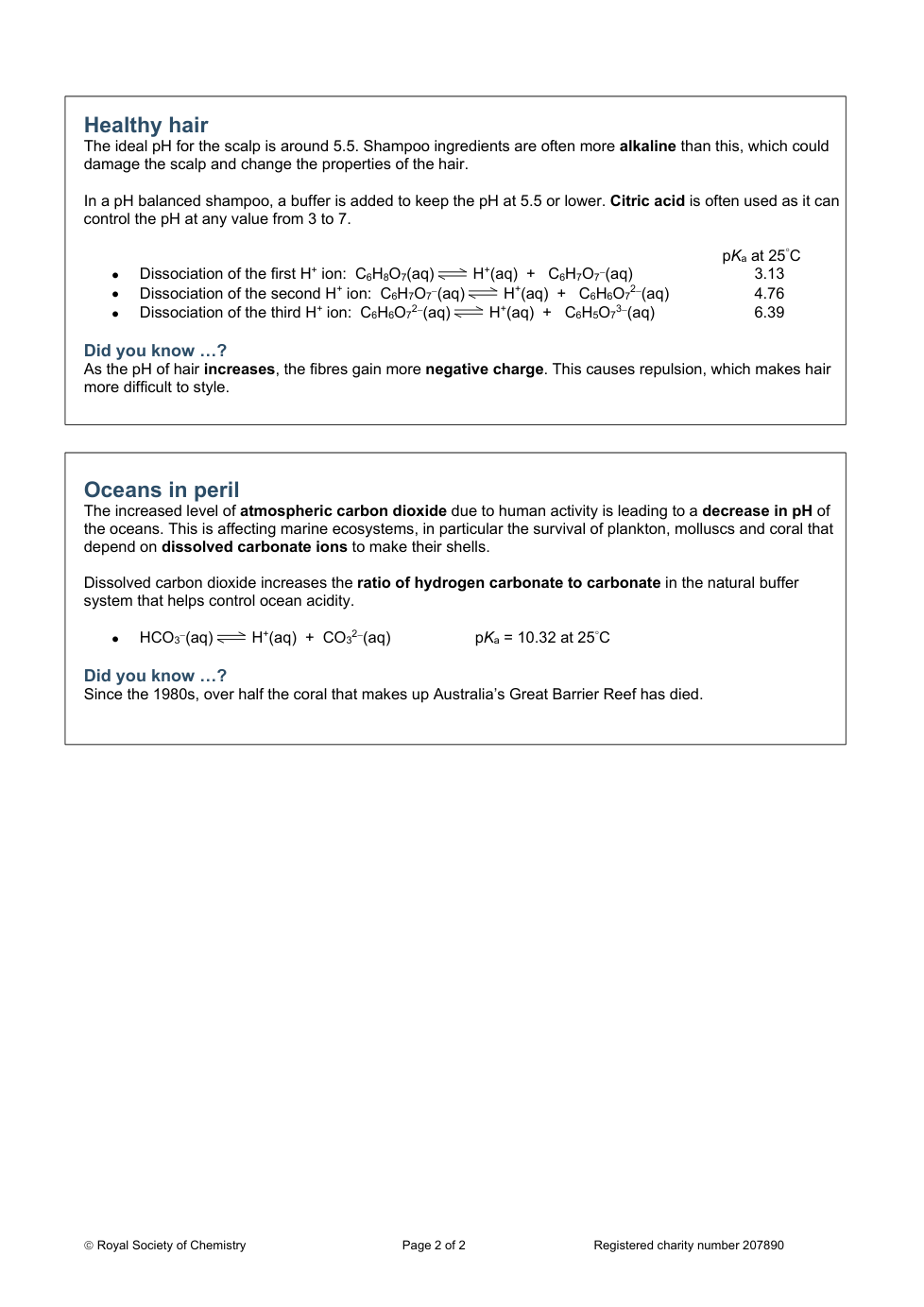
1. Use the pKa of the hydrogen carbonate ion given on the fact sheet to calculate the Ka for the dissociation of this acid.
Some shampoos use a buffer based on 2-hydroxyethanoic acid rather than citric acid to control the pH. 2-Hydroxyethanoic acid has a Ka of 1.48 x 10⁻⁴ mol dm-3. Calculate the pKa of this acid and compare it with the pKa for the first dissociation of citric acid given on the fact sheet to decide which of the two acids is stronger.

Use the pKa for dihydrogen phosphate given on the fact sheet to calculate the salt/acid concentration ratio required to achieve the required pH for the lateral flow test of 7.40.
Calculate the pH of a shampoo which contains 0.0010 mol dm-3 citric acid and 0.0090 mol dm-3 monosodium citrate (C6H7O7-Na+). Use the pKa for first dissociation of citric acid given on the fact sheet.
If the hydrogen carbonate ion concentration in the ocean is 0.0018 mol dm-3 and has a pH of 8.10, calculate the carbonate ion concentration. Use the pKa for hydrogen carbonate given on the fact sheet
Buffer solutions are usually made by partially neutralising the weak acid with a strong base. This converts some of the acid into the salt, while leaving the rest of the acid unchanged. The result is a mixture of the acid and its salt. Some more extended problems may involve using stoichiometry to calculate how much weak acid or strong base you need to achieve a given salt/acid ratio.
EXTENSION . In the preparation of a shampoo, 100 cm3 of an aqueous solution containing 0.0100 mol dm-3 citric acid was partially neutralised by adding 20 cm3 of 0.040 mol dm-3 aqueous sodium hydroxide.
a. Use the first dissociation of citric acid to write an equation for the neutralisation of the acid with sodium hydroxide and then calculate the salt/acid ratio in the resulting mixture.
Use your answer in part a. and the pKa for the first dissociation of citric acid to calculate the pH of the buffer solution in the shampoo.
EXTENSION In the phosphate buffer, the salt/acid ratio needed to achieve a required pH of 7.4 is about 1.5.
a. Write an ionic equation for the reaction of dihydrogen phosphate with sodium hydroxide to form the hydrogen phosphate ion.
A supply of phosphate buffer is made by partially neutralising 500 cm3 of 0.100 mol dm-3 aqueous sodium dihydrogen phosphate with a suitable volume of 0.200 mol dm-3 aqueous sodium hydroxide. Calculate the volume of 0.200 mol dm-3 aqueous sodium hydroxide required to give a salt/acid ratio of 1.5.
1. The change in ocean pH from 8.2 to 8.1 that has resulted from human activity does not seem like very much. However, the increase in hydrogen ion concentration is more significant. Calculate the hydrogen ion concentration of pH 8.2 and 8.1, and then use this to calculate the percentage increase in hydrogen ion concentration.