Chapter 6: Lesson 6.2 Getting Help for Mental Illnesses

Last updated 4 months ago
10 questions
Required
10
Draggable itemCorresponding Item
therapy
mark of shame or embarrassment that is usually unfair
inpatient treatment
gatherings in which a therapist meets with a group of people who share a common experience
therapist
type of therapy in which all family members meet together with a therapist to build positive, healthy relationships
support groups
type of therapy that involves a one-on-one meeting with a therapist to discuss feelings and behaviors
individual therapy
substance that causes changes in the brain to reduce symptoms of a mental illness
family therapy
type of treatment that involves staying in a healthcare facility for a period of time
mental health medication
professional who diagnoses and treats people with mental health conditions
stigma
treatment method that focuses on the psychological aspect of mental health
Required
10

What is the role of a therapist?

Required
10
Recognize When You Need Help
Sometimes, people with _______ do not get the help they need. They may assume their negative feelings will simply go away. Most mental illnesses, however, do not improve without _______ . If left untreated, mental illnesses can result in social issues like homelessness and unemployment. Knowing when to get help is an essential skill for maintaining your _______ health.

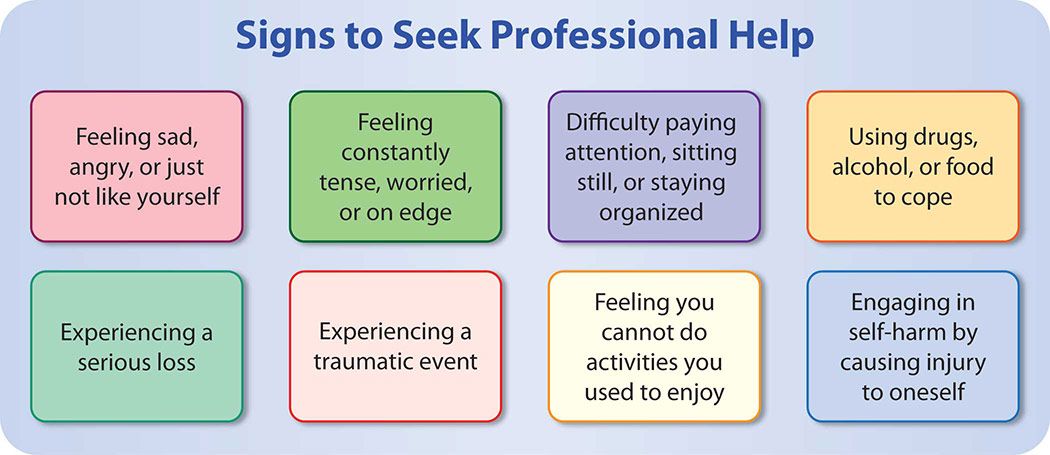
Feeling sad, _______ , or lonely sometimes is a normal part of life for everyone. These feelings will fade over time. Sometimes, however, people need help from a _______ or doctor to manage their feelings. When people lack support, have a negative self-concept, or struggle to cope with overwhelming emotions, they may engage in _______ like self-harm. Taking care of your mental and emotional health is just as important as taking care of your _______ . It is important to recognize the signs of needing professional help (Figure 6.7).

The next step for getting professional treatment is locating resources. There are many ways young people can get mental and emotional help. One simple resource is talking to a _______ such as a parent or guardian, school counselor, school nurse, or doctor. It is a good idea to talk to an adult you trust because this person may be able to help you find a _______ or drive you to and from appointments.

It is also important to understand where you can go to get professional help. Many community agencies and institutions offer some type of mental health _______ . It is possible to find free or low-cost therapy from various locations such as local hospitals, colleges or universities, or mental health clinics.
Required
10

Find Treatment

_______ are trying to find ways of identifying people who are vulnerable to mental illnesses. These researchers work to better understand how the human brain works and to create new treatments for _______ . The purpose of these treatments is to help people live healthy and productive lives. Treatment may involve receiving therapy, taking medication, or staying in a healthcare facility for a period of time.


Therapy

_______ is a treatment method that focuses on the psychological aspect of mental health. This type of _______ seeks to change the way a person thinks, interprets information, behaves, and experiences and expresses emotions. Therapy sessions are often conducted by a therapist.

A _______ is a professional who diagnoses and treats people with mental health conditions and illnesses (Figure 6.8). Therapists include professionals such as _______ , psychiatrists, social workers, and _______ . Therapists may recommend several different types of therapy, which include the following:
  • _______ involves a one-on-one meeting with a therapist to discuss feelings and behaviors. The information a patient shares with the therapist is completely confidential in most cases. One exception is if a therapist believes a patient may hurt oneself, or someone else. Then, the therapist may share that information with a parent or guardian. A therapist can also report signs of abuse or neglect.
  • In _______ , all members of a family meet together with a therapist. This type of therapy helps families build positive, healthy relationships. Family therapy can also help members of a family support one member with a mental illness.
  • In _______ , a therapist meets with a group of people who share a common experience. The therapist shares and discusses strategies for managing this common condition with all group members at the same time. Group members also gain information about what strategies were helpful for others. This type of group therapy can be helpful because people feel the other members truly understand their conditions.
Required
10

What does a therapist NOT do?

Required
10

What is the main goal of a therapist?

Required
10

What is a positive characteristic of therapists?

Required
10
Inpatient Treatment In some cases, a person’s mental illness requires care in a _______ , or inpatient treatment. _______ is necessary when people are at serious risk of harming themselves or others. People who are depressed and have thoughts of _______ may need to be hospitalized for a period of time to make sure they do not attempt suicide. In the hospital, people receive around-the-clock supervision, medication, and therapy.

Overcome Barriers
Unfortunately, people with mental illnesses do not always get the help they need. Only _______ of adults and less than _______ of adolescents with mental illnesses get the help they need. Some people may assume their negative feelings will go away on their own. Most mental illnesses, however, do not improve without treatment. Untreated mental illnesses may even get worse and lead to more severe conditions. Some people may face external barriers that prevent them from getting help for their condition. Examples of these external barriers are _______ attached to mental illnesses and the cost of mental health treatment.

Mental illnesses often carry a social stigma (Figure 6.10). Stigma is a mark of shame or embarrassment that is usually unfair. _______ may cause people with mental illnesses to avoid seeking help, deny they have a condition, or feel shame and _______ . People may also fear they will lose an opportunity because of their condition, such as losing a _______ or leadership position.

If you feel stigma about having a _______ , do not let that stop you from getting help. Stigmas may result from a lack of understanding about a mental illness. Learning more about a mental illness will help you understand your feelings and _______ other people. Talking to friends and family or joining a support group can help provide support, show that you are not alone, and teach you strategies for feeling better.

Another barrier to mental health treatment is cost. People may worry about being unable to _______ . Although mental health professionals do charge for their services, a person's _______ may cover a portion of the expenses. Some mental health clinics may also provide therapy services at no cost or at a reduced rate.
Required
10
Mental Health Medications
Another form of treatment for a mental illness is _______ . Substances that cause changes in the brain to reduce the symptoms of a mental illness are called mental health medications. These _______ are prescribed by healthcare professionals.

Many researchers believe that mental health medications are most effective when used along with some type of therapy. For example, people with _______ may take medication and also benefit from therapy. Medication can often effectively manage symptoms of a _______ . Therapy can help people correct their negative, unhealthy thought patterns.

Different mental health medications _______ the symptoms of various mental illnesses (Figure 6.9). Most medications have some possible _______ such as tiredness and weight gain or loss. In some cases, medications can have very serious side effects. For example, some people who take certain types of _______ can experience more thoughts of suicide. Due to side effects, doctors and mental health professionals _______ monitor people who take mental health medications.
Required
10

Helping Someone with a Mental Illness

You may be _______ that someone you care about has a mental illness. Share your concerns with that person in an open and _______ way (Figure 6.11). Simply saying that you are worried and would like to help lets that person know you are available. You could also offer to find a mental health professional. You may even go with that person to talk to the professional.

Sometimes a person with a _______ is not interested in seeking help. You must intervene when you suspect people may _______ or hurt someone else. In other situations, you need to accept that it is not your responsibility to solve that person’s condition. You should not try to protect people from the _______ of their conditions. This type of protection simply enables people to continue having the condition without treatment. For example, if your friend is too _______ to complete homework, doing the homework for your friend just helps hide the seriousness of your friend’s condition from people who could offer help.

Remember that sometimes people need more time before they are ready to get help. Take _______ , however, if you suspect someone has thoughts of suicide. Call 911 or take the person to the hospital right away.