Review all functions including composition and inverses
star
star
star
star
star
Last updated over 1 year ago
35 questions
2
2
2
2
10
F.BF.4.a
10
F.IF.1
10
F.BF.1.b
F.BF.1.c
1
1
1
1
1
1
1
1
1
1
1
1
1
1
1
1
1
1
1
1
1
Question 22
22.
Let
and
Find
Question 23
23.
Let
and
Find
Question 24
24.
Let
and
Find
Question 25
25.
Let
and
Find
10
Question 26
26.
Problem 4 Got It?
F.BF.4.a
F.IF.1
Question 27
27.
10
Question 28
28.
Problem 6 Got It?
F.BF.4.a
10
Question 29
29.
What is the inverse of f ? Is the inverse a function?
F.BF.4.a
F.IF.1
10
Question 30
30.
What is the inverse of f ? Is the inverse a function?
F.BF.4.a
F.IF.1
10
Question 31
31.
F.BF.4.a
F.IF.1
10
Question 32
32.
F.BF.4.a
10
Question 33
33.
F.BF.4.a
Question 34
34.
Reasoning: A function consists of the pairs (2, 3), (x, 4), and (5, 6). What values, if any, may x not assume?
Question 35
35.
Review Lesson 6-6: For the given functions f, g, and h, match each function operation and composition on the left with the equivalent simplified expression on the right.
Question 1
1.
Question 2
2.
DOMAIN
Question 3
3.
Question 4
4.
DOMAIN
Question 5
5.
Question 6
6.
DOMAIN
Question 7
7.
Question 8
8.
DOMAIN
Question 9
9.
Question 10
10.
DOMAIN
Question 11
11.
Question 12
12.
DOMAIN
Question 13
13.
Question 14
14.
Question 15
15.
Question 16
16.
Question 17
17.
Question 18
18.
Question 19
19.
Question 20
20.
Question 21
21.
A
B
C
D
Problem 6 Got It? Given g(x) below, find g-1(x).
B
C
D
A
B
C
D
A
B
C
D
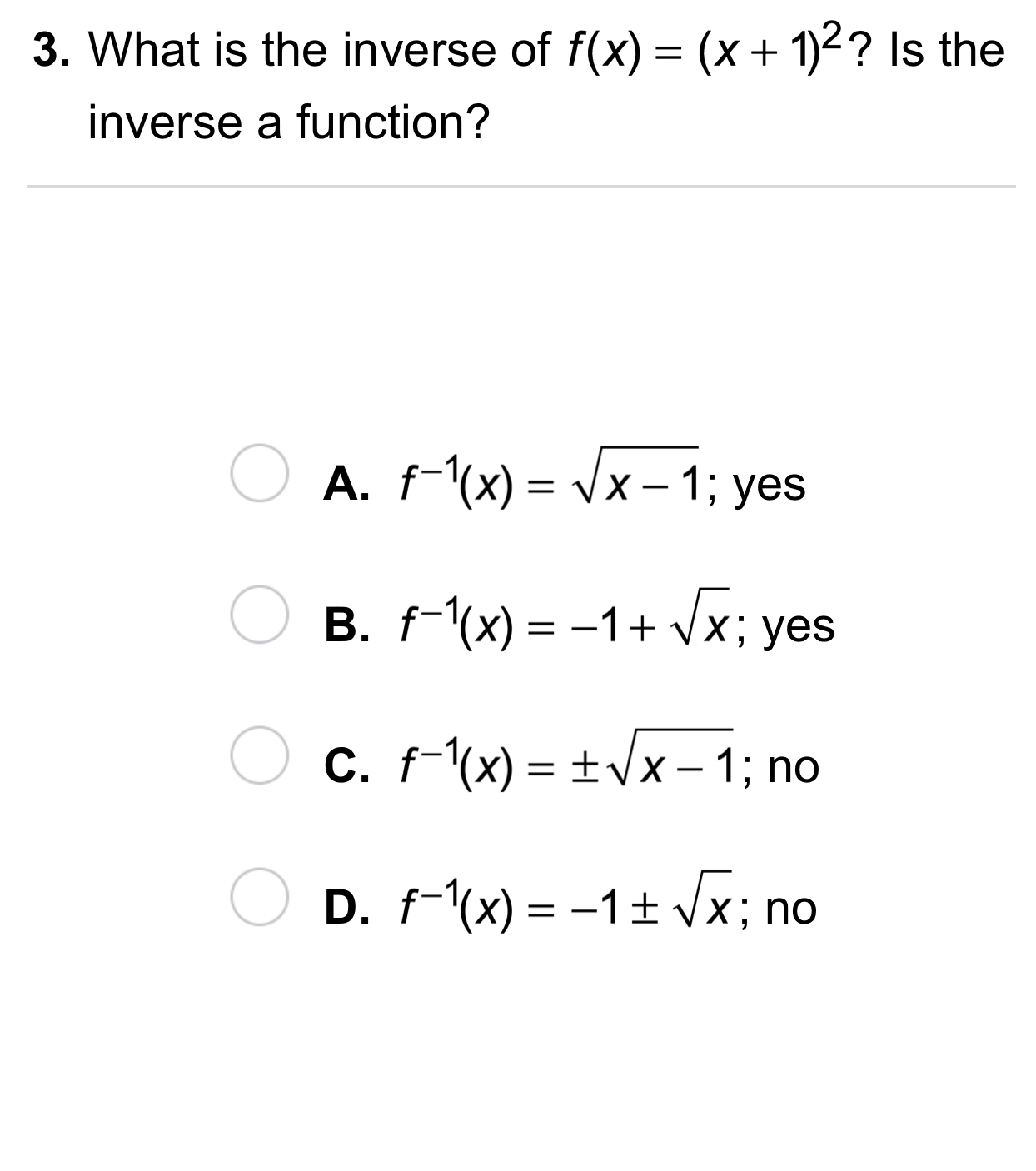
What is the inverse of f ? Is the inverse a function?
B
C
D
C
D
For h, find the value for x for which the equality
(h ◦ h-1)(x) = x does not hold.
C
D
For the relation to be a function, x may not assume 2, 3, 4, 5, or 6.
x may assume any real number and the relation will still represent a function.
For the relation to be a function, x may not assume 2 or 5.
For the relation to be a function, x may not assume 3, 4, or 5.