Building Tough: Earthquake-Resistant Structures

Last updated about 1 year ago
12 questions
1. Make sure to read the text before answering questions
2. Use pages 32-35 in our textbook to support your responses
Explain the concept of earthquake-resistant structures and why they are important for saving lives and reducing damage during seismic events.
Hey there! Let's talk about earthquake-resistant structures and why they are so crucial in saving lives and minimizing damage during seismic events. Earthquake-resistant structures are buildings or other man-made structures designed to withstand the damaging effects of earthquakes. These structures are built using specialized construction techniques and materials to ensure they can absorb and dissipate the energy released during an earthquake. By incorporating features like flexible foundations, shock absorbers, and reinforced walls, these buildings can sway and bend without collapsing when the ground shakes. This design helps protect people inside the building and reduces the potential for injuries or fatalities. Additionally, earthquake-resistant structures also play a significant role in reducing the overall economic losses caused by earthquakes by preserving infrastructure and preventing widespread destruction. So, the next time you see a sturdy building that can withstand an earthquake, remember that it's not just a building - it's a lifesaver!
Required
1

Why are earthquake-resistant structures important?

Required
1

What features can earthquake-resistant structures incorporate to help them withstand earthquakes?

Required
1

How do earthquake-resistant structures help save lives?

Identify key design features and materials used in earthquake-resistant structures, such as base isolators, flexible foundations, and damping systems.
Hey there! Let's talk about how engineers design earthquake-resistant structures to keep buildings safe during earthquakes. One important design feature is base isolators, which are like shock absorbers for buildings. These isolators sit between the building and its foundation, allowing the structure to move independently from the ground motions during an earthquake. Another cool feature is flexible foundations, which are designed to absorb and disperse the energy from an earthquake, reducing the stress on the building. Additionally, engineers use damping systems to absorb and dissipate the energy of seismic waves, helping to reduce the building's movements. By using these key design features and materials, engineers create buildings that are better able to withstand the shaking and vibrations of an earthquake. How awesome is that?
Required
1

What are base isolators used for in earthquake-resistant structures?

Required
1

Which design feature allows the structure to move independently from the ground motions during an earthquake?

Required
1

How do engineers use damping systems in earthquake-resistant structures?

For structures to withstand an earthquake,
the ground itself must hold together. Many
moist soils—especially those rich in clay—and
loose soils, like sand, lose their compactness
during an earthquake. When wet soil or sand
shakes, the water between the grains will
often start to migrate so that the grains do
not touch each other anymore. The soil then
acts like liquid—a process called liquefaction.
A building standing where liquefaction is
happening can collapse as the foundation sinks
into the wet, muddy sediment. Buildings in
earthquake-prone areas should stand on solid
steel pilings driven deep through a loose or wet
soil layer into solid rock deep in the ground.
Required
1

What happens to moist soils like clay during an earthquake?

Required
1

What process occurs when wet soil or sand shakes during an earthquake?

Required
1

Why do buildings in earthquake-prone areas need solid steel pilings?

1

Where should buildings in earthquake-prone areas be placed for better stability?

Required
1

Where should buildings in earthquake-prone areas be placed for better stability?

Required
1

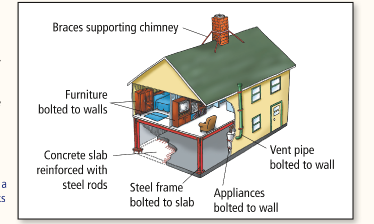
Click on the furniture that should be bolted to the wall?