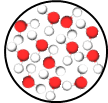
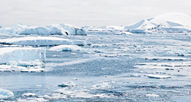
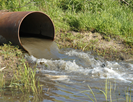
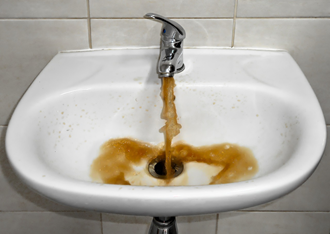
Match each type of water to the correct example.
Match each type of water to the correct example.
| Draggable item | arrow_right_alt | Corresponding Item |
|---|---|---|
Seawater | arrow_right_alt | |
Wastewater | arrow_right_alt | |
Freshwaer | arrow_right_alt | |
Pure | arrow_right_alt |
What do humans use resources for?
Which one of the following objects that you use all the time comes from a renewable resource?
Tick one
What are finite resources?
Match each type of water to the correct example.
| Draggable item | arrow_right_alt | Corresponding Item |
|---|---|---|
Seawater | arrow_right_alt | |
Wastewater | arrow_right_alt | |
Freshwaer | arrow_right_alt | |
Pure | arrow_right_alt |
Sam is preparing to analyse a chemical sample by first dissolving it in water. They reckon tap water will be okay to use because it is potable. Is Sam correct? Explain your answer.
Match each description to the correct type of water.
| Draggable item | arrow_right_alt | Corresponding Item |
|---|---|---|
used water from homes, factories and agriculture | arrow_right_alt | Freshwater |
Composed of only H2O molecules | arrow_right_alt | Waste water |
Contains high amounts of dissolved substances | arrow_right_alt | Pure |
found in lakes, rivers, reservoirs and glaciers | arrow_right_alt | Seawater |
Match each description to the correct step name.
| Draggable item | arrow_right_alt | Corresponding Item |
|---|---|---|
Sterilisation | arrow_right_alt | Removes very small, insoluble particles |
Filtration | arrow_right_alt | A grid acts like a sieve, removing large and insoluble objects |
Sedimentation | arrow_right_alt | Kills bacteria and other microbes |
Screening | arrow_right_alt | Small, insoluble particles settle out of the water source |
Put each step into the correct order to form potable water from groundwater or freshwater.
Sterilisation
Screening
Filtration
Sedimentation
Izzy has written some instructions for how dirty water could be ‘cleaned’ using common laboratory equipment.
Read through Izzy’s apparatus and method. Correct any mistakes you find.
Place appropriate statements on the Venn diagram.
Pressure
Pure Water
Boil
Seawater
Partially Permeable Membrane
Condensation
Desalination
Filtration
Freshwater
Temperature
Distillation
Reverse Osmosis
Both
Neither
Many factors are considered when determining which method to use to obtain potable water from a source.
a)What are the advantages and disadvantages of using distillation to obtain drinking water from seawater?
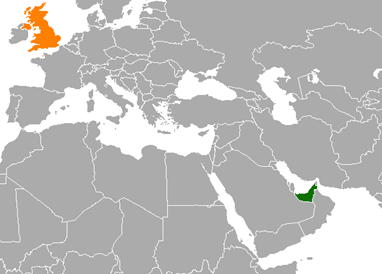
b)Why is distillation not used to provide drinking water in the UK?
Match each description to the correct type of water.
| Draggable item | arrow_right_alt | Corresponding Item |
|---|---|---|
oceans | arrow_right_alt | Groundwater |
only falls from the sky | arrow_right_alt | Pure water |
moves through porous rock | arrow_right_alt | Rainwater |
H2O only | arrow_right_alt | Seawater |
Place each substance below into the correct column(s) to show which soluble substances are found in each type of water. You can reuse answers
Carbon Dioxide (CO2)
Sodium Chloride (NaCl)
Sulfur Dioxide (SO2)
Dissolved Ions (Ca2+, Mg2+)
Groundwater
Rainwater
Seawater
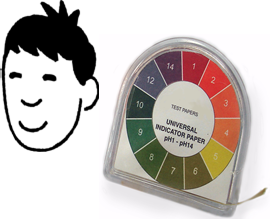
Jun needs to determine the pH of a sample.
Write a method for how he should use universal indicator (UI) paper to complete his task.
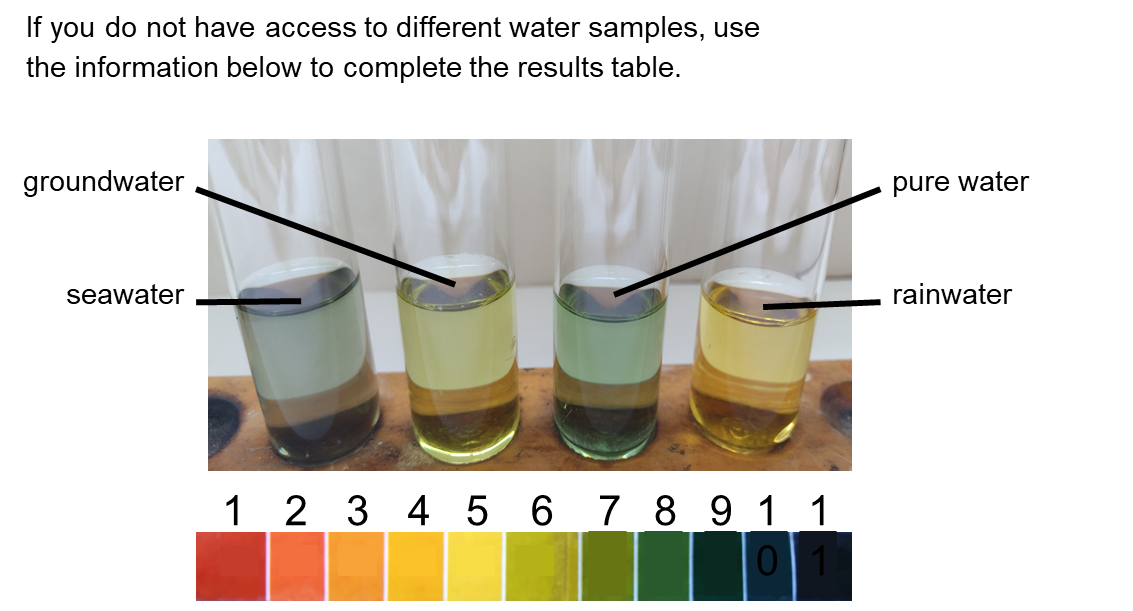
Use the method from above to determine the pH of four water samples.
Record your results in the table below.
What equipment should be used to:
hold the water sample over boiling water?
What equipment should be used to:
measure the mass of the water sample?
What equipment should be used to:
measure the volume of the water sample?
Match each diagram to the appropriate description.
| Draggable item | arrow_right_alt | Corresponding Item |
|---|---|---|
| arrow_right_alt | measure 5 cm3 of water sample | |
| arrow_right_alt | record the mass of the watch glass | |
| arrow_right_alt | remove condensation from watch glass | |
| arrow_right_alt | record the mass of the watch glass and dissolved solids | |
| arrow_right_alt | heat sample until dry |
Order the statements from the last question to create a method for obtaining the dissolved solids from a sample of water.
| Draggable item | arrow_right_alt | Corresponding Item |
|---|---|---|
4 | arrow_right_alt | measure 5 cm3 of water sample |
3 | arrow_right_alt | record the mass of the watch glass |
5 | arrow_right_alt | remove condensation from watch glass |
2 | arrow_right_alt | record the mass of the watch glass and dissolved solids |
1 | arrow_right_alt | heat sample until dry |
Sofia suspects she has a pure water sample and is testing to see if it contains any dissolved substances. What should she expect to observe and why?
Sam used the following method and equipment set-up to see how much dissolved solids are in their garden pond water.
How might Sam’s investigation be improved?
Method
1.Measure 5 cm3 of pond water and pour it onto the watch glass.
2.Heat the pond water until it is dry.
3.Record the mass of the watch glass.
Follow the method from above to obtain any dissolved solids from a water sample.
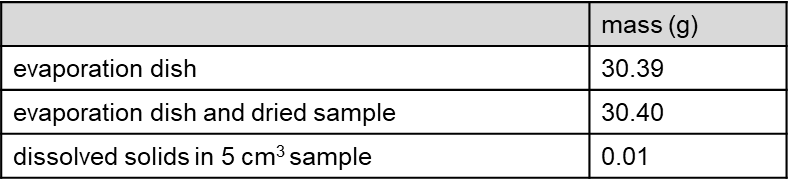
A student’s results are shown in the table below.
What mass of dissolved solids would be in 250 cm3 of the same type of water?
Sofia suspected her water sample was pure and tested to see if it contained any dissolved substances. Here is a table of her results.
Sofia expected to see no dissolved solids in her sample. What may have caused her results?
5 cm3 samples of four different types of water were analysed. The results are in the table below. Put the water samples into order from the most to the least pure.
Tap water - pH 6.9 - Mass of dissolved solids = 0.002g
River Water - pH 7.4 - Mass of dissolved solids = 0.003g
Groundwater - pH 6.3 - Mass of dissolved solids = 0.004g
Seawater - pH 8.1 - Mass of dissolved solids = 0.200g
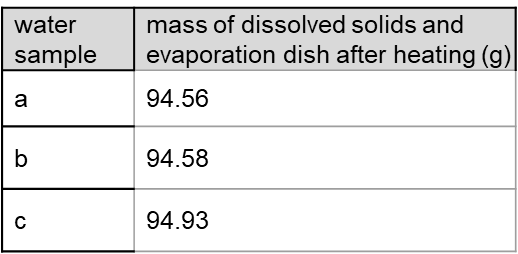
Some students investigated different water samples by heating 10 cm3 of each until dry in an evaporation dish with a mass of 94.56 g. Their results are shown in the table below.
Which sample is pure water? Explain your answer.
Which sample is seawater? Explain your answer.
Complete the diagram to show how you can distill a water sample and collect pure water.
Label the following:
●pure water
●water sample
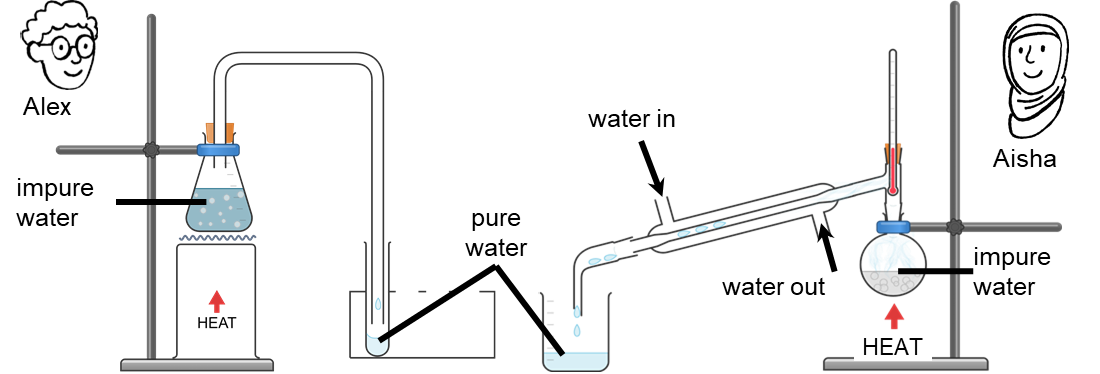
Alex and Aisha used different distillations setups to purify 50 cm3 of impure water. They distilled their samples for the same period of time.
Explain why Alex collected a smaller volume of pure water than Aisha.
Both test the boiling point of the distillate obtained in in the last question
a)What result would you expect if the distillate:
i) is pure?
ii) is impure?
Pure water has a boiling point of
water in the seas and oceans
water in underground streams and rocks
water in underground streams and rocks, rivers, lakes, ice caps and glaciers
used water from homes, industry, and agriculture
water that is fit to drink
water that is 100% water and contains nothing else
Bottled water
Distilled water
Contains microbes and dissolved substances
Contains dissolved substances
Nothing - just water
What chemicals are used to sterilise water?
Tick 3
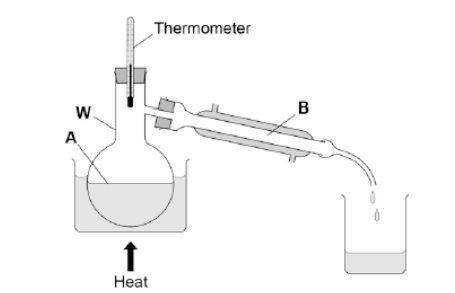
What is apparatus W on above the figure above?
Tick one box
What is the name of this method separation in the question before?
Tick 1 box
(see image above) Name the changes of state taking place at A and B in the figure above.
Use words below.
Change of state at A is
Change of state at B is
What is the pH of pure water
Match types of water to their characteristics.
| Draggable item | arrow_right_alt | Corresponding Item |
|---|---|---|
Potable water | arrow_right_alt | Found below the earth's surface. |
Ground water | arrow_right_alt | Contains no impurities, fully clean. |
Pure water | arrow_right_alt | Safe for drinking and cooking. |
Match steps of making potable water to reasons
| Draggable item | arrow_right_alt | Corresponding Item |
|---|---|---|
sterilising | arrow_right_alt | remove pieces of solid |
desalination | arrow_right_alt | kill microorganisms |
passing water through filter beds | arrow_right_alt | remove dissolved salts |
Desalination can be carried out through distillation. Label the diagram below with the following labels
a. Condenser
b. Thermometer
c. Salty water is boiled
d. 100°C
e. Vapours condense
f. Flask
g. Distilled water
h. Beaker
i. Salty water
j. Steam leaves the flask
Why is desalination only carried out in wealthy countries?
How is waste water treated? Please put these in the correct order
Screen and remove frit and particles
Secondary settling tanks
Primary sedimentation tanks
Treat water
Return to rivers and waterways
Remove effluent and aerate
Which process used in wastewater treatment involves bacteria breaking down organic matter? (Tick 1 correct answer)
Which of the following might lead to wastewater production? (Tick 1 correct answer)
What is grey water? (Tick 1 correct answer)
What is the purpose of sedimentation in wastewater treatment? (Tick 1 correct answer)
What can the anaerobic treatment of sludge produce? (Tick 2 correct answers)
What is the final step involved in wastewater treatment before it is released into the environment? (Tick 1 correct answer)
Please use the words below to fill in the correct boxes to describe the process of phytomining.
Large scale extraction of minerals (metal compounds) from the earth to make metals using traditional mining techniques is only cost effective when there are high concentrations of the mineral in the ground. We call such a mineral, a .
When there are only small amounts of mineral in the ground, called a , then a process called , involving growing plants, is economic to use.
Plants called are grown in soil containing the low grade ore minerals. They absorb the minerals via their and what they don't use is stored and in their leaves. When the plants are big enough, they are in air and the impure metal compound is found in the .
Chemical processes such as and are used to then purify the metal from the ash.
Decide which of these are bioleaching or phytomining
Combustion and displacement reactions involved
This process is made more efficient by controlling conditions such as pH, temperature and humidity
Use active transport to move metal ions from soil into roots
Extracts metals from slag heaps, contaminated ground and low grade ore
Involves bacteria
Some organisms involved use chemosynthesis to produce sugars
This method takes a long time - up to 2 years
Involves plants
Bioleaching
Phytomining
Give a brief description of phytomining
What is the name of the method of extracting metals by growing bacteria on low– grade ores?
Which of the following are advantages of bioleaching? Tick 3 correct answers
Which of the following steps are part of the method for phytomining? Tick 3 correct answers
Which of the following are disadvantages of phytomining? Tick 3 correct answers
Which of the following statements about copper ores are correct? Tick 3 correct answers
How can a metal, such as copper, be extracted from a leachate? Tick 2 correct answers
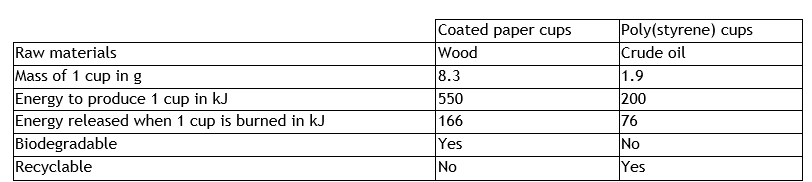
Disposable cups are made from coated paper or poly(styrene). The table below shows information on the life cycle assessments (LCAs) of disposable cups.
Evaluate the use of coated paper compared with poly(styrene) to make disposable cups. Use the table above and your knowledge and understanding of LCAs
Life cycle assessments are used to assess the environmental impact of producing iron nails and glass bottles.
There are four stages, A, B, C and D, in a life cycle assessment.
The stages are not in the correct order.
Stage ADisposalStage BExtracting and processing raw materialsStage CManufacturing and packagingStage DUse and operation
What is the correct order of stages A, B, C, and D?
Life cycle assessments (LCAs) are used to assess the environmental impact of different products.
212 million kilograms of aluminium is used for packaging in the UK each year.
68.0% of aluminium packaging is recycled.
Calculate the mass of aluminium packaging that is recycled in the UK each year.
Mass of aluminium recycled = ____________________ million kg
What is the first step in the life cycle of a product? Tick 1 correct answer
Which of the following can be revealed by a life cycle assessment (LCA)? Tick 1 correct answer
Which of the following can be revealed by a life cycle assessment (LCA)? Tick 1 correct answer
What is one of the main purposes of conducting a life cycle assessment (LCA)? Tick 1 correct answer
What is a potential limitation of using LCAs for decision-making? Tick 1 correct answer
Why is it important to consider vested interests when reviewing the findings of an LCA? Tick 1 correct answer
After being used, clothes can be:
• given to other people to wear
• used to make insulation blocks for buildings.
When clothes are given to other people to wear,
the clothes are .
When clothes are used to make insulation blocks for buildings,
the clothes are .
Use your notes and your own understand to evaluate recycling, as a strategy to dispose of plastics.
What is sacrificial protection?
Which metal is often used to galvanise iron?
Which process involves the use of electricity to prevent corrosion and improve appearance?
Rusting is a specific type of corrosion affecting _______ in the presence of water and oxygen.
Which of the following equations is not involved in the rusting process?
Complete the word equation for the rusting of iron. iron + _________ → (hydrated) iron(Ⅲ) oxide
What is sacrificial protection?
Which metal is often used to galvanise iron?
Which process involves the use of electricity to prevent corrosion and improve appearance?
Rusting is a specific type of corrosion affecting
Complete the word equation for the rusting of iron: iron +
Which of the following equations is not involved in the rusting process?
Match these key terms to the correct definitions
| Draggable item | arrow_right_alt | Corresponding Item |
|---|---|---|
material | arrow_right_alt | materials combined to produce materials with improved properties |
quantitative data | arrow_right_alt | a physical substance that things can be made from |
reinforcement | arrow_right_alt | in composite: substance that binds reinforcement material together |
matrix | arrow_right_alt | information that can be counted or measured, and given numerical value |
composite | arrow_right_alt | in composite: substance bound together by the matrix material |
Soda-lime glass is made from readily available materials. Borosilicate glass requires rarer compounds but its
Considering performance, sustainability or aesthetics can lead to discovery of new materials. Composites are typically more expensive than aluminium. What makes carbon fibre better for aircraft wings? Tick 3 correct answers
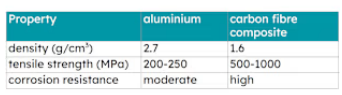
Quantitative data is essential for precise comparisons and decision-making in material selection. Which of the following properties can provide quantitative data for this? Tick 4 correct answers
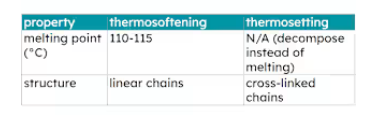
Thermosoftening polymers can be reheated, melted and reshaped multiple times due to their linear chain structure. Thermosetting polymers decompose instead of melting because of their