| Stavka koja se može prevući | arrow_right_alt | Odgovarajuća stavka |
|---|---|---|
Otto von Bismarck | arrow_right_alt | Support for the political independence of a cultural group or ethnicity |
Franco-Prussian War | arrow_right_alt | Haitian revolutionary who led a successful slave revolt against France |
Realpolitik | arrow_right_alt | Prussian Prime Minister who helped to unify Germany |
Simon Bolivar | arrow_right_alt | Politics based on practical needs rather than morality or ideology |
Second Republic | arrow_right_alt | Latin American revolutionary who helped many South American countries revolt away from Spain |
Camilo Cavour | arrow_right_alt | Democratic government est. in France after the overthrow of Louis-Philippe in 1848 |
Nationalism | arrow_right_alt | First president of France; declared himself emperor and ruled until 1870 |
Napoleon III | arrow_right_alt | Embarrassing military defeat for France that led to the creation of a unified Germany |
Toussaint l'Ouverture | arrow_right_alt | Prime Minister of Sardinia-Piedmont that worked to unify Italy |
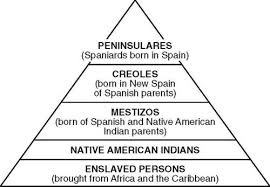
Which of the social classes seen below was responsible for leading Latin American revolutions during the early part of the 1800s?
Which nineteenth century "ism" believes in slow societal change to create strong individual rights?
Which of these policies, originally created by Otto von Bismarck, became a hallmark of German society in the late 1800s?
Which event did Toussaint l'Ouverture influence?
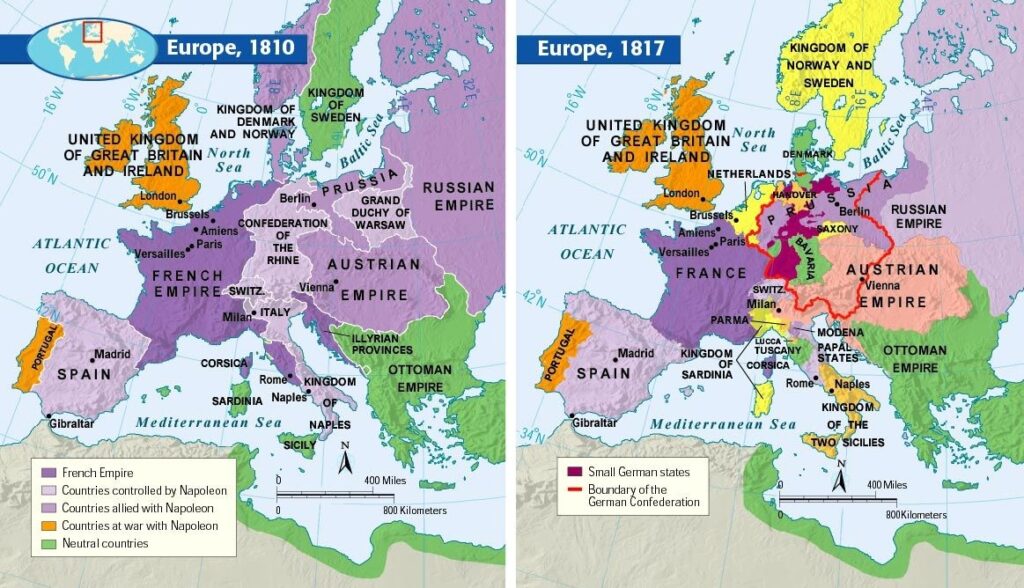
The changes seen in the map below illustrate the success of which philosophy in the early nineteenth century?

Which statement best explains why Giuseppe Garibaldi gave up Naples and Sicily to Victor Emmanuel in 1861?
Which of these factors made Italian unification more difficult?
Which of the following statements best describes why the Revolutions of 1848 failed to create permanent change?
Which of these contributed MOST to the creation of Italian nationalism?
What led to the establishment of Haiti as an independent republic?
Which of the following scenarios best represents the use of realpolitik?
Victory over France in the Franco-Prussian War led to the creation of which state?
Which nineteenth century "ism" called for quick and sweeping change backed by violence?
“Germany does not look to Prussia’s liberalism, but to her power. . . . The great questions of the day are not to be decided by speeches and majority resolutions—that was the mistake of 1848 and 1849—but by blood and iron!”
— Otto von Bismarck, 1862
How does this excerpt from a speech reflect Bismarck’s practice of Realpolitik?
Which of the following social groups would have been most likely to identify as liberal during the 1800s?
“He would march his army across the Andes and attack the Spanish at Bogotá, the capital of the viceroyalty of New Granada (present-day Colombia). First, he cemented an alliance with the hard-riding llañeros, or Venezuelan cowboys. Then, in a grueling campaign, he led an army through swampy lowlands and over the snowcapped Andes. Finally, in August 1819, he swooped down to take Bogotá from the surprised Spanish.”
Which revolutionary leader is discussed in this text?
Choose TWO of the three prompts below. Please respond to your choices in complete thoughts and sentences.
1. Explain the primary difference between conservatism, liberalism, and radicalism.
2. Briefly explain ONE (1) reason why the Revolutions of 1848 fail.
3. Describe how the concept of realpolitik factored into the unification of Germany.