Log in
Sign up for FREE
arrow_back
Library
Mesopotamia Test
By Sara Smith
star
star
star
star
star
Share
share
Last updated 4 months ago
21 questions
Add this activity
Instructions
Required
2
Required
2
Required
2
Required
2
Required
2
Required
2
Required
2
Required
2
Required
2
Required
2
Required
2
Required
2
Required
2
Required
2
Required
2
Read each question and all the answer choices before selecting the best answer.
Question 1
1.
The major cities of ancient Mesopotamia were located…
in the Zagros Mountains
on the Persian Gulf coast
along the Euphrates and Tigris Rivers
in the eastern part of present-day Syria
Question 2
2.
How did the people of Mesopotamia control flooding?
They built irrigation systems and canals to divert floodwaters.
They prayed to the gods of water and weather.
They used advanced weather forecasting to predict flooding.
They built dams and levees along rivers.
Question 3
3.
Which statement describes cuneiform?
an ancient Mesopotamian musical instrument
a system of hieroglyphs used in Egyptian architecture
a form of writing using wedge-shaped characters on clay tablets
a method of constructing arches in architecture
Question 4
4.
Why did the people of Mesopotamia develop calendars?
to track the movements of planets for religious rituals
to organize farming activities and predict flooding seasons
to schedule social events and festivals in the community
to calculate precise distances for trade and navigation purposes
Question 5
5.
What is the Epic of Gilgamesh?
an epic poem telling the adventures of a legendary king
a collection of laws and regulations in Mesopotamia
a religious text describing creation myths in Sumerian culture
a historical record telling about the rise and fall of Babylon
Question 6
6.
What is the importance of Sargon the Great?
Sargon was a renowned architect who built the Hanging Gardens of Babylon.
He introduced the concept of democracy in the ancient world.
He was the first ruler to establish a code of laws.
Sargon created the world’s first known empire.
Question 7
7.
How did a person become a slave in ancient Mesopotamia?
by birth, if born to parents who were slaves
through punishment for serious crimes committed
by being captured in a war
by choice, as a means of paying off debts
Question 8
8.
What evidence proves that Mesopotamians were polytheistic?
their techniques for agriculture and irrigation
the development of the first written language
their advanced knowledge of astronomy and planets
the existence of ziggurats, which were temples dedicated to multiple gods
Question 9
9.
According to Mesopotamians, how were kings chosen?
based on passing rulership from father to son
through elections involving citizens of the city-state.
they believed their kings were appointed by the gods
by proving leadership skills in battles
Question 10
10.
Why was Mesopotamia a good location to settle for farming?
It was separate from other civilizations.
It had fertile soil and access to water.
It had a harsh climate.
It had mineral resources.
Use the Table below to answer questions #11-12.
Required
2
Required
2
zoom_in
Required
2
Required
2
Required
2
Required
2
Question 17
17.
What is one invention from the Sumerians that helped create a change in transportation and farming?
grain
pottery
the wheel
written language
Question 18
18.
Which legal principle states that the same set of rules should apply equally to all citizens?
judicial review
the jury system
constitutionalism
rule of law
Question 19
19.
Who was the ancient Babylonian king who created the earliest known code of laws?
Sargon
Hammurabi
Eannatum
Nebuchadnezzar
Question 20
20.
How did metal plows help to increase Mesopotamian trade with other civilizations?
Farmers could plant faster, helping them plant larger areas and grow extra grain for traders to sell.
Many farmers who had learned metalworking to make plows also made other metal goods for traders to sell.
Farmers could plant faster, so they had more free time to go to markets and buy things.
Farmers who bought plows from traders found their new tools so helpful that they later bought many other goods from traders.
Question 21
21.
Can you identify one Sumerian invention that improved mathematics?
Base 60- number system
Division
Addition
Calculating mean, median and mode
Question 11
11.
How are the four earliest civilizations alike?
They all began in river valleys.
They are all seaports.
They are all on the continent of Asia.
They are all on the continent of Africa.
Question 12
12.
What is the name of the oldest civilization?
China
Egypt
The Indus River Valley
Mesopotamia
Question 13
13.
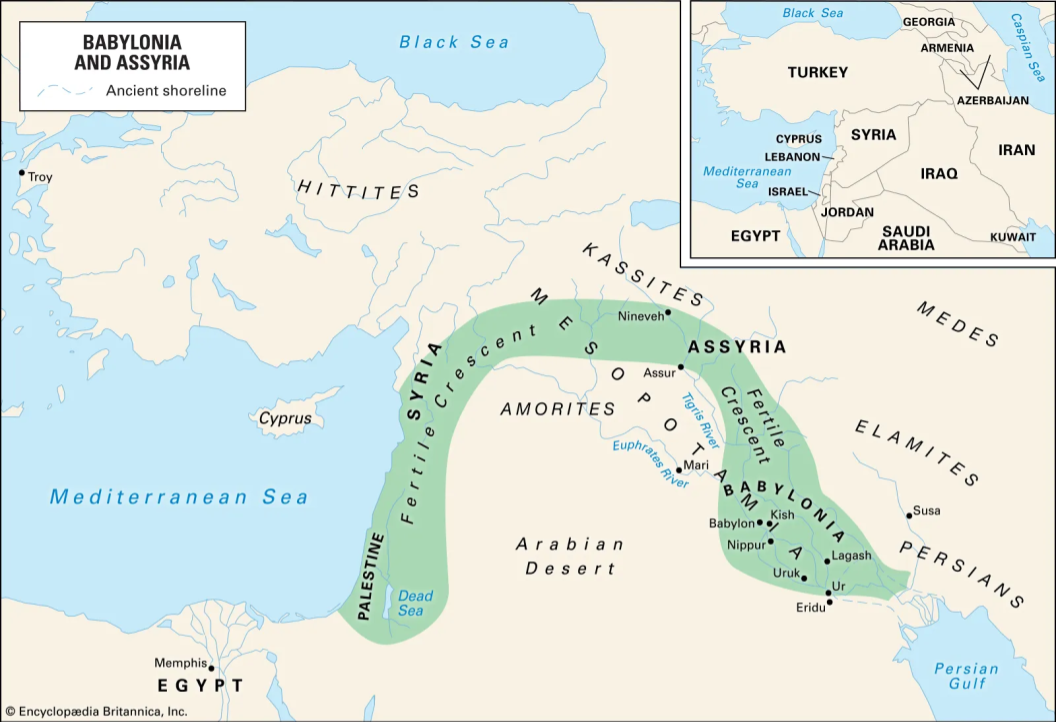
Mesopotamia (Use Map)
named for its fertile soil and curved shape
site of the earliest civilization
one of the earliest known civilizations in ancient Mesopotamia
Sumerian city-states
Question 14
14.
Sumer (Map)
named for its fertile soil and curved shape
site of the earliest civilization
one of the earliest known civilizations in ancient Mesopotamia
Sumerian city-states
Question 15
15.
Ur and Eridu (Use Map)
named for its fertile soil and curved shape
site of the earliest civilization
one of the earliest known civilizations in ancient Mesopotamia
Sumerian city-states
Question 16
16.
Fertile Crescent (use the map)
named for its fertile soil and curved shape
site of the earliest civilization
one of the earliest known civilizations in ancient Mesopotamia
Sumerian city-states