Ɛhia
1
Ɛhia
1
Ɛhia
1
Ɛhia
1
Ɛhia
1
Ɛhia
1
Ɛhia
1
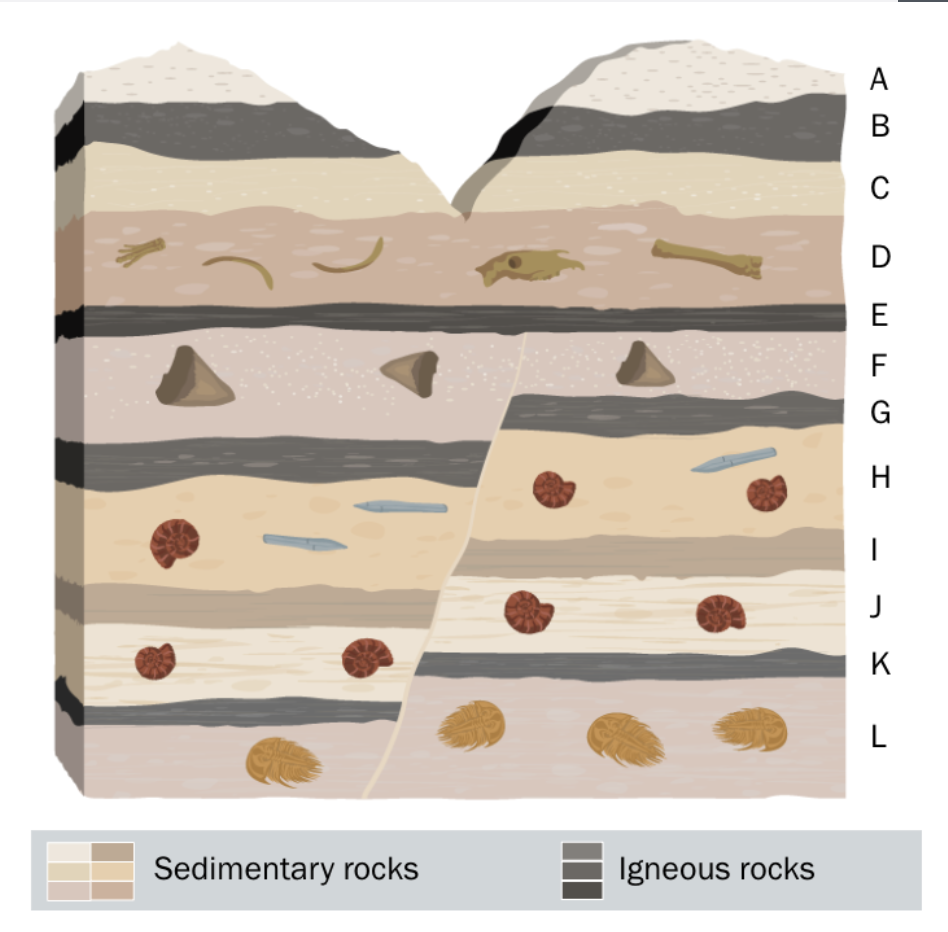
Based on the picture,
circle 1 of the organisms below as “youngest”
circle 1 of the organisms below as “oldest”
the other pictures you can ignore or circle “neither”
| Draggable item | arrow_right_alt | Corresponding Item |
|---|---|---|
Geologic Time Scale | arrow_right_alt | techniques allow us to predict a numerical age or range for past events relatively accurately. |
Igneous Rocks | arrow_right_alt | Technique that relies heavily on looking at the radioactive elements in rocks and the decay that took over time. |
Fossilization | arrow_right_alt | forms when magma cools down and solidifies and is useful for radiometric dating. |
Absolute Dating | arrow_right_alt | is the process by which remains or traces of past life give rise to fossils. |
Radiometric Dating | arrow_right_alt | is a linear representation of the most important events that occurred over a period of time in Earth’s history. |
| Draggable item | arrow_right_alt | Corresponding Item |
|---|---|---|
Principle of Superposition | arrow_right_alt | is a crack or break in the rocks of the Earth’s crust which results in the displacement of the rocks on the opposite sides of the fracture. |
Relative Dating | arrow_right_alt | are fossils that are widespread geographically and can be used as time indicators to match rock layers of the same age. Often, they lived over a large area for a short period of time. |
Fault | arrow_right_alt | The action of geologic processes, such as faults, folds, magma intrusions, or erosion, that move rock layers into different positions. |
Rock Strata | arrow_right_alt | infers that rock layers are ordered on the vertical axis by age; younger rock layers are above ↑ and older rock layers are below ↓. |
Principle of Cross-cutting | arrow_right_alt | Technique that allows us to order events by looking at the oldest vs youngest rock layers. |
Sedimentary Rocks | arrow_right_alt | are horizontal ↔ rock layers originating from the accumulation or compaction of sediments that give rise to sedimentary rocks. |
Index Fossils | arrow_right_alt | forms by compaction of rock fragments or remains of living organisms. Useful for relative dating techniques. |
What kind of rock are the fossils
found in?
Which layer existed after the fault?
To determine the age of the tooth in Layer F, CIRCLE the TWO layers you would use radiometric dating on?
Explain the Law of Superposition. Refer to the picture to help you.
Is organism J older OR younger than organism F? Use the picture to provide evidence to support your claim.
Identify ONE layer that is older than F. Explain how you identified the layer as older based on the picture.
Now identify ONE layer that is younger than F. Explain how you identified the layer as younger based on the picture.