s2w6 Flipped classroom - implications of the doppler effect
star
star
star
star
star
Last updated 3 months ago
11 questions
1 point
1
Question 1
1.
Now that exhibition is over we are going to start putting aspects of light together. so first - some review: below is a list of things we can glean from light from a star. From what you already know, try to match the aspect of a star we can learn
Draggable item
arrow_right_alt
Corresponding Item
distance of the star
arrow_right_alt
pattern of the light tells us the makeup of the outermost layer of the earth
luminosity of the star
arrow_right_alt
whether the star is moving towards or away from the earth
Age of a star
arrow_right_alt
how much light is observed from earth
size of the star
arrow_right_alt
light output of the star based on light observed from earth and calculated distance to the star
doppler shift of the spectral analysis
arrow_right_alt
parallax, speed of doppler shift,
Brightness of the star
arrow_right_alt
uh... we can't really tell that about an individual star. we have theories about stars in general.
the mass of a star
arrow_right_alt
angular diameter, and then calculate the linear measurement with the distance found with parallel. (there are other methods of making more precise measurement as well)
spectral analysis of the light
arrow_right_alt
from measuring the speed of the orbits of the stars planets
1 point
1
Question 2
2.
watch this video which will remind you about the doppler effect
do you have any questions?
1 point
1
Question 3
3.
Hubble noticed that not only were the vast majority of distant galaxies were redshifted, but the further they were the more redshifted they are. He determined this meant
1 point
1
Question 4
4.
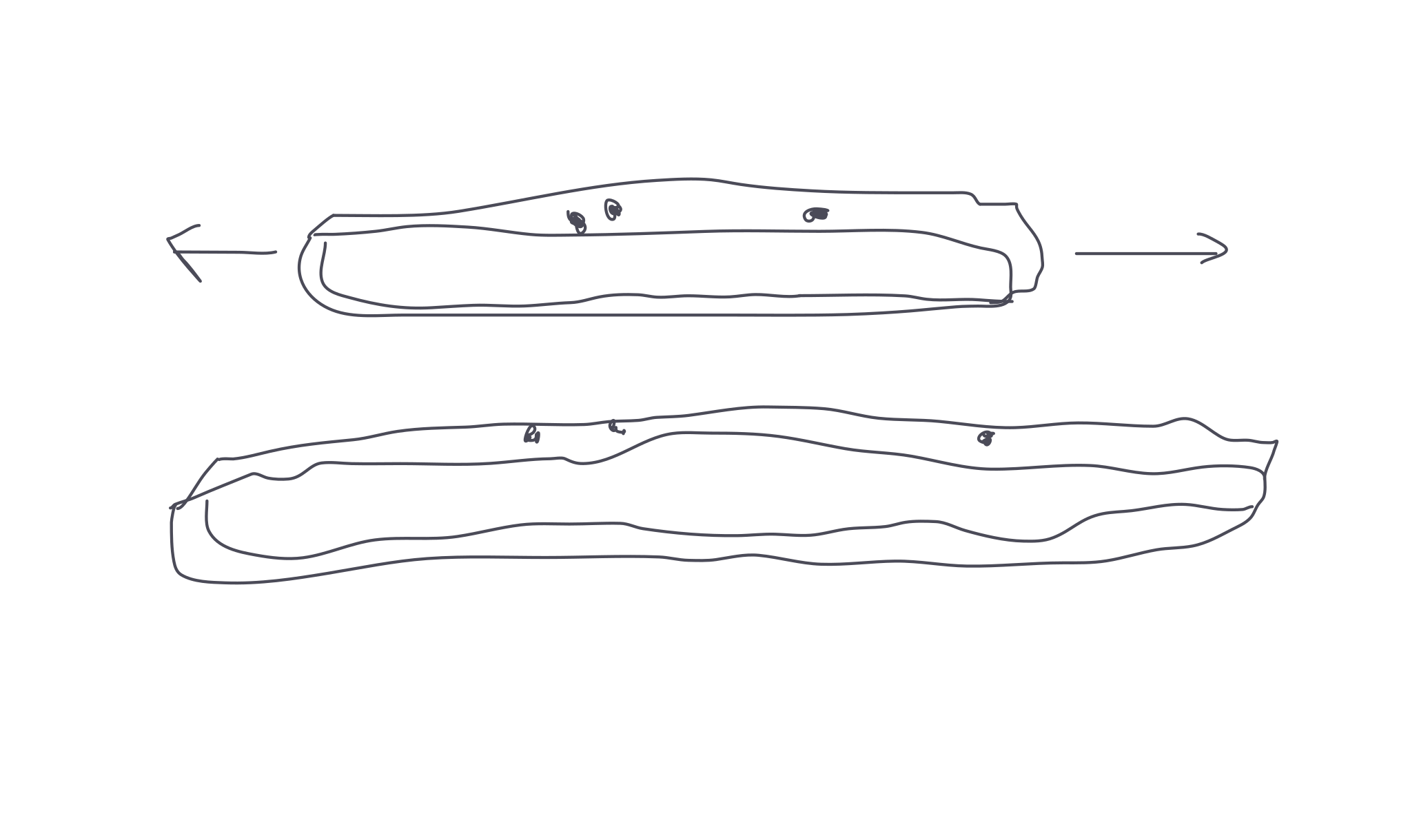
A common misconception about the concept of the expanding universe is that stars and galaxies are moving away from the earth into empty space that surrounds the universe. That is not the theory. Go find a rubber band and make three marks somewhere in the center. make two marks reasonably close together, and another one a little farther away. then stretch the rubber band. which of the following is true?
1 point
1
Question 5
5.
Remember that speed is just measured as change of distance over time, if something moves a larger amount over a set amount of time compared to another moving object, it is moving
1 point
1
Question 6
6.
we have talked about the speed of light as the speed limit of the universe, and there is a lot of fairly complicated math that explains why nothing can move through space at speeds greater than the speed of light. so a couple questions - without doing any research - just using your gut instinct: how would you try to measure the speed of light?
1 point
1
Question 7
7.
Watch the following video. It is pretty long, but I want you focus on the things you do understand, and don't fret too much if you don't understand some of it.
write any questions you have here.
1 point
1
Question 8
8.
What method made the most sense to you?
1 point
1
Question 9
9.
What method made the least sense to you?
1 point
1
Question 10
10.
should we try the american cheese in the microwave method?
1 point
1
Question 11
11.
Come to class ready to discuss one or two of the methods of measuring the speed of light, and discussing the nature of the "speed limit of the universe". One of the things I did want to note is that the speed of light has been measured to be 299,792,458 m/s. The earth moves at 29,780 m/s.
we do not believe the speed of light reaching us is 299,792,458-29,780 when we are moving away from the light source or that it is 299,792,458-29,780 when we are moving towards the light source. be ready to consider why this is.