What would be a good analogy that would help someone picture something that is mostly melted but has a thin solid crust?
1
1
4
4
Question 6
6.
How have lab experiments on rock samples contributed to the understanding of Earth's interior?
4
1
Question 8
8.
How can scientists determine the age of rock samples?
1
1
1
Question 1
1.
Question 3
3.
Question 4
4.
Question 5
5.
The asthenosphere is the part of the _________________ that can . The part of the _________________ that touches the crust is part of the ________________ and is __________
Other Answer Choices:
flow
rigid
lithosphere
upper mantle
crust
Question 7
7.
What purpose do high-temperature and high-pressure experiments serve in studying Earth's interior?
Question 9
9.
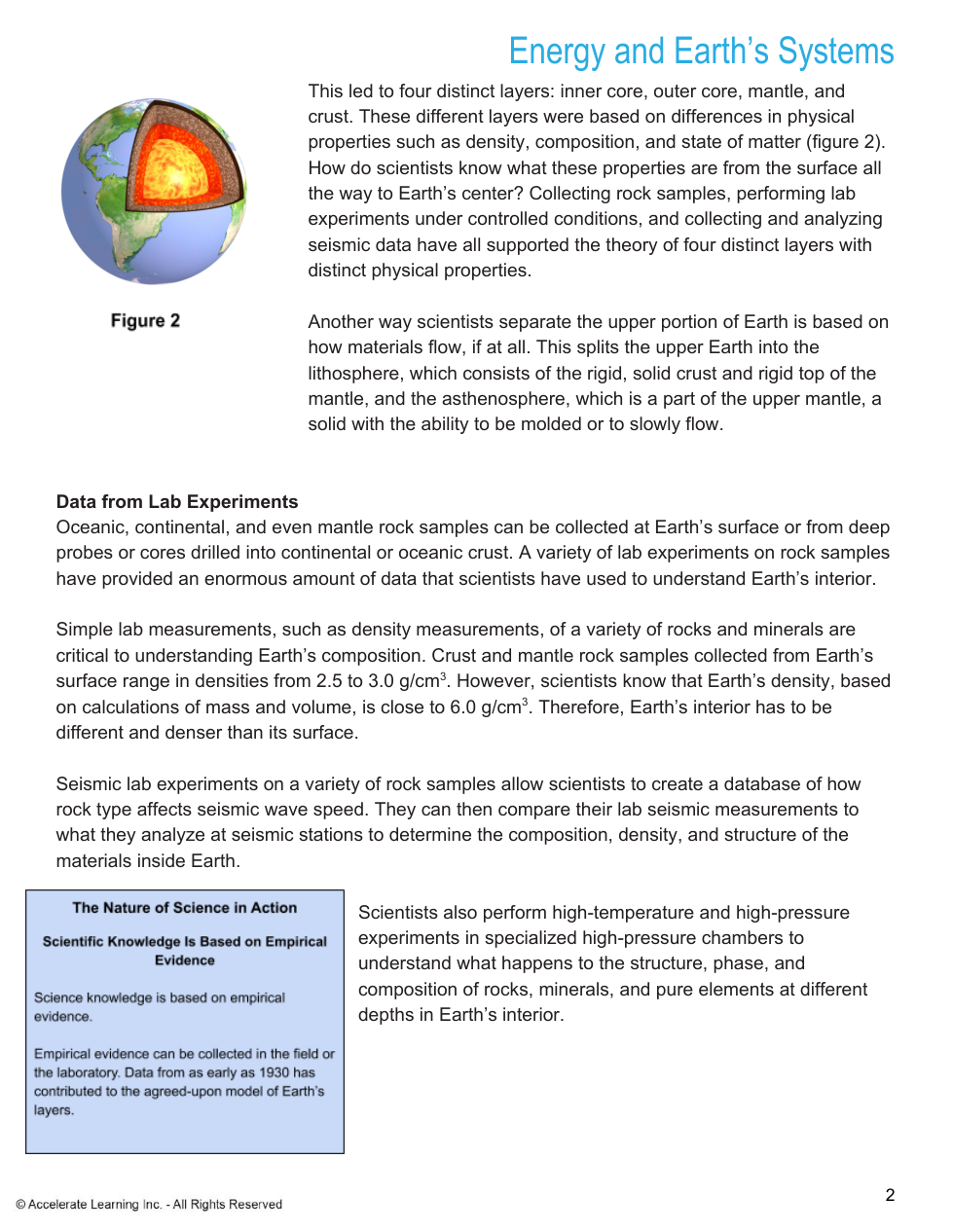
What are seismic waves and how are they generated?
Question 10
10.
Question 11
11.
What processes contributed the energy that helped to melt the interior of the early Earth
collisions with asteroids
forest fires
radioactive decay
solar energy
The interior of the earth is more dense near the core than the crust because
lighter elements like silicon and oxygen form less dense compounds which float
the pull of gravity is equal for different types of elements
heavier elements like iron and nickel tend to form more dense compounds that sink
heavier elements tend to float
Scientists define the layers of the earth based on differences in
density
Whether the rocks are rigid or can flow
distance from the center of the earth
temperature
chemical composition
For each characteristic. click on the type of Seismic wave which best fits it.
P-Wave
S-wave
Arrives first
Moves through all layers of the earth
Can only move through liquid layers
Can travel through the outer boundary
has different speeds in different layers
What does analysis of seismic waves reveal about the interior of the earth.