Log in
Sign up for FREE
arrow_back
Library
CFA 13: WAVES
By Cheryl Collie
star
star
star
star
star
Share
share
Last updated about 1 month ago
9 questions
Add this activity
4
S.8.8
Required
1
S.8.8
Required
1
S.8.8
Required
1
S.8.8
Required
1
S.8.8
Required
1
S.8.8.B
Required
5
S.8.8.B
Required
1
Required
1
Question 1
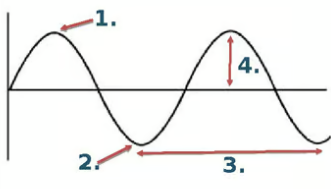
1.
1. __________
2. ___________
3. _______________
4. ______________
Other Answer Choices:
drag_indicator
crest
drag_indicator
wavelength
drag_indicator
midline
drag_indicator
frequency
drag_indicator
top
drag_indicator
trough
drag_indicator
amplitude
Question 2
2.
A wave is....
frequency
large fluctuations in force
a disturbance that carries energy
perpendicular to the direction of the wave
a movement of matter
hertz
Question 3
3.
How does the disturbance move in a transverse wave?
a movement of matter
a disturbance that carries energy
large fluctuations in force
perpendicular to the direction of the wave
frequency
hertz
Question 4
4.
The number of waves that pass a point in a second.
perpendicular to the direction of the wave
a movement of matter
a disturbance that carries energy
hertz
frequency
large fluctuations in force
Question 5
5.
Measures frequency:
hertz
a disturbance that carries energy
frequency
perpendicular to the direction of the wave
a movement of matter
large fluctuations in force
Question 6
6.
As the frequency of a transverse waves increases, the _______________ decreases.
Other Answer Choices:
drag_indicator
direction
drag_indicator
hertz
drag_indicator
crests
drag_indicator
wavelength
Question 7
7.
Low energy & long wavelength__________
High energy & short wavelength __________
Only wavelength we can see__________________
Used for thermal detection _____________
Higher energy than visible light, but lower than X-Ray________________
Other Answer Choices:
drag_indicator
infrared
drag_indicator
TV
drag_indicator
infrablue
drag_indicator
visible light
drag_indicator
gamma
drag_indicator
ultraviolet
drag_indicator
radio
drag_indicator
microwave
Question 8
8.
Describe the difference between a transverse wave and a compressional/longitudinal wave?
Compressional has to have water, transverse has to be perpendicular.
Transverse must be at a 90 degree angle, compressional/longitudinal must have matter
They are both mechanical, however transverse must go up and down (perpendicular), and longitudinal is squeezed or parallel.
They are both mechanical, however longitudinal go up and down, and transverse is in the shape of an S.
Question 9
9.
A wave is traveling at a constant speed. If the frequency of the wave is increased, what must happen to the wave's wavelength?
The wavelength will remain the same.
The wavelength will also increase
The wavelength will increase first, then decrease.
The wavelength will The wavelength will increase first, then decrease.