Copy of 14 Points & the League of Nations Document Analysis cloned 11/11/2021
star
star
star
star
star
Last updated 20 days ago
10 Nsɛmmisa
1
1
Document 1
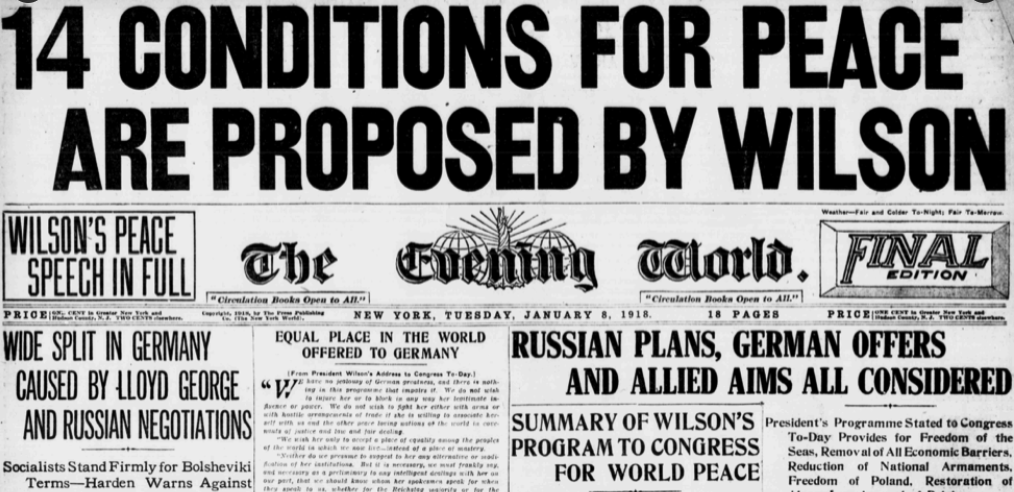
As the war drew to a close, President Woodrow Wilson set forth his plan for a “just peace.” Wilson believed that fundamental flaws in international relations created an unhealthy climate that led inexorably to the World War. His Fourteen Points Plan outlined his vision for a safer world. Wilson called for an end to secret diplomacy, a reduction of armaments, and freedom of the seas. He claimed that reductions to trade barriers, fair adjustment of colonies, and respect for national self-determination would reduce economic and nationalist sentiments that lead to war. Finally, Wilson proposed an international organization comprising representatives of all the world’s nations that would serve as a forum against allowing any conflict to escalate, that organization will be called The League of Nations. Unfortunately, Wilson could not impose his world view on the victorious Allied Powers who wanted to blame and punish Germany for causing the war.
List some of the most important “14 points”.
How did Wilson differ from other world leaders regarding what to do with a defeated Germany? (Corr)
What is The League of Nations (Corr)
Document 2
Most of the decisions made at the Paris Peace Conference were made by the Big Four, consisting of President Wilson of the United States, David Lloyd George of Great Britain, Georges Clemenceau of France, and Vittorio Orlando of Italy. The European leaders were not interested in a fair or just peace. They were interested in retribution [“payback”] and reparations [payment for wrongdoing] to ease the pain of their citizens back home in Europe. Over Wilson’s protests, they ignored the Fourteen Points one by one with the exception of the last one, The League of Nations.
The Result of the Paris Peace Conference is known as the Treaty of Versailles Germany was to admit guilt for the war and pay effectively billions of dollars in reparations. The German military was reduced to a domestic police force and its territory was truncated to benefit the new nations of Eastern Europe. The territories of Alsace and Lorraine were restored to France. German colonies were handed in trusteeship to the victorious Allies. No provisions were made to end secret diplomacy or preserve freedom of the seas. As it was mentioned before, after compromising with some other world leaders attending the peace conference, Wilson did gain approval for his proposal on a League of Nations. Dismayed by the overall results, but hopeful that a strong League could prevent future wars, he returned to present the Treaty of Versailles to the Senate of the U.S. Congress.
What were Great Britain, France, and Italy interested in, and how did that affect Wilson’s 14 Points?
Why the Treaty of Versailles could have a negative impact for Germany?
Document 3
Unfortunately for Wilson, he was met with stiff opposition. The Republican leader of the Senate, Henry Cabot Lodge, was very suspicious of Wilson and his treaty as were many Isolationists.
Article X (10) of the League of Nations required the United States to respect the territorial integrity of member states. Although there was no requirement that would compel the United States to declare war if another country violated any of these principles, the United States might still be bound to impose embargoes or to sever diplomatic relations with the guilty party. Either way, the chance to remain neutral or uninvolved in future conflicts would be taken away. Lodge viewed the League as a supranational government that would take away American sovereignty [control] - meaning it would limit the power of the US government from determining its own affairs. Others believed the League was the sort of entangling alliance the United States had avoided since George Washington’s Farewell. The Senate declared the United States exempt from Article X. In the end, the United States Senate did not approve the Treaty of Versailles because of its article X, and America was excluded from the peace treaty
What did Article X require from the US? Explain, using your own words
Why did the US Senate oppose Article X? (in your own words)
Why the U.S. did NOT join the League of Nations? Explain in a few sentences. (Corr)
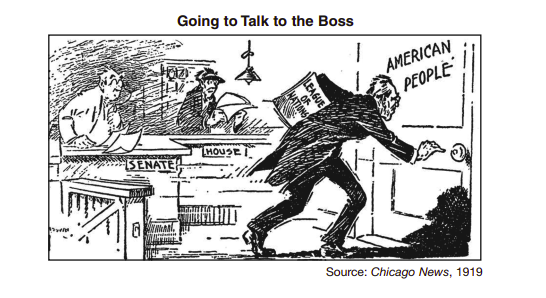
Why did the United States Senate fail to ratify the Treaty of Versailles nor join the League of Nations in 1919?
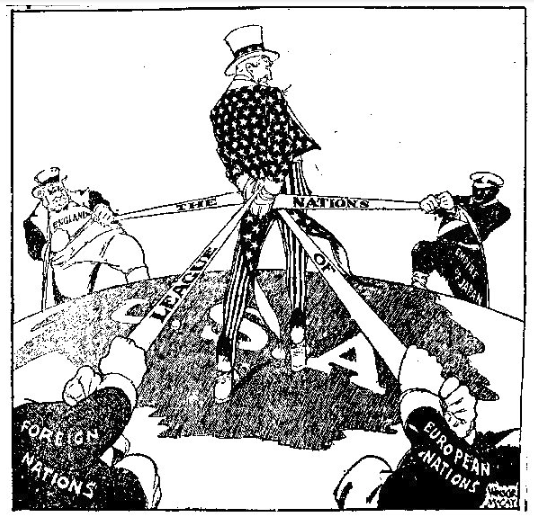
What was the point of view expressed in the cartoon about the United States joining the League of Nations?