Please answer all questions
Carbon is considered to be an element because:
The total number of electrons in a positive, doubly-charged ion of an element with atomic number 12 is:
Which of the following correctly defines the mass number of a given atom?
Which of the following in the list below displays all physical changes?
Consider the following observations and state what TYPE of chemical reaction is involved.
A student added hydrochloric acid to a test tube containing sodium hydroxide at a pH of 9. She noticed that the pH of the solution changed to 7 when the sodium hydroxide was added.
Consider the following observations and state what TYPE of chemical reaction is involved.
A student added some copper sulphate solution to a test tube containing a nail. After sitting for 5 minutes he noticed that the nail had a brown coating and that the solution appeared to be paler in colour.
Which of the following statements regarding atomic particles is false?
Refer to the diagram above. This ion contains:
The electron configuration for Al^3+is:
How many ‘p’ orbitals are to be found in any given shell?
A neutral atom of silver has the atomic number (Z) = 47 and mass number (A)= 107. Examine the information below and decide which alternative correctly shows the numbers of protons, electrons and neutrons for the silver atom.
P= protons, E= electrons, N= neutrons
Atoms of the same element which have the same number of protons but a different number of neutrons are known as:
The electron configuration: 2, 8, 4 is that of:
An element has the following ground state electron configuration:
1s2 2s2 2p5
How many ‘valence’ electrons does this atom have?
The ground state electron configuration for nitrogen is:
‘d – block’ elements are found in:
Which one of the following is the most important factor that determines the chemical properties of an element?
An element has the following ground state electron configuration:
1s2 2s2 2p6 3s2 3p6 4s2
Based on this information, the element would most likely belong to which group in the periodic table?
The properties of the elements that change across a period in the periodic table are
I: electronegativity
II: number of electrons in the outer shell
III: metallic character.
Moving across period 3 from sodium to chlorine, which of these properties increase?
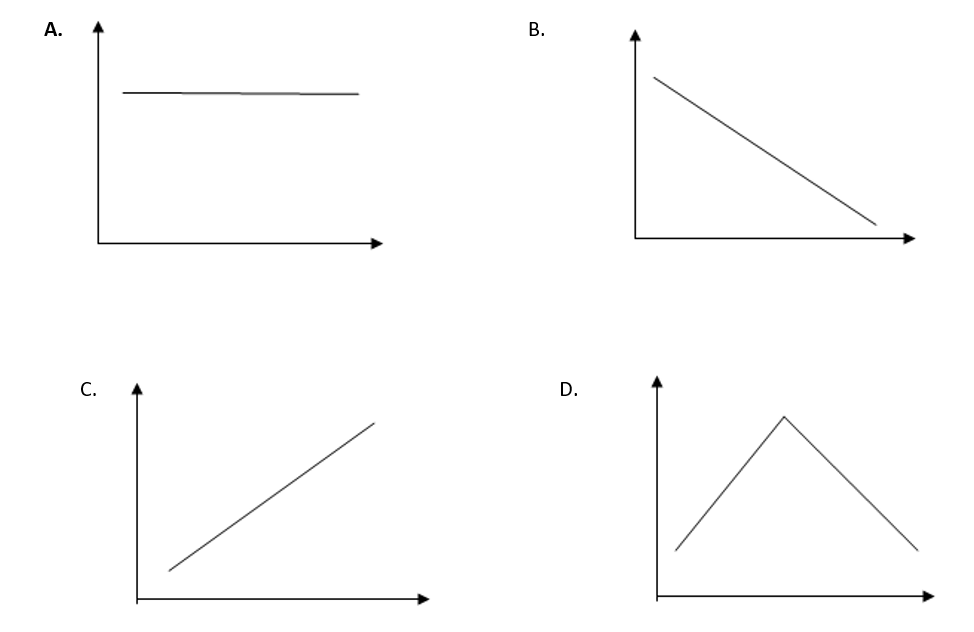
Refer to the diagram above.
The following graphs show trends with increasing atomic number in atomic properties across period 2. Which graph best represents the trend in the electronegativity of each element?
Balance the following equation:
Draw the electron dot configuration for Silicon.
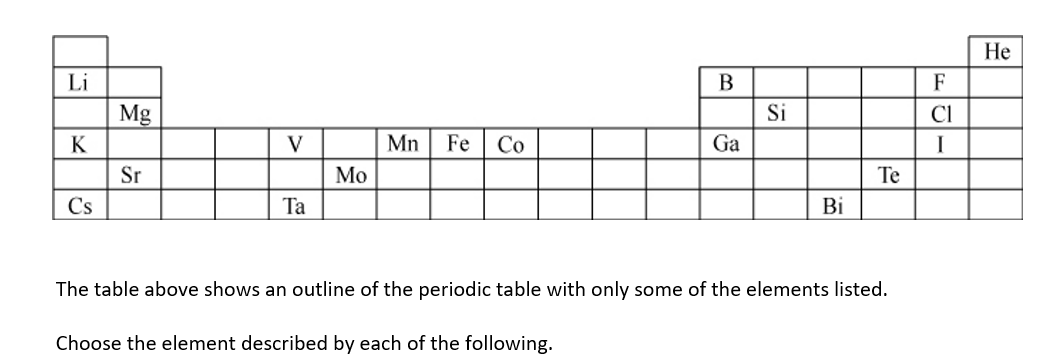
Refer to the above table.
Choose the element described by each of the following.
(Each element can be selected only once.)