AKS 34c - Cotton Gin & Railroads Transform Georgia
star
star
star
star
star
Last updated about 1 year ago
37 questions
How Did the Cotton Gin Shape Georgia's Economy?
Cotton has always played an important role in both the history and economy of Georgia. By 1820, Georgia was the world's leading producer of cotton. On the eve of the Civil War in 1861, cotton exports from the southern United States were twice that of the rest of the world. Cotton was indeed "king." But that had not always been the case.
In 1790, the only profitable cotton grown in the United States was the long-staple variety grown on the Sea Islands off the coasts of South Carolina and Georgia. Sea Island cotton produced a long, strong fiber that was easily separated from the seed. But Sea Island cotton could only be grown along the coast. Short-staple cotton grew inland, but its fibers covered the entire seed,making it difficult to separate. Short-staple cotton could only be separated by hand, which was slow and inefficient.
Most Georgians at the beginning of the nineteenth century lived in or near the cities of Savannah and Augusta, along the Savannah River. With populations growing, farmers began moving westward, drawn to the rich soil of interior Georgia. However, cotton was still too labor-intensive to be profitable. With Georgia's tobacco industry in decline, a new technology was desperately needed for short staple cotton to flourish.
The new technology came from an unlikely source. Eli Whitney was born in Massachusetts in 1765. His father was a farmer with a small manufacturing business on the side. In this shop, Eli learned mechanics. By age 14, he ran a profitable nail-manufacturing business.
In 1793, ten years after the Revolutionary War, Whitney left the North and set sail to work as a tutor on a plantation in South Carolina. There, he saw cotton growing for the first time and devoted himself to finding a way to gin the fibers. In a letter to his father, he wrote that "if a machine could be invented which would clean the cotton with expedition, it would be a great thing both to the country and the inventor."
Whitney's cotton gin was simple. Wire hooks attached to a cylinder pulled cotton through a mesh screen. Because the seeds could not pass through the filter, the fibers were easily separated. His device allowed a person to "clean" fifty pounds of cotton per day rather than just one pound. Growing cotton was still labor-intensive, but the labor shifted from ginning to growing and picking cotton.
Eli Whitney never made much money from his cotton gin. Its simple design made it easy to copy. Between 1794 and 1803, nine patents for improvements to the gin were granted to people other than Whitney. In 1812, Whitney's own application for renewal of his cotton gin patent was denied by the US government.
Throughout history, inventions and new technologies have changed the way humans live. Perhaps no other development affected life in the United States more than the cotton gin. Its impact was far-reaching. This assignment asks you to examine the economic effects of the cotton gin and answer the question, How did the cotton gin shape Georgia s economy?
Required
1
What state was the world’s leading cotton producer in 1820?
Required
1
Where did most Georgians live at the beginning of the 1800s?
Required
1
Why was short-staple cotton so difficult to process?
Required
1
How did Eli Whitney’s childhood influence his development of the cotton gin?
Required
1
Why did the cotton gin encourage people to grow cotton across the South?
Cotton Explosion
Within a year of Whitney’s invention, the South’s cotton exports increased more than 1,000 percent. With the money that cotton brought in, Southerners could buy manufactured goods from Northern cities and food from western farmers. Merchants in the North also benefitted. They earned big profits buying Southern cotton and shipping it to England, where they sold it to manufacturers. By the 1840s, more than half of the 900 million pounds of cotton the South produced went to Britain.
The effects of the cotton gin were evident in Georgia. Cotton plantations spread in to the Piedmont region, where short-staple cotton grew best, and the population of the lower Piedmont increased. The strip of land across the middle of the state became known as the :Black Belt" because of its rich, dark soil. As you have learned, this land belonged to the Creek Nation. The lure of the Black Belt increased the demands by Georgia’s farmers for their removal.
Farmers began growing short-staple cotton throughout the entire state, while tobacco, wheat, and corn production declined. Georgia’s frontier was transformed from a region of small farms with just a few slaves to one with large cotton plantations and thousands of slaves . Many of the farmers moving into the upcountry became as wealthy as those in the low country. By1826,Georgiawas the world’s leading cotton producer, and cotton was “king” of the state’s economy.
Required
1
What significant effect did the cotton gin have on Georgia's economy?
Required
1
What happened to tobacco, wheat, and corn production after the cotton gin invention?
Required
1
What was the Black Belt?
Required
1
Why did the population of the lower Piedmont region in Georgia increase?
Required
1
What was a consequence of the increased profitability of cotton?
The Empire State of the South
Since cotton was so profitable, there was little motivation to invest in other businesses. Some Georgians tried to introduce industry in order to keep the economy balanced. They reasoned that if cotton failed, the state would have nothing else to rely on. Not surprisingly, most of the new industries were directly related to cotton production. Plantation owners sometimes built cotton mills next to their fields. The mills brought a profitable textile industry to the plantation. Factories also spread to the many river towns of Georgia. Textile factories flourished in Athens, Macon, Columbus, Thomaston, and Augusta. By 1860, Georgia led the South in textile production. Out of approximately 2,800 textile workers in the state, 1,600 were women. While the number of factories and workers was quite small when compared to Northern states, Georgia was often called the “New England of the South” and the “Empire State of the South.”
The Emergence of the Railroad
The need to transport cotton in Georgia led to the increased desire for a better way to do so. Following Clay’s American System, Georgia’s General Assembly set aside $500,000 to improve roads and canals. The canals were never built because people thought the rivers would provide sufficient transportation, but the rivers in Georgia were not deep enough for steamboats to navigate. The state turned to railroads instead. In 1832, Georgia’s first railroad was chartered to transport cotton from Athens to Augusta. The Georgia Railroad Company began laying track that year. The Central of Georgia Railroad Company built a different line that linked Savannah to Macon. From there, the Monroe Railroad Company built a line to Forsyth. The success of these railroad lines in rapidly moving cotton throughout the state spurred the production of new lines.
Georgia’s leaders decided they needed a line to connect the northwestern part of the state with the Tennessee River in Chattanooga. Soon Georgia had more railroad miles than any other state in the Deep South. A new city called Atlanta would become the epicenter
Atlanta’s Rise
Perhaps the most important railroad line was built by the Western & Atlantic Railroad Company. It connected Chattanooga to a small hub called Terminus, which was at the end of that line. Two other lines were built from other parts of the state to Terminus, which changed its name to Marthasville in 1843, after the daughter of Governor Wilson Lumpkin. In 1845, Marthasville was renamed Atlanta.
Atlanta grew rapidly because of the railroad lines that intersected it. Its importance as a railroad town made it the first major city in the United States built where there was no navigable river. Although Milledgeville remained the state capital, Atlanta rose in prominence. It would become the state capital in 1868.
Required
1
What motivated the introduction of industry in Georgia during the antebellum period?
Required
1
Why did Georgia turn to railroads for transportation?
Required
1
What city became the epicenter of the railway network in Georgia?
Required
1
What was one of the earlier names of the city now known as Atlanta?
Required
1
What is the connection between the invention of the cotton gin and the expansion of railroads in Georgia?

Required
1
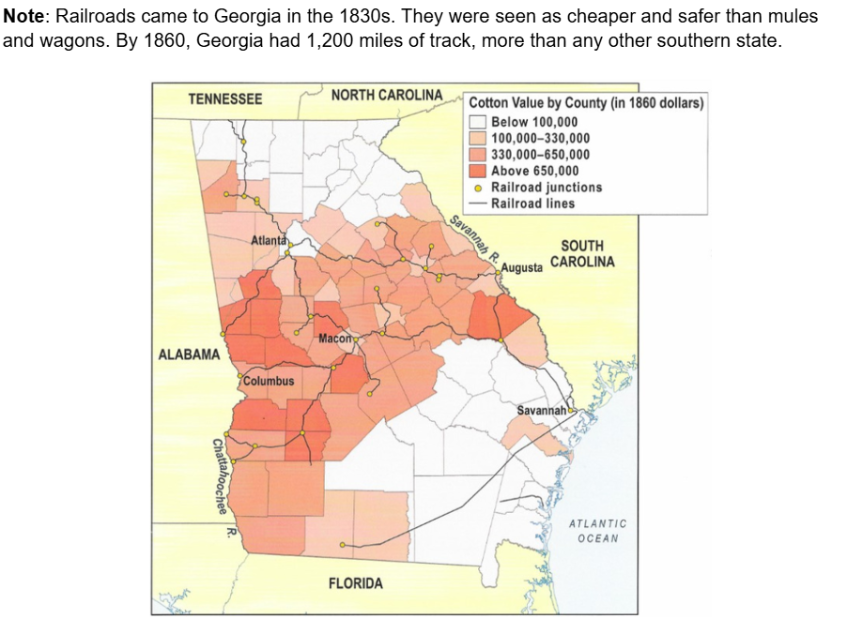
North, central, or south: Which region of Georgia had the highest cotton production in 1860?
Required
1
Which region of Georgia had the most railroad track?
Required
1
What probably explains why central Georgia had the most railroad track?
Required
1
How might Savannah have benefited from cotton production?
Slavery Expands
Planters did not have enough workers to plant and pick cotton fast enough. The demand for cotton had created a demand for farm labor. To keep their costs down and their profits up, planters used the unpaid labor of enslaved Africans. They saw this as key to maximizing their profits. As the cotton fields expanded, so did the enslaved population. By 1860, enslaved Africans comprised 44 percent of Georgia’s population. The total number that year was more than any other state in the lower South.
All of this planting exhausted the soil. When the land was no longer fertile, some planters moved west, taking their slaves with them. As a result, slavery expanded across the South. The demand for enslaved Africans and the spread of wealth brought upcountry and low country whites closer together on matters of politics. Soon, most of the men who held seats in the state legislature were slaveholders.
Slaveholding translated into not only wealth, but status and power. As cotton became the center of Georgia’s economy, planters became dependent on enslaved labor. The system only worked if enslaved blacks were part of it, so it became more important for planters to make sure slavery was here to stay. They passed stricter laws to keep the system in place, and they began to defend the enslavement of humans in new ways. For the enslaved, life just got harder. Northern textile mills also depended on slavery. How could they keep producing without a steady supply of cotton from the South? Manufacturers were able to buy cotton at a low cost because planters did not have to pay for labor.
Slavery grew tremendously, and Georgia had more slaveholders and more slaves than any other state in the Deep South. However, most white people in Georgia (about two-thirds) did not own any slaves. The elite whites who ran enormous plantations with hundreds of slaves were a minority of the state’s overall population. In 1860, fewer than one-third of the state’s adult white males owned slaves—and most of them owned fewer than 20. Nevertheless, in certain regions, enslaved blacks outnumbered whites.
Required
1
What ultimately led to the expansion of slavery in Georgia?
Required
1
Why did slaveholders in Georgia see slavery as essential?
Required
1
By 1860, what percentage of Georgia's population was made up of enslaved Africans?
Required
1
Why did northern textile mills rely on slavery?
The Following Resource was written by Charles Ball, who was born into slavery in Maryland sometime around 1780. In 1806, Ball was given as a wedding present to his owner's daughter and forced to relocate to a new plantation in Georgia. This passage from his autobiography describes his introduction to slavery in Georgia.
Source: Charles Ball, Fifty Years in Chains; or, The Life of an American Slave, 1860.
"The landlord assured my master that at this time slaves were much in demand, both in Columbia and Augusta; that purchasers were numerous and prices good; ... Cotton, he said, had not been higher for many years, and ... prime hands were in high demand, for the purpose of clearing the land in the new country - that the boys and girls, under twenty, would bring almost any price at present. ... My master said he would ... sell a portion of us in Carolina, but seemed to be of opinion that his prime hands would bring him more money in Georgia, and named me, in particular, as one who would be worth, at least, a thousand dollars .... I therefore concluded, that ... I was likely to become the property of a Georgian, which turned out in the end to be the case."
Required
1
Who was Charles Ball? What happened to him in 1806?
Required
1
According to Ball, why were slaves in high demand in Georgia?
Required
1
Which slaves brought the highest prices at market?
Required
1
Why do you think younger slaves were more desirable?

Required
1
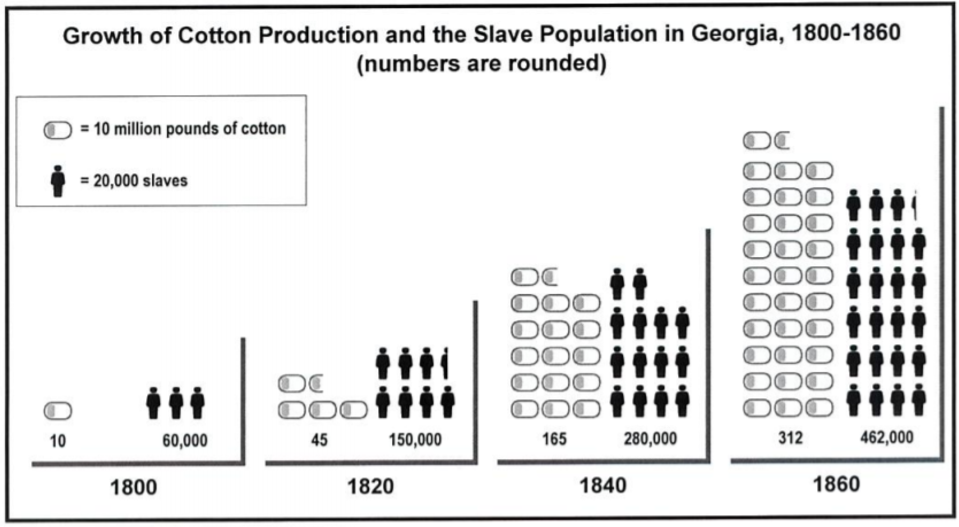
How much cotton was produced in Georgia in 1800? In 1860?
Required
1
What was Georgia's slave population in 1800?
Required
1
What was Georgia's slave population in 1860?
Required
1
What generalizations can be made regarding cotton production and the slave population in Georgia?
Required
1
How does this document help explain how the cotton gin caused the expansion of slavery?

Required
1
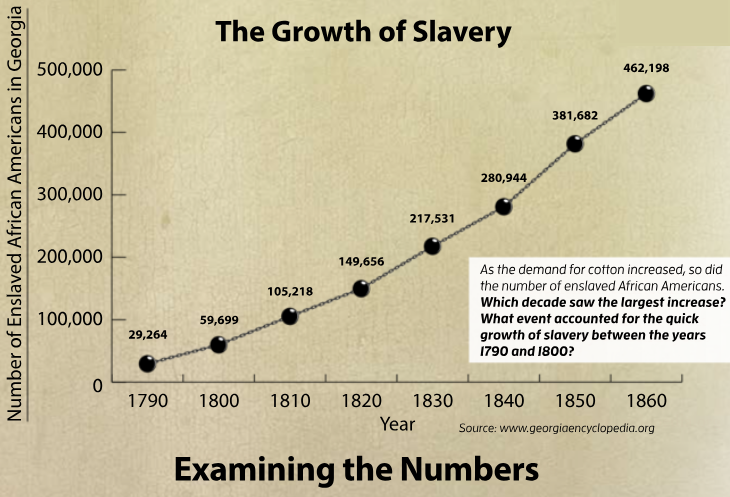
Which decade saw the largest increase?
Required
1
Which event do you think accounted for the quick growth of slavery between the years 1790 and 1800?
1
What major impact did the cotton industry have on the economy of the United States?
1
Which area of the United States was primarily associated with the cotton industry?
1
By the start of the Civil War, what percentage of the global cotton supply did the United States provide?