Ɛhia
1
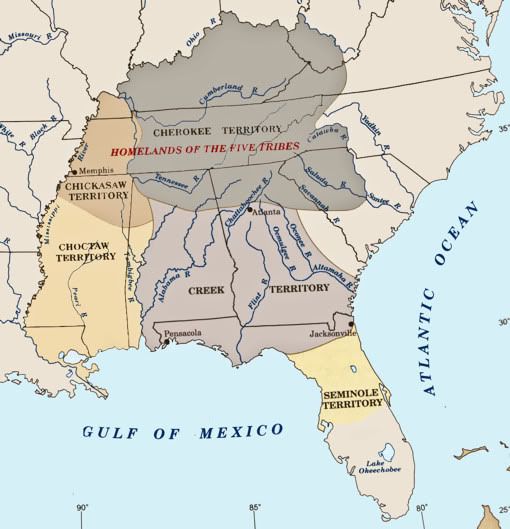
List the 5 Tribes listed on the map.
List the 5 Tribes listed on the map.
Ɛhia
1
Ɛhia
1
Ɛhia
1
Ɛhia
1
The city of Atlanta was in what was once
List the 5 Tribes listed on the map.
The city of Atlanta was in what was once
The Creek Indians had once settled on a large part of Georgia lands. They were the most prevalent group of Indians living in Georgia. During the colonial period, Creeks traded with the colony, and some colonist intermarried with the Creeks. Relations were good between Georgia colonists and Creeks. Some Creeks took on lifestyles of the white settlers changing from their traditional lifestyle, while others kept to the Creek traditions.
During the Revolutionary War, Creeks sided with the English. This strained the relationship between the Georgians and the Creek Indians. The war cost the Creek Indians some of their lands. Georgians wanted more of their lands, primarily to grow cotton on. Many Creek Indians felt they should fight for their land. Others felt they should negotiate with the white man while they were still willing to pay for that land.
William McIntosh was one of the leading spokesmen for the Creek during the early 1800s. He headed the group of warriors appointed by the Creek National Council known as “Law Menders.” These warriors were responsible for apprehending and punishing by beatings, ear cropping, or execution of those who had committed crimes against Americans.
The actions of McIntosh and his Law Menders in executing a number of Upper Creek warriors responsible for murders and robberies along the Tennessee border directly led to a rebellion by many Creeks against the Creek government. That civil war quickly became an American-Creek war after the rebellious Creeks, known as Red Sticks, attacked the hastily constructed Fort Mims in the Mississippi Territory.
During the Creek War, McIntosh was appointed as major of a regiment of Creek Indians who fought alongside American forces against Red Stick Creeks. He later fought with the United States during the First Seminole War.
After the Creek war, McIntosh rose to the prominent role in the National Council as a Chief and became one of the most powerful and wealthy Creeks of his generation. He owned a sizeable plantation and inn operated by slave labor, as well as other business operations.
McIntosh's prestige as a high-ranking member of the Creeks was enhanced by his American father's relationship and family connections to George McIntosh Troup, who served as the governor of Georgia from 1823 to 1827. During Troup’s term, McIntosh signed the unauthorized Treaty of Indian Springs (1825) which surrendered all Creek lands in Georgia as well as substantial property in Alabama.
The Treaty of Indian Springs provided for the cession of virtually all Creek land remaining in the state of Georgia in exchange for a payment of $200,000. A controversial article in the treaty provided additional payment to McIntosh for the lands granted to him in the treaty. McIntosh's motives have since been debated. His supporters suggest that he acted realistically, believing that the Georgians' relentless demand for Creek land made its loss unavoidable.
Whatever his motivations were, McIntosh's participation in the 1825 Treaty of Indian Springs cost him his life. According to a Creek law that McIntosh himself had supported, a sentence of execution awaited any Creek leader who ceded land to the United States without the full assent of the entire Creek Nation. Just before dawn on April 30, 1825, Upper Creek chief Menawa, accompanied by 200 Creek warriors, attacked McIntosh at his inn to carry out the sentence. They set fire to his home, and shot and stabbed McIntosh to death.
Which two tribes existed in Georgia?
What region in Georgia was part of Cherokee Territory?
What region in Georgia was part of Creek Territory?
Who were the most prevalent group of Indians living in Georgia?
What event changed the relationship between the Georgians and the Creek Indians?
What did some Creeks adapt from the white settlers in Georgia?
What caused the Creeks to lose some of their lands in Georgia?
Creek felt pressured by Georgians to leave their land. Describe the TWO views of the Creek Nation. (1:36)
What was William McIntosh's view about Creek lands? (1:57)
Describe the Treaty of Indian Springs signed by William McIntosh and its impact on the Creek. (2:26)
What Creek law did McIntosh break? (3:12)
Put the events in order. (Earliest event at the top)
Creek civil war begins due to actions of McIntosh
George McIntosh Troup becomes governor
McIntosh becomes leader of the “Law Menders”
McIntosh becomes leader in Creek War fighting against the Red Sticks
William McIntosh executed by other Creek leaders
Treaty of Indian Springs Signed
What role did William McIntosh play in the Creek tribe during the Creek-American war?
What were the responsibilities of the Law Menders?
What actions of William McIntosh led to his execution?
What did the unauthorized Treaty of Indian Springs represent?