Digital Inquiry - Day & Night

Last updated 7 months ago
7 questions

TIME-LAPSE PHOTO: MORNING TO NIGHT

Watch the 1 minute time-lapse photo below that shows how the sun seems to move across the sky.

1

What did you observe from the time-lapse video?

TEXT: SPIN ME AROUND


The Sun comes up. The Sun rises in the sky. Wrong! That’s not how the Sun works. We know that people say the Sun moves or rises. It looks like it does, but why is that wrong?

The Sun is not moving across our sky; the Earth is spinning. Hold up two fists. Let the Sun be your
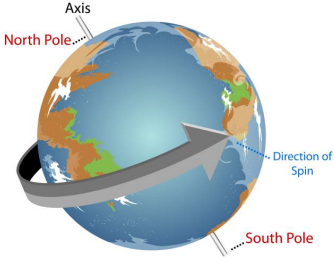
left fist. It stays put. Now spin your right fist as much as your wrist allows. If you are the right thumb, you can see how the Sun appears to the thumb-you and then is out of sight as you are on the other side of your spinning fist-Earth. This spin is called rotation.

The direction of the spin can be modeled by first letting your right-fist-Earth be with the back of your hand facing you. Then spin it so that the fingers are facing you. That’s the direction.

The Sun appears in your sky as the side of the Earth you are on faces the Sun. It’s daytime. When the rotating Earth takes you away from facing the Sun, it’s night.
1

How does the Earth’s movement affect the appearance of the Sun across the sky?
VIDEO: DAY & NIGHT


WATCH
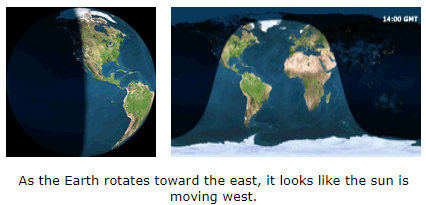
Earth rotates (spins) on its axis one complete time every 24 hours. As Earth rotates, the sun appears to move across the sky.

1

What is it like for the half of Earth facing the Sun? What is it like for the half of Earth turned away from the Sun?

VIDEO: EARTH'S ROTATION & REVOLUTION

How does Earth move?

Click the link to watch an 8-minute video about Earth’s movements.

Revolution and Rotation of the Earth
Earth takes 365 days to complete one revolution around the Sun. The Earth also rotates at its own axis. Days and nights occur due to Earth's rotation. We have seasons due to tilt in the Earth's axis. Watch this video to find out how days, nights and different seasons occur on Earth.
1

What happens because of Earth’s rotation on its axis?

Q&A: WHAY DOES THE SUN "RISE" AND "SET"?

Because Earth rotates counterclockwise, the sun appears to rise in the East and set in the West.

Why Does the Sun "Rise" and "Set"?

Exploring the Earth's Daily Cycle

Here's what scientists say about "sunrise" and "sunset":

The sun stays in its position at the center of our solar system. It doesn't rise and set. But it appears to rise and set because of the Earth's rotation on its axis. It makes one complete turn every 24 hours. It turns toward the east.


As the Earth rotates, different locations on Earth pass through the sun's light. The animation shows how that looks hour by hour (for 4 hours). As your town turns toward the sun and begins to enter its light, the sun seems to rise in the east. As your town begins to leave the sun's light and enter darkness, it appears to set in the west.

Try this! Shine a flashlight on the side of a ball and rotate the ball counterclockwise. (You can figure out which way to turn it by looking down on the ball from above and thinking of a clock face.) Watch what happens to the light and dark areas as the ball turns. This is what happens on the earth as it rotates toward the east (counterclockwise).
1

From what direction does the Sun seem to rise?

1

From what direction does the Sun seem to set?

8
The sun appears to move across the sky because Earth ____________ on its axis each day. The Sun seems to rise in the _________ and set in the _________.
When the side of Earth you are on is facing the Sun, you are experiencing ______________________. When the side of Earth you are on is turned away from the Sun, you are experiencing __________ .
As the Earth rotates on its _________ , the sun appears to move across the sky from ____________ in the East to ___________ in the West.
Other Answer Choices:
sunrise
sunset
West
East
day
rotates
night
axis