Log in
Sign up for FREE
arrow_back
Library

NAFCS Q2 Geometry Benchmark 24-25 (11/21/2024)

star
star
star
star
star
Last updated over 1 year ago
16 questions
1
G.T.1
1
G.T.1
1
G.T.1
2
G.T.1
1
G.T.2
1
G.T.2
3
G.T.2
2
G.T.4
G.T.5
1
G.T.4
G.T.5
1
G.T.4
G.T.5
1
G.T.4
G.T.5
1
G.T.6
1
G.T.6
1
G.T.6
1
G.T.6
1
G.T.6
Question 1
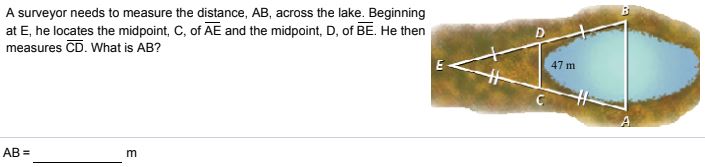
1.

Question 2
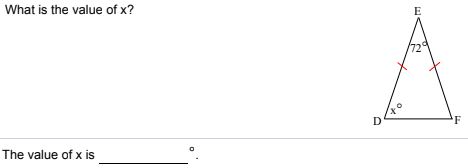
2.

Question 3
3.

Question 4
4.
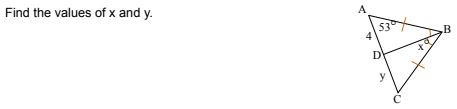
x = _______ (Simplify your answer.)
y = _______ (Simplify your answer.)
Question 5
5.

Question 6
6.

Question 7
7.
Provide the answer for the three blanks (1, 2, & 3) below.
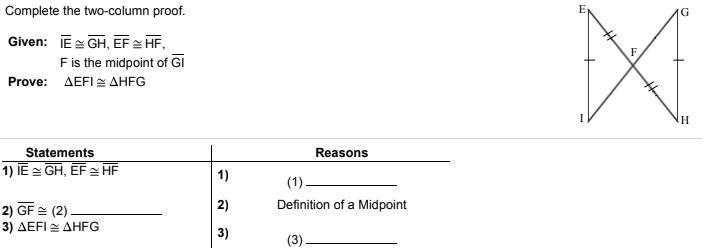
Answer for Blank 1__________
Answer for Blank 2__________
Answer for Blank 3__________
Question 8
8.
The triangles shown are similar. Find the value of each variable.
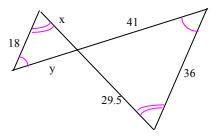

The value of x is _______.

The value of y is _______.
Question 9
9.

Question 10
10.
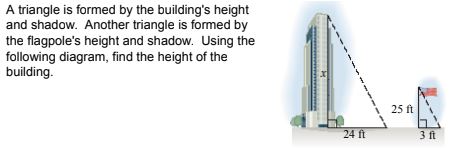
The height of the bulding is _______ feet.
Question 11
11.
x= _______ (Simplify your answer. Type an integer or a decimal.)
Question 12
12.

Question 13
13.

Question 14
14.

Question 15
15.

Question 16
16.

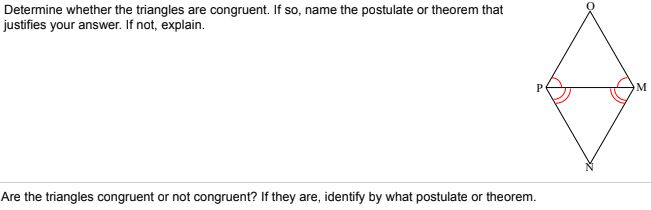
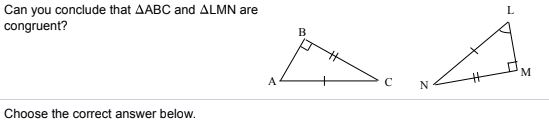
The triangles are not necessarily congruent. Not enough information is provided.
The triangles are congruent by the SAS Postulate.
The triangles are congruent by the SSS Postulate.
The triangles are congruent by the ASA Postulate.
Yes, by the SAS Postulate
Yes, by the ASA Postulate
Yes, by the SSS Postulate
Yes, by the H-L Theorem
Yes, by the AAS Theorem
No
ΔABC ~ ΔHKG by the SAS ~ Theorem.
ΔABC ~ ΔHKG by the SSS ~ Theorem.
ΔABC ~ ΔHKG by the AA ~ Postulate.
ΔABC and ΔHKG are not similar because the corresponding sides of the triangles are not in
proportion.
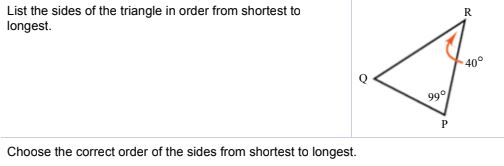
Once you find the largest angle of a triangle, how do you find the longest side?
The longest side is the side across __________________
the smallest angle.
the largest angle.
the medium angle.
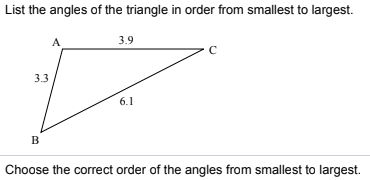
∠A, ∠C, ∠B
∠A, ∠B, ∠C
∠B, ∠C, ∠A
∠C, ∠B, ∠A
∠B, ∠A, ∠C
∠C, ∠A, ∠B
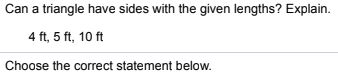
Yes, because 10 + 4 > 5 satisfies the triangle inequality theorem.
No, because 4 + 5 < 10 contradicts the triangle inequality theorem.
Yes, because 4 + 5 < 10 satisfies the triangle inequality theorem.
No, because 10 + 4 > 5 contradicts the triangle inequality theorem.
While driving on a highway, a sign reads " City B 130 mi,City A 150 mi." Someone in the car is surprised that it is only 20 miles from City A to City B. Explain why the difference between the two cities does not have to be 20 mi.
If the cities are in opposite directions, the distance is 20 mi.
If the cities are in the same direction, the distance is 280 mi.
If the cities are not in the same direction, the distance is between 20 mi and 280 mi.
The distance between the two cities must be exactly 20 mi.