Task:
Your class has been learning about different types of jobs to prepare for your school's job week. Your teacher has asked each person to learn about a different job. You think being an astronaut must be an interesting job so you decide to learn about what it is like to be an astronaut. You have found two sources about being an astronaut.
After you have looked at these sources, you will answer some questions about them. Briefly scan the sources and the three questions that follow. Then, go back and read the sources carefully so you will have the information you will need to answer the questions and complete your research. You may also use scratch paper to take notes.
In Part 2, you will write an informational article using information you have read.
Directions for Beginning:
You will now look at two sources. You can look at either of the sources as often as you like.
Research Questions:
After looking at the sources, use the rest of the time in Part 1 to answer three questions about them. Your answers to these questions will be scored. Also, your answers will help you think about the information you have read and looked at, which should help you write your informational article.
You may refer back to your scratch paper to look at your notes when you think it would be helpful.
Your written notes on scratch paper will be available to you in Part 1 and Part 2 of the performance task.
Explain why it is hard to be an astronaut. Give two reasons, one from Source #1 and one from Source #2. For each reason, include the source title or number.
For Part 2, you are being asked to write a story that is several paragraphs long. Type your response in the box below. The box will get bigger as you type.
Source #1 describes cold islands. How are the tropical islands in Source #2 like cold islands? Support your answer with two details from Source #2.
Which source has the most useful information about what it is like to live on an island? Include the source title or number and explain why this source has the most useful information about living on an island. Support your answer with at least two details.
Click on the boxes to match each source with the idea or ideas that it supports. Some ideas may have more than one source selected.
Source #1: What is an Astronaut? | Source #2: Life in Space | |
|---|---|---|
Astronauts feel weak when they come back from space. | ||
Since objects are also able to float in space, astronauts can easily lift things in space that are heavy on Earth. | ||
Astronauts have a special view of Earth from space. |
Explain why it is hard to be an astronaut. Give two reasons, one from Source #1 and one from Source #2. For each reason, include the source title or number.
You will review your notes and sources, and plan, draft, revise, and edit your writing. You may use your notes and go back to the sources. Now read your assignment and the information about how your writing will be scored, then begin your work.
Your teacher is creating a bulletin board display in the school library to show what your class has learned about different types of jobs. You decide to write an informational article on astronauts. Your article will be read by other students, teachers, and parents.
Using more than one source, develop a main idea about being an astronaut. Choose the most important information from the sources to support your main idea. Then, write an informational article that is several paragraphs long. Clearly organize your article and support your main idea with details from the sources. Use your own words except when quoting directly from the sources. Be sure to give the source title or number when using details from the sources.
REMEMBER: A well-written informational article
has a clear main idea.
is well-organized and stays on the topic.
has an introduction and conclusion.
uses transitions.
uses details from the sources to support your main idea.
puts the information from the sources in your own words, except when using direct quotations from the sources.
gives the title or number of the source for the details or facts you included.
develops ideas clearly.
uses clear language.
follows rules of writing (spelling, punctuation, and grammar usage).
Now begin work on your informational article.
Manage your time carefully so that you can
plan your informational article.
write your informational article.
revise and edit the final draft of your article.
Word-processing tools and spell check are available to you.
For Part 2, you are being asked to write an informational article that is several paragraphs long. Type your response in the box below. The box will get bigger as you type.
Remember to check your notes and your prewriting/planning as you write, and then revise and edit your informational article.
Using more than one source, develop a main idea about being an astronaut. Choose the most important information from the sources to support your main idea. Then, write an informational article that is several paragraphs long. Clearly organize your article and support your main idea with details from the sources. Use your own words except when quoting directly from the sources. Be sure to give the source title or number when using details from the sources.
You have found a source describing the type of training that astronauts receive in order to do their job.
by Talia Yee
Have you ever thought about what it is like in space? Astronauts are people who go out into space. Being an astronaut is an exciting job. Astronauts who see Earth from space say that it is round, like a ball. While in space, astronauts can look down and see clouds, land, and water. Some can even see the moon up close. Astronauts get the chance to see more stars than you or I have ever seen.
Being an astronaut may be exciting, but it is not an easy job. A person who wants to be an astronaut has to study for years. There are many things an astronaut must learn to do before going into space for the first time.

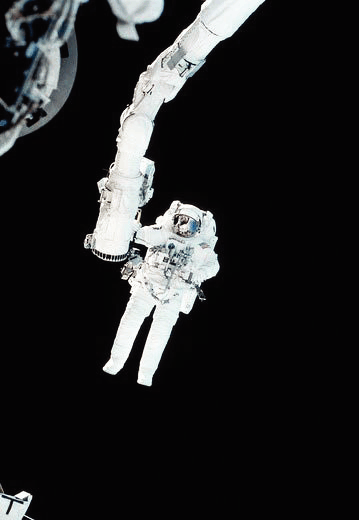
A weightless astronaut in space
Astronauts train for hundreds of hours. During their training, they learn about space. This type of training might include studying the stars and Earth. It is important that astronauts study space so that they understand what they will work with while in space. The astronauts also learn medical skills like basic first aid during their training. This training allows them to treat simple medical problems so that they can keep each other healthy and safe in space.
In their training, astronauts also learn what life is like on the International Space Station (ISS). The ISS is a large spacecraft that orbits the earth. The ISS is a place where astronauts do science experiments while in space. Astronauts also learn to eat, exercise, and do experiments while floating in the air. They also practice riding in special vehicles that are just for space. These vehicles bring supplies like food and fuel to the ISS. The vehicles are about the size of a pickup truck with 12 wheels. Astronauts even take classes in scuba diving!1 When they're walking underwater in their scuba suits, astronauts feel the same as they would feel walking in space. Lastly, astronauts must also learn how to work together as a team. This is important because as many as eight astronauts may be in one spacecraft. These astronauts have to learn how to live and work together in space.
Each astronaut has a special job to do as part of the team. Some astronauts learn how to put things together so they become good at fixing things. This is important because if something on a spaceship breaks, the astronauts must be able to fix it themselves. Some astronauts are pilots who know how to fly airplanes. These astronauts have to study how to fly and steer a spaceship. They train for many hours to learn how to turn it, how to make it go faster and slower, and how to guide it through space. Some astronauts are leaders and are in charge of all of the people on the ship. They make sure that everybody is doing the right job. Other astronauts learn mostly about science. Their job is to learn how living things change when they are in space.
Although each astronaut has a special job on the team, each of them has to learn how to work where there is no gravity. When they are in a spaceship that is moving around Earth, they can feel as though they do not weigh anything. They are able to float. Many astronauts say that it is fun to float around the inside of a spaceship. Objects in the spaceship can also float, so astronauts can lift and move heavy things easily.
Feeling weightless is fun, but being in space is work for astronauts. Astronauts must be healthy and eat right. They have to exercise and be in good shape. Astronauts have many adventures, but they work hard, too.
¹scuba diving: swimming underwater with a special suit, air tank, and fins
Sources Used
European Space Agency (n.d.). Astronaut training. Retrieved from http://www.esa.int/esaKIDSen/SEM3RIWJD1E_LifeinSpace_0.html
Kidzworld (n.d.). Becoming an astronaut. Retrieved from http://www.kidzworld.com/article/3084-becoming-an-astronaut
NASA (n.d.). Astronauts answer student questions. Retrieved from http://www.nasa.gov/centers/johnson/pdf/569954main_astronaut%20_FAQ.pdf
NASA (2011, November 30). What is the International Space Station? Retrieved from http://www.nasa.gov/audience/forstudents/k-4/stories/what-is-the-iss-k4.html
NASA (n.d.). NASA's space exploration vehicle. Retrieved from: http://www.nasa.gov/exploration/technology/space_exploration_vehicle/index.html
Photograph of weightless astronaut (Image Number 4128R-4871), copyright by Superstock. Used by permission.
Click on the boxes to match each source with the idea or ideas that it supports. Some ideas may have more than one source selected.
Source #1: What is an Astronaut? | Source #2: Life in Space | |
|---|---|---|
Astronauts feel weak when they come back from space. | ||
Since objects are also able to float in space, astronauts can easily lift things in space that are heavy on Earth. | ||
Astronauts have a special view of Earth from space. |
Task:
Your class is going to make a book about different places people visit. You and your classmates have been learning about different islands around the world. You want to learn more and decide to do more research on the different types of islands. You have found two articles about islands.
After you have looked at these sources, you will answer some questions about them. Briefly scan the sources and the questions that follow. Then, go back and read the sources carefully so you will have the information you will need to answer the questions and complete your research. You may click on the NOTES box to take notes on the information you find in the sources as you read. Your notes will be available to you as you answer the questions.
In Part 2, you will give your opinion using information you have read.
Directions for Beginning:
You will now look at two sources. You can look at either of the sources as often as you like.
Research Questions:
After looking at the sources, use the rest of the time in Part 1 to answer question(s) about them. Your answers will be scored. Also, your answers will help you think about the information you have read and looked at, which should help you write.
You may click on the NOTES button above the sources to look at your notes when you think it would be helpful. Answer the questions in the spaces below them.
The following article includes interesting facts about the cold islands of Greenland and the Faroe Islands.
An island is a body of land that is not connected to a continent and has water all around it. Islands can be found in oceans, seas, rivers, and lakes. They can be all different sizes. Some islands are only big enough for a few people, while some islands are huge. Some islands are hot all year around and other islands are cold.
Greenland and the Faroe Islands are a group of cold islands. They are rocky, covered in ice, and they do not have trees, but they are very pretty. Glaciers circle the islands, and icebergs float by in the summer. Because Greenland and the Faroe Islands are wet, lots of things grow there. There are over 1,000 kinds of plants that bring many birds to the islands.
The people in Greenland and the Faroe Islands live in brightly colored houses that dot the hillsides. They share the land with many animals. Seals, walruses, and polar bears live there. There are a few roads that connect the towns, but people mainly use dog sleds to get around.
The people of Greenland and the Faroe Islands depend on fishing. They cannot farm the cold, hard land, but they can fish!
may be cold on these islands, the people there camp in tents, go bird watching, fish in the sea, and hike the island mountains. While they have modern forms of amusement like television and the Internet, they also have kept their old traditions like poetry, music, drama and storytelling. One special tradition is the chain dance. This dance has been passed down for hundreds of years. People do the chain dance at festivals and other events. They even join chain dance clubs!
As you can see, the people of Greenland and the Faroe Islands have a rich and interesting island life. You would have fun on a visit to their cold islands.
The following article includes interesting facts about tropical islands.
Exploring Tropical Islands
by Sarah Donovan Chase

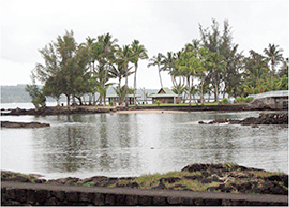
Photograph of tropical island by W. Nowicki.
There are more than 45,000 tropical islands in the world. A tropical island is one that is hot and wet most of the time. These islands are found near the equator, where it is warmest all year. Because of that, tropical islands do not get cold.
Tropical islands get a lot of sun all year and have a long rainy season. They have thick forests and interesting plant life. During hurricane season, tropical islands often experience very high winds. The people who live on these islands build homes that can hold up to strong winds.
Tropical islands have many types of vines, bushes, and small flowering plants. There are also more than 2,600 types of palm trees found on these islands. Fruit trees also grow there. If you visited one of these islands, you could eat a coconut or banana right off the tree.
Some tropical islands, like the Florida Keys, are very flat. Some have mountains and hills, and others have a mix of high and low spots. Most of them have sandy beaches. Many tropical islands have huge waterfalls and coral reefs. All of them have lagoons, or shallow pools sheltered from the ocean by sandbars.
Because the islands have water all around them, there is a lot of sea life. Sharks, eels, crabs, and many kinds of colorful fish live in the waters. There are also a lot of insects, like big spiders. You might find lizards, peacocks, snakes, and maybe even a chimpanzee in the back yard!
When people visit a tropical island they can swim in the ocean, play in the sand, sail boats, hike trails, and fish in the ocean. Each hot island has its own traditions and things that make it special. If you visit a tropical island you will find many things to do, and you will certainly have a good time!
Sources Used:
National Geographic Society. (n.d.). Island. Retrieved from http://education.nationalgeographic.com/education/encyclopedia/island/?ar_a=1
Technological Solutions, Inc. (2013, December). Geography for kids: Islands. Ducksters. Retrieved from http://www.ducksters.com/geography/islands.php
10 Most Today (n.d.). 10 largest islands in the world. Retrieved from http://10mosttoday.com/10-largest-islands-in-the-world/
Student Directions for Part 2
You will now review your sources, take notes, and plan, draft, revise, and edit your writing. You may use your notes and go back to the sources. Now read your assignment and the information about how your writing will be scored; then begin your work.
Your assignment:
Your class is going to make a book about different places people visit. You will write an opinion essay to contribute to the class book. Your assignment is to use the information from the sources to write an opinion essay in which you give your opinion about which type of island would be better to visit—a hot island or a cold island. Make sure you clearly state your opinion and write several paragraphs supporting your opinion with reasons and details from the sources. Develop your ideas clearly and use your own words, except when quoting directly from the sources. Be sure to give the source title or number for the details or facts you use.
REMEMBER: A well-written opinion essay:
has a clear opinion
is well-organized and stays on the topic
has an introduction and conclusion
uses transitions
uses details or facts from the sources to support your opinion
puts the information from the sources in your own words, except when using direct quotations from the sources
gives the title or number of the source for the details or facts you included
develops ideas clearly
uses clear language
follows rules of writing (spelling, punctuation, and grammar)
Now begin work on your opinion essay.
Manage your time carefully so that you can:
plan your opinion essay
write your opinion essay
revise and edit the final draft of your opinion essay
Word-processing tools and spell check are available to you.
For Part 2, you are being asked to write an opinion essay that is several paragraphs long. Type your response in the box below. The box will get bigger as you type.
Remember to check your notes and your prewriting/planning as you write and then revise and edit your opinion essay.
Your class has been learning about different types of jobs to prepare for your school's job week. Your teacher has asked each person to learn about a different job. You think being an astronaut must be an interesting job so you decide to learn about what it is like to be an astronaut. You have found two sources about being an astronaut.
After you have reviewed these sources, you will answer some questions about them. Briefly scan the sources and the questions that follow. Then, go back and read the sources carefully so you will have the information you will need to answer the questions and complete your research. You may click on the Global Notes button to take notes on the information you find in the sources as you read. You may also use scratch paper to take notes.
In Part 2, you will write an informational article using information you have read.
You will now review two sources. You can review either of the sources as often as you like.
After reviewing the research sources, use the rest of the time in Part 1 to answer question(s) about them. Your answers to these questions will be scored. Also, your answers will help you think about the information you have read and viewed, which should help you write your informational article.
You may click on the Global Notes button or refer back to your scratch paper to review your notes when you think it would be helpful. Answer the questions in the spaces below the items.
Both the Global Notes on the computer and your written notes on scratch paper will be available to you in Part 1 and Part 2 of the performance task.
You have found a source describing the type of training that astronauts receive in order to do their job.
by Talia Yee
Have you ever thought about what it is like in space? Astronauts are people who go out into space. Being an astronaut is an exciting job. Astronauts who see Earth from space say that it is round, like a ball. While in space, astronauts can look down and see clouds, land, and water. Some can even see the moon up close. Astronauts get the chance to see more stars than you or I have ever seen.
Being an astronaut may be exciting, but it is not an easy job. A person who wants to be an astronaut has to study for years. There are many things an astronaut must learn to do before going into space for the first time.

A weightless astronaut in space
Astronauts train for hundreds of hours. During their training, they learn about space. This type of training might include studying the stars and Earth. It is important that astronauts study space so that they understand what they will work with while in space. The astronauts also learn medical skills like basic first aid during their training. This training allows them to treat simple medical problems so that they can keep each other healthy and safe in space.
In their training, astronauts also learn what life is like on the International Space Station (ISS). The ISS is a large spacecraft that orbits the earth. The ISS is a place where astronauts do science experiments while in space. Astronauts also learn to eat, exercise, and do experiments while floating in the air. They also practice riding in special vehicles that are just for space. These vehicles bring supplies like food and fuel to the ISS. The vehicles are about the size of a pick-up truck with 12 wheels. Astronauts even take classes in scuba diving!* When they're walking underwater in their scuba suits, astronauts feel the same as they would feel walking in space. Lastly, astronauts must also learn how to work together as a team. This is important because as many as eight astronauts may be in one spacecraft. These astronauts have to learn how to live and work together in a space.
Each astronaut has a special job to do as part of the team. Some astronauts learn how to put things together so they become good at fixing things. This is important because if something on a space ship breaks, the astronauts must be able to fix it themselves. Some astronauts are pilots who know how to fly airplanes. These astronauts have to study how to fly and steer a spaceship. They train for many hours to learn how to turn it, how to make it go faster and slower, and how to guide it through space. Some astronauts are leaders and are in charge of all of the people on the ship. They make sure that everybody is doing the right job. Other astronauts learn mostly about science. Their job is to learn how living things change when they are in space.
Although each astronaut has a special job on the team, each of them has to learn how to work where there is no gravity. When they are in a spaceship that is moving around Earth, they can feel as though they do not weigh anything. They are able to float. Many astronauts say that it is fun to float around the inside of a spaceship. Objects in the spaceship can also float, so astronauts can lift and move heavy things easily.
Feeling weightless is fun, but being in space is work for astronauts. Astronauts must be healthy and eat right. They have to exercise and be in good shape. Astronauts have many adventures, but they work hard, too.
*scuba diving: swimming under water with a special suit, air tank, and fins
Source #2
This article describes what happens to astronauts' bodies when they go into space.
by Aaron Higgins
Many people say they want to be an astronaut, but do they know what it's really like? When astronauts are in space, they feel weightless. They can float. This sounds like fun, but it is not that simple. The human body is used to being on Earth, but some people stay out in space for months. A lot of strange things happen to the body when it floats for that long.
Astronauts sometimes feel sick in space. It takes a few days for them to get used to feeling weightless and being able to float.
Being in space also changes how blood flows in the body. In space, more blood flows to the astronauts' heads so their faces get puffy and their necks get bigger. At the same time, less blood flows to their legs, making them skinny. They call this condition "bird legs."
The heart is a muscle that pumps blood around the body. The heart does not have to work as hard to pump blood in space. A muscle that does not work hard gets weaker and smaller. Astronauts' other muscles and their bones can also get weaker. This is because they do not have to work as hard to move the astronaut's body.
To help keep their muscles strong, astronauts have to do exercises when they are in space. They use big rubber bands attached to the walls of the space ship and hook them over their shoulders. Then they bend their knees and press against the rubber bands to make their legs stronger.
Even with regular exercise in space, astronauts come back feeling weak. It takes time for them to get back their Earth legs and learn how to live with gravity again.
Sources Used
Discovery News (2009, May 13). Astronaut [Video file]. Retrieved from http://news.discovery.com/videos/cool-jobs-astronaut.html
NASA (2009). When space makes you dizzy. Retrieved from http://www.nasa.gov/audience/forstudents/5-8/features/F_When_Space_Makes_You_Dizzy.html