The sources discuss how service animals help people. Explain what you have learned about how service animals help people. Use one detail from Source #1 and one detail from Source #2 to support your explanation. For each detail include the source title or number.
Student Directions – Service Animals Opinion Performance Task, Part 2
You will now review your notes and sources, and plan, draft, revise, and edit your writing. You may use your notes and go back to the sources. Now read your assignment and the information about how your writing will be scored; then begin your work.
Your Assignment: When your class returns from the library, your classmates begin to share what they learned about different types of service animals. They also begin to discuss the new rule that allows only dogs and miniature horses as service animals in public places. Some students agree with the rule, and some students disagree with the rule. Your teacher asks you to write a paper explaining your opinion about the new rule.
In your paper, you will take a side as to whether you agree with the rule allowing only service dogs and miniature horses in public places, or whether you disagree with the rule. Your paper will be read by your teacher and your classmates. Make sure you clearly state your opinion and write several paragraphs supporting your opinion with reasons and details from the sources. Develop your ideas clearly and use your own words, except when quoting directly from the sources. Be sure to give the source title or number for the details or facts you use.
REMEMBER: A well-written opinion paper has a clear opinion; is well-organized and stays on the topic; has an introduction and conclusion; uses transitions; uses details or facts from the sources to support your opinion; puts the information from the sources in your own words, except when using direct quotations; gives the title or number of the source for the details or facts you included; develops ideas clearly; uses clear language; and follows rules of writing (spelling, punctuation, and grammar usage).
Now begin work on your opinion paper. Manage your time carefully so that you can:
plan your opinion paper.
write your opinion paper.
revise and edit the final draft of your opinion paper.
Word-processing tools and spell check are available to you.
For Part 2, you are being asked to write an opinion paper that is several paragraphs long. Type your response in the box below. The box will get bigger as you type.
Remember to check your notes and your prewriting/planning as you write and then revise and edit your opinion paper.
Your class has been learning about oceans around the world. You and your classmates are most interested in the animals that live in these oceans. Your teacher has asked each of you to pick an ocean animal to research, and you have picked whales. While doing your research, you found a book and two magazine articles about whales.
After you have reviewed these sources, you will answer some questions about them. Briefly skim the sources and the questions that follow. Then, go back and read the sources carefully so you will have the information you will need to answer the questions and complete your research. You may click on the NOTES box to take notes on the information you find in the sources as you read. Your notes will be available to you as you answer the questions.
In Part 2, you will write a story about a topic related to the sources.
You will now look at three sources. You can go back to any of the sources as often as you like.
After examining the sources, use the rest of the time in Part 1 to answer the question(s) about them. Your answers to these questions will be scored. Also, your answers will help you think about the information you have reviewed, which should help you write your story.
You may click on the NOTES button above the sources to look at your notes when you think it would be helpful. Answer the questions in the spaces below them.
by Tamra Orr

Deep under the surface of the ocean, a gentle giant swims through the water. Larger than many of the dinosaurs, the whale is the true king of the sea. Some species grow as long as 100 feet long. They can weigh more than 100 tons! Although there are many different types of whales, and they come in various sizes and colors, their bodies are all quite similar. They use flippers and tails to help push themselves through the water and keep their balance.
Although many people think of whales as fish, they are actually warm-blooded mammals. They need air to breathe, so they have to rise to the surface of water to take a deep breath. Instead of using a nose or mouth, however, whales use a blowhole on the top of their heads. They take in air through the hole and straight into their lungs. They exhale the same way. Once whales take a few breaths, they dive back down, sometimes thousands of feet deep. Many of them can stay underwater for more than an hour before having to come back up and breathe again.
When it comes time to sleep, whales rest near the surface, so they can come to the top and breathe whenever needed. In order to do this, whales do something rather amazing. They only allow one side of their brain to sleep at a time! This way, they are aware of when they need to take another breath!
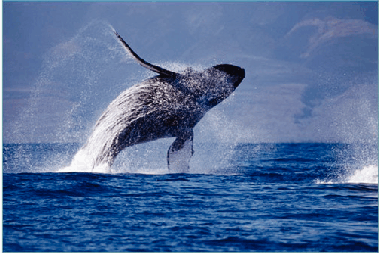
Whales come to the surface to do more than breathe, however. As big and heavy as they are, many of them jump out of the water. This action is known as breaching. Why do they do it? Even the experts are not sure, but they have a number of theories. Many scientists think the mammals do it to shake the barnacles* and other growths off of their skin. Other ideas are that breaching is done to scare away predators or simply because it is a lot of fun!
Whales live in deep ocean waters across the world. When summer arrives and the water begins to warm up, some species migrate, or move to colder waters in search of more food. How do they keep warm? Whales have built-in coats known as blubber under their skin.
Blubber is a thick layer of fat and it not only keeps the mammals warm, but helps them float and gives them extra energy when it is hard to find enough to eat. In the winter, whales migrate to warmer water to have their young.
Whales are incredible creatures that live under the water, but come above it to breathe the air, jump, and play. They truly are the kings of the sea.
*barnacles: small crustaceans that attach themselves to other animals or objects
Explain why whales use different types of sounds. Give two reasons, using information from two different sources. Be sure to give the title or number of the sources you use.
You will now review your notes and sources, plan, draft, revise, and edit your story. You may use your notes and refer to the sources. Now read your assignment and the information about how your story will be scored; then begin your work.
Your class is making a storybook about adventures in the ocean to finish your Oceans Around the World unit. You will write a story to contribute to the class storybook. You have decided to write a story about a family that goes on vacation to a place right by the ocean. They go out on a boat ride and spot a huge creature coming out of the water. It's a whale! Tell the story of what happens when the family sees the whale.
Your story will be read by your teacher and the other students in your class. When writing your story, find ways to use information and details from the sources to improve your story. Make sure you develop your character(s), the setting, and the plot, using details, dialogue, and description.
has a clear plot and clear sequence of events
is well-organized and has a point of view
uses details from the sources to support your story
uses clear language
follows rules of writing (spelling, punctuation, and grammar)
Now begin work on your story. Manage your time carefully so that you can:
plan your story
write your story
revise and edit the final draft of your story
Word-processing tools and spell check are available to you.
For Part 2, you are being asked to write a story that is several paragraphs long. Type your response in the box below. The box will get bigger as you type.
Remember to check your notes and your prewriting/planning as you write and then revise and edit your story.
Task:
Your school is preparing for an assembly to celebrate Earth Day. As part of the assembly, each class is responsible for setting up an exhibit about different aspects of nature. Your class has been assigned the theme “Unusual Animal Behaviors.” As part of the project, you have decided to learn more about hibernation. You decide to do some research, and you find three sources about hibernation.
After you have reviewed these sources, you will answer some questions about them. Briefly skim the sources and the questions that follow. Then, go back and read the sources carefully so you will have the information you will need to answer the questions and complete your research. You may click on the Global Notes button to take notes on the information you find in the sources as you read. You may also use scratch paper to take notes.
In Part 2, you will write an informational article using information you have read.
Directions for Beginning:
You will now review several sources. You can review any of the sources as often as you like.
Research Questions:
After reviewing the sources, use the rest of the time in Part 1 to answer question(s) about them. Your answers to these questions will be scored. Also, your answers will help you think about the information you have read and viewed, which should help you write your informational article.
You may click on the Global Notes button or refer back to your scratch paper to review your notes when you think it would be helpful. Answer the questions in the spaces below the items.
Both the Global Notes on the computer and your written notes on scratch paper will be available to you in Part 1 and Part 2 of the performance task.
Source #1 and Source #3 discuss bears hibernating. Explain what the sources say about bears hibernating. Use two details, one detail from Source #1 and one detail from Source #3, to support your explanation. For each detail, include the source title or number.
Which source has the most useful information about how hibernation works? Explain why this source has the most useful information about how hibernation works. Give at least two details from the source to support your answer.
Student Directions
Ready for a Nap Informational Performance Task
Part 2
You will now review your notes and sources, and plan, draft, revise, and edit your writing. You may use your notes and go back to the sources. Now read your assignment and the information about how your writing will be scored; then begin your work.
Your Assignment:
Your class has been learning about unusual animal behaviors in preparation for your school’s Earth Day assembly. As part of your class’s exhibit, you will write an informational article about hibernation. Your article will be read by other students, teachers, and parents who attend the Earth Day assembly.
Using more than one source, develop a main idea about hibernation. Choose the most important information from more than one source to support your main idea. Then, write an informational article that is several paragraphs long. Clearly organize your article and support your main idea with details from the sources. Use your own words except when quoting directly from the sources. Be sure to give the source title or number when using details from the sources.
REMEMBER: A well-written informational article
has a clear main idea.
is well-organized and stays on the topic.
has an introduction and a conclusion.
uses transitions.
uses details from the sources to support your main idea.
puts the information from the sources in your own words, except when using direct quotations from the sources.
gives the title or number of the source for the details or facts you included.
develops ideas clearly.
uses clear language.
follows rules of writing (spelling, punctuation, and grammar usage).
Now begin work on your informational article. Manage your time carefully so that you can
plan your informational article.
write your informational article.
revise and edit the final draft of your informational article.
Word-processing tools and spell check are available to you.
For Part 2, you are being asked to write an informational article that is several paragraphs long. Type your response in the box below. The box will get bigger as you type.
Remember to check your notes and your prewriting/planning as you write and then revise and edit your informational article.
You have found a current article about capuchin monkeys on a website about service animals. The author is a veterinarian who writes articles for educational publications.
Monkey Helpers
by Tamra Orr
An Unusual Set of Helping Hands
Every day people make countless moves that they tend to take for granted. They scratch their noses and pull on their backpacks. People grab something to eat and push up their glasses. They flip the pages of their textbooks and turn off their lights. For people living with injuries to the spinal cord, however, these basic movements are very difficult. For some, they are even impossible. For the past 35 years, more than 160 people with injuries to the spinal cord have found support from a very unusual set of helping hands: those of specially trained capuchin monkeys.
Capuchin monkeys are very small. Some weigh less than eight pounds, even when fully grown. They are also extremely smart. In the wild, they have shown the ability to pick up tools and use them to solve problems. Their hands can easily carry small tools. This makes it easier for them to handle modern items such as remotes and cell phones.
Although capuchin monkeys are smart and are able to handle small tools, not all types of monkeys are ideal to use as service animals. Some monkeys, such as howler monkeys, are too large or strong. Monkeys who have not been properly trained are also unreliable.
They might behave in ways that are hard to predict. For example, a monkey could suddenly hurt a person if it got angry or frightened for some reason.
While some people believe capuchin monkeys are wonderful service animals, not everyone agrees. Capuchins are small, easy to train, and able to bond, or form close relationships, with humans. However, they are still, in the end, wild animals. April Truitt, director of the Primate Rescue Center in Kentucky, says that having a wild animal in your home may put both the animal and the owner at increased risk of getting injured. She points out that it is possible for capuchins to become violent suddenly and this can be a danger to their owners and others.
Long Before School Starts
Long before capuchin monkeys begin their training, they have already spent years around humans. Born in a Massachusetts zoo, they must live with foster families as long as twelve years before beginning their training on how to assist a person with a disability.
During this time, they are taught how to share a house with humans. They get used to being around pets. They even learn basic tasks like how to take baths. This requires a great deal of time and effort.
Learning to Help
Capuchin monkeys learn how to assist people with disabilities at Helping Hands, otherwise known as the monkey college, in Boston, Massachusetts. This college is not quite like going to a traditional school. Every day, for three to five years, capuchin monkeys learn new skills. Their lessons do not focus on reading and writing though. Days are spent learning how to load a DVD into a player and push play, or how to open and close microwave doors. This education takes time, patience, and money. The cost of educating just one monkey is close to $40,000. Finally, after up to five years of training, the animals finish school. Now the monkeys are ready to go and live with someone who needs them to help make life a little bit easier.
The Simple Things
Having a capuchin monkey in the house is not the same as having a dog or cat. Because of their training and their intelligence, these monkeys are able to do an amazing number of chores for the person who is disabled and cannot do them alone. Along with operating microwaves and DVD players, these service animals can also turn lights off and on for their new owners. They can open bottles and flip the pages of a book for their owner. They can even reach out and scratch an annoying itch.
Every year, Helping Hands places dozens of monkeys in homes of people with disabilities. The monkeys take good care of their owners. In return, the owners feel safer and more able to do tasks that so many others take for granted.
Sources Used
ABC News. (n.d.). Tearful Kentucky senator wants monkeys to be made service animals. Retrieved from: http://abcnews.go.com/blogs/headlines/2014/01/tearful-kentucky-senator-wants-monkeys-to-be-made-service-animals/
CBS News. (n.d.). Monkeys lend helping hand to disabled. Retrieved from: http://www.cbsnews.com/pictures/monkeys-lend-helping-hand-to-disabled
DiBlasio, N. (2013, July 4). Monkey see. Monkey do. USA Weekend. Retrieved from: http://www.usaweekend.com/article/20130705/HEALTH/307050007/Graduates-of-Monkey-College-give-their-companions-a-sense-of-purpose
Helping Hands. (n.d.). Training center. Retrieved from:
Click on the boxes to match each source with the idea or ideas that it supports.
Some ideas may have more than one source selected.
Source #1: Monkey Helpers | Source #2: Animals Helping People | Source #3: New Service Animal Rules | |
|---|---|---|---|
People who own businesses have to consider the well-being of all of their guests. | |||
Being smart and able to handle small objects makes certain animals more appropriate than other animals to assist people who have a disability. |
Which source would most likely be the most helpful in understanding how a service animal is trained? Explain why this source is most likely the most helpful.
Give at least two details from the source to support your answer.
All three sources describe how whales behave. Choose two details below that can be found in more than one of the sources.
Explain how whales work together to help each other. Give one detail from Source #2 and one detail from Source #3 to support your explanation. For each detail, identify the source title or number.
This article from Cricket magazine explains how animal hibernation works.
by Margery Facklam
A 300-pound grizzly bear shuffled through a dry autumn meadow in Yellowstone National Park. She stopped to catch a mouse with one swat of her huge paw and then ambled on toward a clear stream. At the water’s edge, she stood on her hind legs to sniff the air before she plunged into the cold water. In a moment she caught a salmon with a swoop of her paw and gulped it down. She devoured two more fish before she waded out and shook the water from her thick, gray-tipped, “grizzled” fur.
Day after day the grizzly loped through the meadows in search of insects, berries, and small rodents. . . . Food seemed to be the only thing on her mind.
But as she grew fatter and the air grew colder, she began to search for something else—her winter den. When she found a place that suited her, on a steep north-facing slope at the base of a large fir tree, she started to dig. It was a tight fit as she tunneled under the tree roots that would make a strong roof for her den, but she needed room enough only to squeeze through to her bedroom. In the spring, after four or five months of a deep sleep called hibernation, she would be much thinner.
Late in November, when the temperature had dropped below freezing, the big grizzly no longer raced across the open meadow. Day after day she acted as though she were walking in her sleep. Then one day, when the wind whipped the snow in swirls around her, the bear crawled into her den.
All night it snowed, covering the opening to her tunnel. No one would be able to find it. The grizzly was safe for the winter, cozy and warm beneath the blanket of snow. She would not eat [or] drink water, . . . until spring. Her heart rate would slow down from its usual 40 or 50 beats a minute to 10 or 12. Her temperature would drop a few degrees, and she would breathe slowly, just as a person in a deep sleep would do.
How does hibernation work? How can animals go without food and water for many months without starving to death? What tells them it’s time to enter the den? And then how do they know it’s time to wake up? . . .
Hibernation is a way for animals to save energy and survive through the winter when food is hard to find. (Hiberna is a Latin word that means winter.) It is controlled by a part of the brain called the hypothalamus (hi-po-thal-a-mus), which also regulates hunger, thirst, and blood pressure.
In one experiment to find out how hibernation works, a biologist [scientist] took a small amount of blood from hibernating ground squirrels. He froze the blood. In spring, he defrosted it and injected it into a different group of ground squirrels who had been running around. Not long after, the energetic ground squirrels curled up and began to hibernate.
Scientists have found in the blood of hibernating animals a substance they call HIT, which stands for hibernation inducement1 trigger. Although they do not know exactly what this . . . is, they have learned that this trigger goes into action when one of three things happens: when the days become shorter and there is less light, when there are big changes in temperature (either extreme cold or heat), or when food is scarce.
There are different levels of hibernation. The animals known as the “real” hibernators, such as woodchucks and ground squirrels, sleep so deeply that they are almost impossible to wake up. . . . During hibernation, the woodchuck’s heart slows from beating 80 times a minute to only 4 or 5. Its normal body temperature of 100 degrees Fahrenheit drops to 45 or 50 degrees. But even so, every few weeks the woodchuck gets up to nibble on food and use the small toilet room in its underground burrow. . . .
The in-between hibernators really take only long winter naps. Skunks, raccoons, and a few others lower their body temperature a couple of degrees and breathe more slowly, but they wake up to forage [search] for food between winter storms.
In order to survive weeks or months without food, most hibernating animals go on an eating binge in late summer and early fall. The fat they build up supplies energy and keeps them warm while they sleep. But along with this regular white fat, hibernating mammals have patches of special brown fat across their shoulders and back. The brown fat works like a fast food restaurant; it delivers quick energy whenever it is needed.
A hibernating animal must warm up before it can wake up, and its brain has to warm up first in order to send messages to the rest of the body to get moving. In its handy location across the shoulders and back, the brown fat is close to the hibernating mammal’s brain, heart, and lungs, which must get the first spurt of energy as hibernation comes to an end.
Whether a groundhog sound asleep in its burrow or a grizzly wintering in a cozy den—each hibernating animal follows the built-in pattern of its species to survive the cycle of the seasons. Hibernation is an amazing way for some animals to protect themselves until food and warmth reappear in spring.
inducement: something that gives you a reason for doing something