Student Directions
Hiking in the Grand Canyon Narrative Performance Task
Task:
Your school writing club is holding a short story contest about “The Great Outdoors.” You have often thought about hiking and you wonder what it would be like to hike in Grand Canyon National Park. You decide to do more research about hiking in Grand Canyon National Park. As part of your initial research, you find four sources about the Grand Canyon and hiking.
After you have reviewed these sources, you will answer some questions about them. Briefly skim the sources and the questions that follow. Then, go back and read the sources carefully so you will have the information you will need to answer the questions and finalize your research. You may click on the Global Notes button to take notes on the information you find in the sources as you read. You may also use scratch paper to take notes.
In Part 2, you will write a story on a topic related to the sources.
Directions for Beginning:
You will now examine several sources. You can re-examine any of the sources as often as you like.
Research Questions:
After examining the research sources, use the rest of the time in Part 1 to answer question(s) about them. Your answers to these questions will be scored. Also, your answers will help you think about the information you have read and viewed, which should help you write your story.
You may click on the Global Notes button or refer back to your scratch paper to review your notes when you think it would be helpful. Answer the questions in the spaces below the items.
Both the Global Notes on the computer and your written notes on scratch paper will be available to you in Part 1 and Part 2 of the performance task.
Most of the sources provide information about hiking in national parks. Which source would be most relevant to students researching how to get the most enjoyment out of hiking in a national park? Justify and support your answer with two pieces of evidence from the most relevant source.
Part 2
You will now review your notes and sources, and plan, draft, revise, and edit your writing. You may use your notes and refer to the sources. Now read your assignment and the information about how your writing will be scored; then begin your work.
Your Assignment:
Your school writing club is creating an online magazine that is a collection of fictional stories about “The Great Outdoors.” You choose to write a story that is several paragraphs long to include in the online magazine. For your story, imagine that you are hiking in Grand Canyon National Park. In your story tell about an exciting adventure that you have during your hike.
The online magazine will be read by parents, teachers, and the other students in your school. When writing your story, find ways to use information and details from the sources to improve your story. Make sure you develop your character(s), the setting, and the plot. Use details, dialogue, and description where appropriate.
Narrative Story Scoring:
Your story will be scored using the following:
1. Organization/purpose: How effective was your plot, and did you maintain a logical sequence of events from beginning to end? How well did you establish and develop a setting, narrative, characters, and point of view? How well did you use a variety of transitions? How effective were your opening and closing for your audience and purpose?
2. Development/elaboration: How well did you develop your narrative using description, details, dialogue? How well did you use relevant details or information from the sources in your story?
3. Conventions: How well did you follow the rules of grammar usage, punctuation, capitalization, and spelling?
Now begin work on your story. Manage your time carefully so that you can:
plan your multi-paragraph story.
write your multi-paragraph story.
revise and edit the final draft of your multi-paragraph story.
Word-processing tools and spell check are available to you.
For Part 2, you are being asked to write a story that is several paragraphs long, so please be as thorough as possible. Type your response in the space provided. The box will expand as you type.
Remember to check your notes and your prewriting/planning as you write and then revise and edit your story.
Some of the sources suggest there are certain rules that people should follow when they decide to go on a hike. Provide two pieces of evidence, one piece of evidence each from two different sources, which support this idea and explain how each piece of evidence supports the idea that there are certain rules that people should follow when they decide to go on a hike. Identify the source for each piece of evidence by title or number.
Task:
Your school's technology club is building a new website. The club sponsor is also your English teacher, and he has encouraged everyone to research a topic related to technology for an upcoming project. Since you saw a movie about robots recently, you want to know more about what real robots can do. During your research, you have found three articles about robots.
After you have reviewed these sources, you will answer some questions about them. Briefly scan the sources and the questions that follow. Then, go back and read the sources carefully so you will have the information you will need to answer the questions and complete your research. You may click on the Global Notes button to take notes on the information you find in the sources as you read. You may also use scratch paper to take notes.
In Part 2, you will write a story on a topic related to the sources.
Directions for Beginning:
You will now examine several sources. You can re-examine any of the sources as often as you like.
Research Questions:
After examining the research sources, use the rest of the time in Part 1 to answer the questions about them. Your answers will be scored. Also, your answers will help you think about the information you have read and viewed, which should help you write your story.
You may click on the Global Notes button or refer back to your scratch paper to review your notes when you think it would be helpful. Answer the questions in the spaces below the items.
Both the Global Notes on the computer and your written notes on scratch paper will be available to you in Part 1 and Part 2 of the performance task.
Explain what Source #1 and Source #3 say about how robots are able to save lives by paraphrasing the information while avoiding plagiarism.
Many robots are designed to do normal tasks that improve people’s lives or jobs. Provide two pieces of evidence from different sources that support this idea and explain how each example supports the idea. Cite evidence for each piece of information and identify the source title or number.
You will now review your notes and sources, and plan, draft, revise, and edit your writing. You may use your notes and refer to the sources. Now read your assignment and the information about how your writing will be scored; then begin your work.
Your technology club is ready to launch its website. Your English teacher is making the website into a class project. For your part in the project, you are assigned to write a story that is several paragraphs long about what happens when you get a robot of your own.
In your story, you have just received your new robot. You are excited to turn it on and see how it works. You press the button to turn on the robot. Write a story about what happens next. When writing your story, find ways to use information and details from the sources to improve your story. Make sure you develop your character(s), the setting, and the plot, using details, dialogue, and description where appropriate.
Your story will be scored using the following:
Organization/purpose: How effective was your plot, and did you maintain a logical sequence of events from beginning to end? How well did you establish and develop a setting, narrative, characters, and point of view? How well did you use a variety of transitions? How effective was your opening and closing for your audience and purpose?
Development/elaboration: How well did you develop your story using description, details, and dialogue? How well did you use relevant details or information from the sources in your story?
Conventions: How well did you follow the rules of grammar usage, punctuation, capitalization, and spelling?
Now begin work on your story. Manage your time carefully so that you can
plan your multi-paragraph story.
write your multi-paragraph story.
revise and edit the final draft of your multi-paragraph story.
Word-processing tools and spell check are available to you.
For Part 2, you are being asked to write a story that is several paragraphs long, so please be as thorough as possible. Type your response in the space provided. The box will expand as you type.
Remember to check your notes and your prewriting/planning as you write and then revise and edit your story.
The Chicago World's Fair of 1893 lasted for six months and was full of remarkable exhibits and inventions that would make history, such as the dishwasher and the fluorescent light bulb. To celebrate inventions, your school is hosting its own "World's Fair" event this spring. To help the class prepare, your history teacher presents a lesson about the fair. You decide to do some research into the fair in order to come up with your own World's Fair project. As part of your initial research, you have uncovered four articles about the World's Fair of 1893 that you think will be helpful in planning your project.
After you have reviewed these sources, you will answer some questions about them. Briefly scan the sources and the questions that follow. Then, go back and read the sources carefully to gain the information you will need to answer the questions and finalize your research. You may click on the NOTES box to take notes on the information you find in the sources as you read. Your notes will be available to you as you answer the questions.
In Part 2, you will write an explanatory essay on a topic related to the sources.
You will now examine several sources. You can re-examine any of the sources as often as you like.
After examining the research sources, use the remaining time in Part 1 to answer question(s) about them. Your answers will be scored. Also, your answers will help you think about the research sources you have read and viewed, which should help you write your essay.
You may click on the NOTES button above the sources to look at your notes when you think it would be helpful. Answer the questions in the spaces provided below them.
Inventors can find themselves in competition when they make similar inventions at the same time. Provide at least two examples from different sources that support this observation and explain how each example supports the claim. For each piece of information, identify the source title or number.
Source #2 describes one attendee's experience at the 1893 World's Fair. What information does Source #1 provide that might help the reader better understand the experience of attending the fair? Be sure to provide two details from Source #1 and explain their connection to the information in Source #2. For each piece of information, identify the source title or number.
You will now review your sources, take notes, and plan, draft, revise, and edit your essay. You may use your notes and refer to the sources. Now read your assignment and the information about how your essay will be scored; then begin your work.
Your history class is preparing for the “World's Fair” event at your school. The event will focus on the Chicago World's Fair of 1893. To prepare students and parents for their visit, you have been assigned an explanatory essay on the impact of the 1893 World's Fair.
Using more than one source, develop a thesis/controlling idea to explain the impact of the 1893 World's Fair. Once you have a thesis/controlling idea, select the most relevant information to support your thesis/controlling idea. Then, write a multi-paragraph explanatory essay explaining your thesis/controlling idea. Clearly organize your essay and elaborate on your ideas. Develop your ideas clearly and use your own words, except when quoting directly from the sources. Be sure to reference the source title or number when quoting or paraphrasing details or facts from the sources.
Your explanatory essay will be scored using the following:
Organization/purpose: How well did you state your thesis/controlling idea, and maintain your thesis/controlling idea with a logical progression of ideas from beginning to end? How well did you narrow your thesis/controlling idea so you can develop and elaborate the conclusion? How well did you consistently use a variety of transitions? How effective were your introduction and your conclusion?
Elaboration/evidence: How well did you integrate relevant and specific information from the sources? How effective were your elaborative techniques? How well did you clearly state ideas using precise language that is appropriate for your audience and purpose?
Conventions: How well did you follow the rules of grammar usage, punctuation, capitalization, and spelling?
Now begin work on your essay. Manage your time carefully so that you can:
plan your multi-paragraph essay
write your multi-paragraph essay
revise and edit the final draft of your multi-paragraph essay
Word-processing tools and spell check are available to you.
For Part 2, you are being asked to write a multi-paragraph essay, so please be as thorough as possible. Type your response in the space provided. The box will expand as you type.
Remember to check your notes and your prewriting/planning as you write and then revise and edit your essay.
Task:
While riding to school, you notice people along the side of the road who are picking up litter. You are surprised to see that they even have an old computer monitor in the pile of litter they have collected. You notice a sign that has the name of a local community service club. You wonder why these people are cleaning the side of the road. You decide to do some research and find four sources about the topic.
After you have reviewed these sources, you will answer some questions about them. Briefly skim the sources and the questions that follow them. Then, go back and read the sources carefully so you will have the information you will need to answer the questions and finalize your research. You may click on the Global Notes button to take notes on the information you find in the sources as you read. You may also use scratch paper to take notes.
In Part 2, you will write an argumentative essay on a topic related to the sources.
Directions for Beginning:
You will now examine several sources. You can re-examine any of the sources as often as you like.
Research Questions:
After examining the sources, use the rest of the time in Part 1 to answer question(s) about them. Your answers to these questions will be scored. Also, your answers will help you think about the information you have read and viewed, which should help you write your argumentative essay.
You may click on the Global Notes button or refer back to your scratch paper to review your notes when you think it would be helpful. Answer the questions in the spaces below the items.
Both the Global Notes on the computer and your written notes on scratch paper will be available to you in Part 1 and Part 2 of the performance task.
This article from a travel brochure is about programs that help keep highways clean.
Driving along America’s highways is one of our nation’s favorite pastimes. Many Americans love to drive for sightseeing, vacations, and relaxation.
Today, there are more than 4 million miles of roads and streets in the United States. Drivers and passengers can enjoy mile after scenic mile of grass, trees, waterways, farms, forests, wildflowers, and wildlife.
But imagine if those “scenic” miles were cluttered with bags, cans, and all kinds of trash and junk. This might be hard to imagine today, yet it was very common 50 years ago.
In the late 1950s, the United States was considering building a highway system. Before then, America was a spider web of roads that twisted through small towns from coast to coast. The proposed highways would link major cities so people could have quick and easy access to airports, landmarks, and other key locations. As these highways were built and more vehicles traveled them, they became littered with all kinds of unsightly trash. It was ugly to look at and a danger to wildlife. But what could be done to solve the problem?
On September 16, 1965, President Johnson signed the Highway Beautification Act. He believed that “beauty belongs to all the people.” President Johnson wanted to limit billboards and other advertising along America’s highways. He also wanted to eliminate junkyards and other roadside messes. The Highway Beautification Act was a big success. The roadways were cleaner and safer—and the people of America were participating in the process. But there was still work to do!
In 1985, the people of Texas had an idea to address roadside littering in their own state. They developed a campaign called “Adopt-a-Highway.” The program encouraged groups of volunteers to work together to keep small sections of Texas highways free of litter. In return for volunteering, the groups could put their names on specially designed blue-and-white signs posted along the roadways.
Texas’s Adopt-a-Highway program was so successful that other states wanted to start similar programs. Over the years, the program has spread to many other states. Though the overall goal remains the same, each state can design a plan that fits its own needs. Celebrities and corporations joined forces to encourage everyone to support Adopt-a-Highway and other programs in their own communities.
The next time you travel America’s highways, enjoy the beautiful scenery. But remember all the ideas, innovations, and hard work that went into making it a safe, clean, and healthy place to travel too!
References
How the Highway Beautification Act Became a Law. (2013, October). US Department of Transportation: Federal Highway Administration. Retrieved from: http://www.fhwa.dot.gov/infrastructure/beauty.cfm
Highway Finance Data Collection. (nd). US Department of Transportation: Federal Highway Administration. Retrieved from: http://www.fhwa.dot.gov/policyinformation/pubs/hf/pl11028/chapter1.cfm
President Lyndon Johnson Signs the Highway Beautification Act. (nd). History. Retrieved from: http://www.history.com/this-day-in-history/president-lyndon-johnson-signs-the-highway-beautification-act
How to Adopt a Highway. (nd). Texas Department of Transportation. Retrieved from: http://www.txdot.gov/inside-txdot/get-involved/volunteer/adopt-a-highway.html
Electronic waste is becoming a growing problem in communities. Provide two pieces of evidence from different sources that support this idea and explain how each example supports the idea that electronic waste is becoming a growing problem in communities. Cite evidence for each piece of information and identify the source title or number.
You will now review your notes and sources, and plan, draft, revise, and edit your writing. You may use your notes and refer to the sources. Now read your assignment and the information about how your writing will be scored; then begin your work.
Your school is planning for an upcoming community service project. The student council has come up with two ideas, but there is only time for your school to focus on one service project. The student council president has asked you for a recommendation about whether the school should agree to clean a section of a highway or host a technology recycling day. She will share your recommendation with the principal to help decide on this year’s community service project.
Your assignment is to use the sources to write a multi-paragraph argumentative essay for the principal in which you recommend adopting a highway or hosting a technology recycling day as your school’s community service project. Make sure you establish an argumentative claim and support your claim with reasons and details from the sources you have read. Clearly organize your article and elaborate on your ideas. Develop your ideas clearly and use your own words, except when quoting directly from the sources. Be sure to identify the sources by title or number when using details or facts directly from the sources.
Your argumentative essay will be scored using the following:
Organization/purpose: How well did you state and maintain your claim with a logical progression of ideas from beginning to end? How well did your ideas thoughtfully flow from beginning to end using effective transitions? How effective were your introduction and your conclusion?
Evidence/elaboration: How well did you integrate relevant and specific information from the sources? How well did you elaborate your ideas? How well did you clearly state ideas in your own words using precise language that is appropriate for your audience and purpose? How well did you reference the sources you used by title or number?
Conventions: How well did you follow the rules of grammar usage, punctuation, capitalization, and spelling?
Now begin work on your argumentative essay. Manage your time carefully so that you can
plan your multi-paragraph argumentative essay.
write your multi-paragraph argumentative essay.
revise and edit the final draft of your multi-paragraph argumentative essay.
Word-processing tools and spell check are available to you.
For Part 2, you are being asked to write a multi-paragraph argumentative essay so please be as thorough as possible. Type your response in the space provided. The box will expand as you type.
Remember to check your notes and your prewriting/planning as you write and then revise and edit your argumentative essay.
Source #1
This article from Appleseeds magazine is about the formation of the Grand Canyon.
The Three “R”s of Folding Time
Grand Canyon Style
by Leigh Anderson
There is a place—like no other in the world—where time seems to fold in on itself. Where the past meets the here-and-now, mountains meet oceans, beauty meets danger, and discovery meets mystery. This place is the Grand Canyon.
The Grand Canyon is 277 river miles long. At certain points, it’s more than a mile deep and as much as 18 miles wide. Going 50 miles per hour, it would take over five hours to drive its entire length! At such speed, you’d hardly see any of what makes the canyon truly grand: dazzling, glittering colors; fossils and wildlife; a great river snaking through... rock; and many-layered canyon walls giving glimpses of Earth’s history.
Geologists1 have many, different... [ideas] about how and when the Grand Canyon was formed. The story of the canyon’s beginnings is like a jigsaw puzzle with many pieces missing. There are a few things geologists do agree on. We’ll call them the three “R”s: Rocks, River, and ‘Rosion (actually, Erosion,2 but we’re going to cheat a bit!).
Rocks
The Grand Canyon’s walls are made up mainly of three types of rock: limestone, sandstone, and shale. Over... [thousands of] years, the rock built up layer by layer. Each new layer of rock pressed down on the layers beneath it. Then the Colorado River began to cut through these layers like a knife, exposing them for us to see. At the Grand Canyon today, 18 or more layers of Earth’s history are laid out for us to see. We can see backward in time! The rocks near the top of the canyon are... [very] old, but those toward the bottom of the canyon are... [thought to be over six times older]. What an amazing place for scientists to study the history of Earth.
Limestone, sandstone, and shale: Each of these types of rock was formed in a different way. Limestone is made from the fossilized skeletons of tiny organisms that lived in ancient seas. (Fossils are the super hard remains of plants or animals...) Sandstone is actually sand, pressed so hard over... [thousands of] years that it stuck together into rock. And shale is basically mud, left over from the bottoms of ancient lakes and marshes. Some rock is softer, some is harder, and they erode at different rates. When a layer of hard rock is on top of a layer of softer rock, amazing cliffs are created. ...
River
Without the Colorado River, there would be no Grand Canyon. The river flows southwest from the Rocky Mountains to the Gulf of California, crossing through an area called the Colorado Plateau. As it flows, the river crosses Colorado, Utah, Arizona, and Nevada before flowing into Mexico and the Gulf. But the ancient Colorado was not the same river we know today. In fact, long ago it was probably more than one river. When those ancient rivers joined, the newly formed Colorado began flowing southwest. It bucked over dangerous rapids and frothed like chocolate milk in a blender as it carried mountains of dirt downstream. Like sandpaper repeatedly rubbing the same piece of wood, the fast-moving, sand-filled water slowly carved a groove in the rock beneath it.
But the Colorado River didn’t carve the canyon by itself. As ancient glaciers melted, the river and its tributaries3 flooded again and again. The floods cleared away the sand, gravel, and other sediment at the bottom of the river. Then, rocks and boulders, which had tumbled into the river, were able to grind and scrape the bedrock at the river’s bottom, further deepening the canyon.
As water moves through the canyon, it flows “downhill,” dropping in elevation. This makes the water flow faster, with more power to carve out the rock. Also, long ago, the land around the Colorado River began to rise bit by bit, bubbling upward like a giant blister. Known as uplift, this process continued over... [many] years. Uplift helped form the canyon we know today.
What Do You Think? The Colorado River Today
Today, the Glen Canyon and Hoover Dams tightly control the Colorado River. The river now runs more slowly. Floods no longer sweep away the sediment at the bottom of the river. The river-bottom sediment is 75 feet deep in some places! Because of the slower water and the thick “blanket” of sediment, the carving of the canyon has slowed down. . .
‘Rosion
When rain falls on rocks, water seeps into the cracks in the rock. When the weather gets cold and that water freezes, it expands, or gets bigger. Over and over, water freezes and expands in the cracks. And slowly, the rock splits apart. Pieces of broken rock (from tiny to huge) fall into the canyon below. As they fall, they might hit another rock and send it tumbling too. When they finally reach bottom, some rocks are carried away by the Colorado. Others remain where they landed.
Heavy rains send great slabs of sediment, mud, and rock crashing down cliff faces, widening the canyon and carving new shapes into the giant red walls. The Colorado’s tributaries are busy, too, carving smaller side canyons. Sometimes these side canyons erode into each other, further widening the canyon. This is all part of the process of rocks, river, and ‘rosion that makes this canyon so GRAND!
1geologists: people who study rocks, minerals, and soils of the earth or a particular area 2erosion: a process by which rock, soil, or sand is gradually worn away by water, wind, or ice
3tributaries: smaller rivers and streams that flow into a larger river
The Three “R”s of Folding Time Grand Canyon Style by Leigh Anderson. Copyright © 2008 by Carus Publishing Company. Reprinted by permission of Carus Publishing Company.
Click on the boxes to show the idea(s) that each source supports. Some sources may have more than one box selected.
Source #1: The Three "R"s of Folding Time Grand Canyon Style | Source #2: Follow in Muir's Footsteps—Take a Nature Walk | Source #3: Take a Hike! | Source #4: How to Be a Green Traveler | |
|---|---|---|---|---|
It is a good idea to bring food when you hike. | ||||
Try to conserve water while you are in the park. | ||||
Primarily, three types of rock make up the Grand Canyon. |
The following is an article about several robots and the jobs they perform.
by Lucas Langley
If you think of robots as a thing of the future, think again. Robots do many jobs today. They work in mines and on farms, they help doctors and save lives, and even explore volcanoes. Here are some robots that are hard at work.
Gemini-Scout is a remote-controlled robot that does search-and-rescue work in mines under the ground. The robot is less than two feet tall and has wheels that enable it to go up and down stairs and make tight turns—it can even roll through water! Gemini may be small, but it is strong and can easily carry food, water, and other supplies. In real emergencies, Gemini can even drag an injured person to safety.
Wherever it goes, Gemini-Scout constantly collects information. For example, it tests the air for gases and then tells miners when the air is safe. The robot also has a thermal camera, a special camera that locates heat energy to produce images that help it find miners who are trapped underground.
Once the robot finds the trapped miners, the miners can use the robot's two-way radio to talk with the rescue team. This robot was built to be easy to use because its remote control operates like a remote control used for many video games. If you've ever played a video game, you would probably know how to use Gemini-Scout.
Although Dante 2 isn't saving lives directly like Gemini-Scout, its job is just as interesting and important. Dante 2's job is to climb into volcanoes to gather information for scientists. Like a spider, this robot has eight legs, which can help it climb the steep walls of the volcano while secured with a rope. Dante 2 is also built to survive extreme heat. When a volcano is too dangerous for scientists to enter, Dante 2 goes instead.
Once in the volcano, Dante 2 looks for vents, or holes, in the crater. Then the robot collects information about the gases that come out of the vents. In the past, scientists could not learn as much about volcanoes, but Dante 2 is changing that. Now scientists can study a volcano up close while remaining at a safe distance.
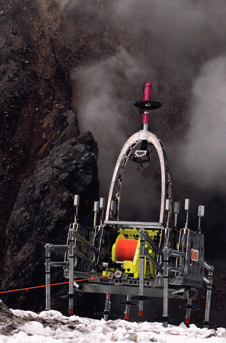
Dante 2 (NASA)
At first glance, Mr. Gower looks like a small metal cabinet on wheels, but its job is just as important as Dante 2 and Gemini-Scout. Mr. Gower is a robot that moves throughout a hospital, helping doctors and nurses bring medicine to patients. The body of the robot is a stack of locked drawers that store medicine. Nurses and doctors can unlock the drawers and get the medicine they need for their patients.
Mr. Gower can be programmed to go anywhere in the hospital. It can ride elevators, steer through hallways, and even move around things that get in the way. The robot is so strong that it can pull 500 pounds. Mr. Gower is battery powered, and after charging for only two hours, the robot can deliver medicine for twelve hours without stopping.
Not only does it work long days, but Mr. Gower can talk. It has been programmed to say hundreds of phrases like "Calling elevator" or "Your delivery is here." Mr. Gower reduces the amount of time doctors, pharmacists, and nurses spend walking around the hospital, allowing them to use their time to focus on other important tasks.
Agribots may not save lives, but many farmers find them very useful. An agribot is a robot that picks fruit. It might pick berries, oranges, grapes, or apples. Agribots are not yet widely used, but farmers are very interested in what these robots can do. Because picking a strawberry is different than picking an apple, agribots come in all shapes and sizes. Some have giant arms that are towed behind trucks, while others are able to move around on their own. In Japan, there is a strawberry-picking robot that can sense the color of the berries. This helps the robot know when each berry is ripe.
At the Massachusetts Institute of Technology (MIT), scientists are working to grow cherry tomatoes with no human help at all! They have created a greenhouse full of plants that are cared for by small agribots. The agribots are like robot farmers. Every plant has sensors that tell the robots what the plant needs. If a plant is too dry, a robot will water it. When a robot senses that a tomato is ripe, it uses a mechanical arm to pick the tomato. Agribots may seem unusual now, but one day they may be common on farms.
No matter how large or small a robot's job, one thing is for certain—robots are here to stay. Because robots are dependable and tireless, they are valuable tools, and as technology advances, they will be capable of doing increasingly complex jobs.
References
Dillow, C. (2011). Rescue robot just made for mine disasters. NBC News. Retrieved from http://www.nbcnews.com/technology/rescue-robot-just-made-mine-disasters-121251
Leary, W. E. (1994). Robot completes volcano exploration. The New York Times. Retrieved from http://www.nytimes.com/1994/08/03/us/robot-completes-volcano-exploration.html
Bares, J., & Whittaker, W. L. Dante II. Carnegie Mellon: The Robotics Institute. Retrieved from http://www.ri.cmu.edu/research_project_detail.html?project_id=163&menu_id=261
Rivers, C., & Boston, S. (2004). Robot delivers medications at shock trauma center. University of Maryland Medical Center. Retrieved from http://umm.edu/news-and-events/news-releases/2004/robot-delivers-medications-at-shock-trauma-center
Fields of automation. (2009) The Economist. Retrieved from http://www.economist.com/node/15048711
Your research leads you to an article with some general information about the Chicago World's Fair of 1893.
At the time the 1893 Chicago World's Fair took place, the idea of a world's fair was still relatively new. The event was meant to be a chance for participants to display the products of industry and innovation to the public. While the fairs that had preceded the 1893 event were exciting and anxiously awaited by the public, that year's fair was a milestone. There were over 65,000 exhibits, with exhibitors from all over the world. Some of the inventions displayed there are still in use!
The structure of the fair itself was simple, but it took up a vast amount of space. Jackson Park, on the shore of Lake Michigan, was the site of the fair. The total area of the fairgrounds was over six hundred acres. During the six months that the fair lasted, it received over 27 million visitors, many of whom came from far away. There were, indeed, some very famous visitors, including Helen Keller, Susan B. Anthony, and Thomas Edison.
But what was the draw of the fair? A better question might be: at that time, why would you not go to the fair? Visitors had a great variety of activities to choose from. For instance, they could eat food from all over the world—there was seating for approximately 7,000 people. Some of the food products introduced at the fair remain popular to this day. They could also attend lectures on a tremendous number of topics: during the course of the fair, there were nearly 6,000 of these speeches. But, beyond all of this, there was another feature that was a much bigger draw: the fair's inventions.
The exhibits at the fair showcased inventions which many visitors had not seen before—a full range of human innovation was on display. Among the inventions shown were the dishwasher, the fluorescent light bulb, and the zipper, all of which have become significant parts of American life and culture. Also present at the Fair, towering above the heads of the visitors, was the Ferris wheel, a new invention at the time and a staple of carnivals ever since. In fact, the Ferris wheel was responsible for drawing many of the fair's visitors, according to some sources.
Another amazing attraction of the fair was how it was lighted—by electricity. It was light, in fact, that brought Edison to the fair: he had competed for a contract to provide lighting for the event, but he lost to Nicola Tesla and George Westinghouse, two other inventors who had also made great progress with electricity and lighting.
Westinghouse had developed a system in which one circuit could light an entire town. By this time, Westinghouse had also started his own company, which dealt primarily with electrical appliances and electrical wiring, still fairly new at the time. When he and Nicola Tesla competed against Edison to light the World's Fair, they already had experience casting light over a large area. They also had experience figuring out what the best solution to a problem would be. This might help explain why they were selected to light the fair, and not Edison.
There were many more inventions (and their inventors) at the fair. Among them were Milton Hershey, inventor of a very popular chocolate bar, and H. J. Heinz, who began by selling a very tasty pickle. Heinz's company would later produce some of our most popular condiments.
Though human invention and spectacle have certainly developed since 1893, this event was indeed a true milestone.
References
Biography.com. (n.d.). Thomas Edison biography. Retrieved from http://www.biography.com/people/thomas-edison-9284349
The Field Museum. (2013). Opening the Vaults: Wonders of the 1893 World's Fair. Retrieved from http://fieldmuseum.org/happening/exhibits/opening-vaults-wonders-1893-worlds-fair
Maranzani, B. (2013, May 1). 7 things you may not know about the 1893 Chicago World's Fair. Retrieved from http://www.history.com/news/7-things-you-may-not-know-about-the-1893-chicago-worlds-fair
Overfelt, M. (2003, Apr 1). A world (fair) of invention: Heinz had a hit at 1893's Chicago exposition. And some then-unknowns like Milton Hershey got a taste of sweet inspiration. Retrieved from http://money.cnn.com/magazines/fsb/fsb_archive/2003/04/01/341008
Rose, J. K. (1996). A history of the fair. Retrieved from http://xroads.virginia.edu/~ma96/wce/history.html
Westinghouse Electric Company. (n.d.). Timeline: 1846-1899. Retrieved from http://www.westinghousenuclear.com/our_company/history/timeline/1846_1899.shtm
While avoiding plagiarism, explain how information from Source #2 is different from the information in Source #1 by paraphrasing the content. Identify sources by title or number.