Twa kɔ nsɛm atitiriw so
Log in
Sign up for FREE
arrow_back
Laabri

CAASPP Grade 7 ELA - Performance Task

star
star
star
star
star
Last updated 17 days ago
14 Nsɛmmisa
3
W.7.9a
W.7.9b
Ɛhia
10
W.7.2b
CCR.R.7
CCR.R.8
+8
1
W.7.1b
3
W.7.8
CCR.L.2
WHST.6-8.1.a
+8
10
W.7.1a
W.7.1b
+3
10
W.7.3a
RI.6.7
RST.6-8.1
+8
CCR.L.2
CCR.W.5
+8
10
W.7.2a

Student Directions

Napping Explanatory Performance Task

Task:

There has been much discussion in the news recently about the role of sleep and the role of napping. How many hours of sleep is enough? What is too much sleep? What is too little sleep? How do naps fit into sleep cycles? The journalism club advisor has asked you to research the roles of sleep and napping. As part of your research, you have found three sources about sleep and napping.

After you have reviewed these sources, you will answer some questions about them. Briefly scan the sources and the questions that follow. Then, go back and read the sources carefully so you will have the information you will need to answer the questions and complete your research. You may click on the Global Notes button to take notes on the information you find in the sources as you read. You may also use scratch paper to take notes.

In Part 2, you will write an explanatory article on a topic related to the sources.

Directions for Beginning:

You will now examine several sources. You can re-examine any of the sources as often as you like.

Research Questions:

After examining the research sources, use the remaining time in Part 1 to answer question(s) about them. Your answers to these questions will be scored. Also, your answers will help you think about the research sources you have read and viewed, which should help you write your explanatory article.

You may click on the Global Notes button or refer back to your scratch paper to review your notes when you think it would be helpful. Answer the questions in the spaces below the items.

Both the Global Notes on the computer and your written notes on scratch paper will be available to you in Part 1 and Part 2 of the performance task.

Part 1

Sources for Performance Task:

Source #1

Here is an article based on scientific research about sleep.

How Much Sleep Is Enough?

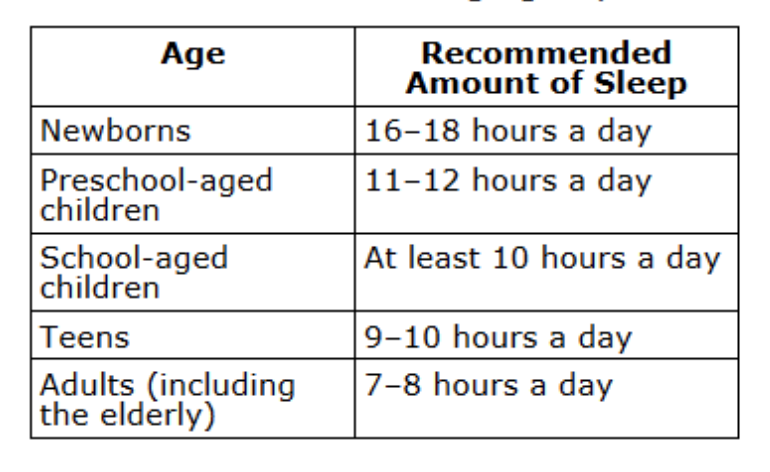
The amount of sleep you need each day will change over the course of your life. Although sleep needs vary from person to person, the chart below shows general recommendations for different age groups.

If you routinely lose sleep or choose to sleep less than needed, the sleep loss adds up. The total sleep lost is called your sleep debt. For example, if you lose 2 hours of sleep each night, you'll have a sleep debt of 14 hours after a week.

Some people nap as a way to deal with sleepiness. Naps may provide a short-term boost in alertness and performance. However, napping doesn't provide all of the other benefits of night-time sleep. Thus, you can't really make up for lost sleep.

Some people sleep more on their days off than on work days. They also may go to bed later and get up later on days off.

Sleeping more on days off might be a sign that you aren't getting enough sleep. Although extra sleep on days off might help you feel better, it can upset your body's sleep-wake rhythm.

Bad sleep habits and long-term sleep loss will affect your health. If you're worried about whether you're getting enough sleep, try using a sleep diary for a couple of weeks.

Write down how much you sleep each night, how alert and rested you feel in the morning, and how sleepy you feel during the day.

Sleeping when your body is ready to sleep is also very important. Sleep deficiency can affect people even when they sleep the total number of hours recommended for their age group.

For example, people whose sleep is out of sync with their body clocks (such as shift workers) or [is] routinely interrupted (such as caregivers or emergency responders) might need to pay special attention to their sleep needs.

"How much sleep is enough?" by The National Heart, Blood, and Lung Institute. In the public domain.

Ɛhia
2
Asemmisa {{asɛmmisaAhyɛnsode}}
1.

Explain how the table in Source #1 supports information provided in the two other sources. Cite evidence and identify the source of each piece of information by title or number.

RH.6-8.1
Ɛhia
1
RH.6-8.1
Asemmisa {{asɛmmisaAhyɛnsode}}
3.

People whose sleep is routinely interrupted might need to pay special attention to their

sleep needs. Provide two pieces of evidence from different sources that support this claim and explain how each example supports the claim. Cite evidence for each piece of information and identify the source by title or number.

Asemmisa {{asɛmmisaAhyɛnsode}}
4.

Part 2

You will now review your notes and sources, and plan, draft, revise, and edit your writing. You may use your notes and refer to the sources. Now read your assignment and the information about how your writing will be scored; then begin your work.

Your Assignment:

Now that you have completed research on the topic of sleep, the journalism club advisor has asked you to write an explanatory article about sleep and naps for the next issue of the school newspaper. The audience for your article will be other students, teachers, and parents.

Using more than one source, develop a thesis/controlling idea to explain about sleep and naps. Once you have a thesis/controlling idea, select the most relevant information from more than one source to support your thesis/controlling idea. Then, write a multi-paragraph

explanatory article explaining your thesis/controlling idea. Clearly organize your article and elaborate your ideas. Unless quoting directly from the sources, use your own words. Be sure to reference the source title or number when quoting or paraphrasing details or facts from the sources.

Explanatory Article Scoring:

Your explanatory article will be scored using the following:

  1. Organization / purpose: How well did you state your thesis/controlling idea, and maintain your thesis/controlling idea with a logical progression of ideas from beginning to end? How well did you narrow your thesis/controlling idea so you can develop and elaborate the conclusion? How well did you consistently use a variety of transitions? How effective was your introduction and your conclusion?

  2. Evidence/elaboration: How well did you integrate relevant and specific information from the sources? How well did you elaborate your ideas? How well did you clearly state ideas using precise language that is appropriate for your audience and purpose?

  3. Conventions: How well did you follow the rules of grammar usage, punctuation, capitalization and spelling?

Now begin work on your explanatory article. Manage your time carefully so that you can:

  • plan your multi-paragraph explanatory article.

  • write your multi-paragraph explanatory article.

  • revise and edit the final draft of your multi-paragraph explanatory article.

Word-processing tools and spell check are available to you.

For Part 2, you are being asked to write a multi-paragraph explanatory article, so please be as thorough as possible. Type your response in the space provided. The box will expand as you type.

Remember to check your notes and your prewriting/planning as you write and then revise and edit your explanatory article.

Student Directions

Second Language Learning Argumentative Performance Task

Task:

There has been much debate about the role of second language learning in American schools. The school board in your town, Pinesville, is holding a meeting to decide what programs to include in the elementary school for the upcoming year. One of the programs it is looking at is foreign language studies.

Before you make up your mind about foreign language education in your hometown, you will review four sources (two research articles, a compilation of letters to the editor, and an interview) that provide information about the pros and cons of foreign language studies and discuss at what age it is best to learn a foreign language.

After you have reviewed these sources, you will answer some questions about them. Briefly scan the sources and the three questions that follow. Then, go back and read the sources carefully to gain the information you will need to answer the questions and write an argumentative letter.

In Part 2, you will write an argumentative letter on a topic related to the sources.

Directions for Beginning:

You will now examine several sources. You can re-examine any of the sources as often as you like.

Research Questions:

After examining the research sources, use the remaining time in Part 1 to answer three questions about them. Your answers to these questions will be scored. Also, your answers will help you think about the research sources you have read and viewed, which should help you write your argumentative letter.

You may click on the appropriate buttons to refer to the sources when you think it would be helpful. You may also refer to your notes. Answer the questions in the spaces provided below them.

Part 1

Sources for Performance Task:

Source #1

Information for “The Best Time to Learn a Language” is based on the following sources:

http://www.cal.org/resources/digest/RaiseBilingChild.html

http://www.multilingualliving.com/2010/05/31/does-bilingualism-multilingualism-cause-language-delay/.

The Best Time to Learn a Language

by E.B. Perkins

Is earlier really better when it comes to learning to speak a second language? Many parents, educators, and policymakers are now coming to that conclusion. With increasingly sophisticated technology making our world smaller, there is a greater need for people to speak more than one language. A question that remains, however, is when that second language should be learned. Should a child be exposed to that second language from birth? In order to speak like a native speaker, an early start is important. But many parents worry that their children will be confused by hearing two different languages, and that they will not learn to speak either language as early as they might otherwise.

According to the American Academy of Family Physicians, “A bilingual home environment may cause a temporary delay in the onset of both languages. The bilingual child’s comprehension of the two languages is normal for a child of the same age, however, and the child usually becomes proficient in both languages before the age of five years.” (American Academy of Family Physicians, 1999)

But the conclusion is different in a report by Center for Applied Linguistics (2006). “Although many parents believe that bilingualism results in language delay, research suggests that monolingual and bilingual children meet major language developmental milestones at similar times.”

One thing that they both agree on is the fact that children end up at similar levels of language learning. But the bilingual child knows two languages!

It may be that it helps children to have more experience in life before learning a second language. Knowing what an orange is in one language may make it easier to know that naranja is the same thing—in Spanish. Children who start learning a second language a little later have already figured out how to use words in their first language. Many researchers believe this makes it easier to learn the second language.

Also, if a child already knows how to read in one language, he can use many of those same reading skills while learning a second language. Learning two languages while also learning how to read, though, is a much bigger challenge.

Another aspect of language is producing the sounds like a native speaker. While it is true that children may learn how to speak like a native speaker more easily than adults, adolescents and adults can also learn to speak without an accent. Older speakers are able to concentrate on learning for longer periods of time.

Children are often more open and curious with new languages, but older learners bring discipline to learning. Children learn better through games and activities, while adults tend to rely more on structure and rules. Whatever program is being used for learning a second language, the age of the learner should be taken into account.

There are definitely two ways to look at the question of when a second language should be learned. But there is no question about whether a second language should be learned. People who speak two languages are able to communicate to more people in better ways than those who only speak one.

Asemmisa {{asɛmmisaAhyɛnsode}}
5.

Select the boxes to show the idea(s) that each source supports. Some ideas may have more than one box selected. Some sources may not be selected.

Source #1: The Best Time to Learn a Language

Source #2: The Importance of Language Education

Source #3: Upton Daily Gazette Letter to Editor

Source #4: Interview

The United States lags behind other nations in teaching students a second language.

There are challenges in providing second language instruction in schools in the United States.

Asemmisa {{asɛmmisaAhyɛnsode}}
6.

All of the sources provide information about learning a second language. Which source would be the most relevant to students researching when learning a second language should start? Justify and support your answer with two pieces of evidence from the most relevant source.

Student Directions for Part 2

You will now review your sources, take notes, and plan, draft, revise, and edit your letter. You may use your notes and refer to the sources. You may also refer to the answers you wrote to the questions in Part 1, but you cannot change those answers. Now read your assignment and the information about how your argumentative letter will be scored; then begin your work.

Your Assignment:

You are a middle school student in the town of Pinesville. The school board, the group of people who make decisions regarding school policy, is holding a meeting to decide what programs to include in the elementary school for the upcoming year. Today, you will write a letter addressed to the school board. In your letter, establish an argumentative claim for or against the inclusion of second language instruction in the local elementary school. Make sure to address potential counterarguments in your letter and support your claim with information from the sources you have examined.

Argumentative Scoring

Your argumentative letter will be scored using the following:

  • Statement of claim and organization: How well did you state your claim, address opposing claims, and maintain your claim with a logical progression of ideas from beginning to end? How well did your ideas thoughtfully flow from beginning to end using effective transitions? How effective was your introduction and your conclusion?

  • Elaboration/evidence: How well did you integrate relevant and specific information from the sources? How well did you elaborate your ideas? How well did you clearly state ideas using precise language that is appropriate for your audience and purpose?

  • Conventions: How well did you follow the rules of grammar usage, punctuation, capitalization, and spelling?

Now begin work on your argumentative letter. Manage your time carefully so that you can:

  • plan your letter

  • write your letter

  • revise and edit the final draft of your letter

Word-processing tools and spell check are available to you.

For Part 2, you are being asked to write a multi-paragraph letter so please be as thorough as possible. Type your response in the space provided. The box will expand as you type. Remember to check your notes and your prewriting/planning as you write and then revise and edit your letter.

Asemmisa {{asɛmmisaAhyɛnsode}}
7.

Write a multi-paragraph letter addressed to the Pinesville school board. Establish an argumentative claim for or against the inclusion of second language instruction in the local elementary school. Address potential counterarguments and support your claim with information from the sources you have examined. Be thorough, and revise and edit your letter.

Student Directions

Climbing Mount Everest Narrative Performance Task

Task:

Your social studies class is planning an exhibit to highlight exploration around the world. Each student is to pick a topic, and you have decided to learn more about climbing Mount Everest. As part of your research, you have found two articles and one book excerpt about Mount Everest.

After you have reviewed these sources, you will answer some questions about them. Briefly scan the sources and the questions that follow. Then, go back and read the sources carefully to gain the information you will need to answer the questions and finalize your research. You may click on the NOTES box to take notes on the information you find in the sources as you read. Your notes will be available to you as you answer the questions.

In part 2, you will write a story on a topic related to the sources.

Directions for Beginning:

You will now examine several sources. You can re-examine any of the sources as often as you like.

Research Questions:

After examining the research sources, use the remaining time in part 1 to answer question(s) about them. Your answers will be scored. Also, your answers will help you think about the research sources you have read and viewed, which should help you write your story.

You may click on the NOTES button above the sources to look at your notes when you think it would be helpful. Answer the questions in the spaces provided below them.

Part 1

Sources for Performance Task:

1
W.7.8
3
Asemmisa {{asɛmmisaAhyɛnsode}}
9.

Explain how the chart in Source #1 supports the information provided in the other two sources. Cite evidence and identify the source of each piece of information by title or number.

W.7.8
3
Asemmisa {{asɛmmisaAhyɛnsode}}
10.

Explain why climbing Mount Everest is difficult. Provide at least two examples from different sources to support this idea and explain how each example supports the idea. Be sure to identify the source of each piece of information.

W.7.8
Asemmisa {{asɛmmisaAhyɛnsode}}
11.

Student Directions for Part 2

You will now review your sources, take notes, and plan, draft, revise, and edit your story. You may use your notes and refer to the sources. Now read your assignment and the information about how your story will be scored; then begin your work.

Your assignment:
As part of the social studies exhibit, there will be a collection of realistic fiction stories. You are going to write a multi-paragraph story to include in the exhibit. Your story in the exhibit will be read by teachers, students, parents, and friends. For your story, imagine that you have the chance to climb Mount Everest. When writing your story, tell a story about something that happens as you climb the mountain. When writing your story, find ways to use information and details about Mount Everest and those who climbed the mountain from the sources to improve your story. Make sure you develop your character(s), the setting, and the plot, using details, dialogue, and descriptions where appropriate.

Narrative Scoring
Your story will be scored using the following:

  • Organization and purpose: How effective was your plot, and did you maintain a logical sequence of events from beginning to end? How well did you establish and develop a setting, narrative, characters, and point of view? How well did you use a variety of transitions? How effective was your opening and closing for your audience and purpose?

  • Elaboration and evidence: How well did you develop your story using description, details, dialogue? How well did you use relevant details or information from the sources in your story?

  • Conventions: How well did you follow the rules of grammar usage, punctuation, capitalization, and spelling?

Now begin work on your story. Manage your time carefully so that you can:

  • plan your multi-paragraph story

  • write your multi-paragraph story

  • revise and edit the final draft of your multi-paragraph story

Word-processing tools and spell check are available to you.

For Part 2, you are being asked to write a story that is several paragraphs long, so please be as thorough as possible. Type your response in the space provided. The box will expand as you type.

Remember to check your notes and your prewriting/planning as you write and then revise and edit your story.

Student Directions

Non-Native Plants Explanatory Performance Task

Task:

Before Thanksgiving break, your science teacher brings some apple pie to your class. He tells you that during your next unit, you will study non-native plants. You do not understand the connection until your teacher asks, "Did you know that apples were brought to America from Europe?" This fact surprises you, and you decide to find out more about how plants have traveled from their native environment to new regions. As part of your initial research, you have uncovered four articles about non-native plants.

After you have reviewed these sources, you will answer some questions about them. Briefly scan the sources and the questions that follow. Then, go back and read the sources carefully to gain the information you will need to answer the questions and finalize your research. You may click on the NOTES box to take notes on the information you find in the sources as you read. Your notes will be available to you as you answer the questions.

In Part 2, you will write an explanatory article on a topic related to the sources.

Directions for Beginning:

You will now examine several sources. You can re-examine any of the sources as often as you like.

Research Questions:

After examining the research sources, use the remaining time in Part 1 to answer question(s) about them. Your answers will be scored. Also, your answers will help you think about the research sources you have read and viewed, which should help you write your article.

You may click on the NOTES button above the sources to look at your notes when you think it would be helpful. Answer the questions in the spaces below them.

Part 1

Sources for Performance Task:

Source #1

As you start your research, you find this article about how some non-native plants came to North America.

Plant Invaders!

When you hear invaders, you might think the word only applies to science fiction novels. But some invaders live right in your backyard! These are invasive plants, and once they take root, getting rid of them can be a challenge.

What Is an Invasive Plant?

An invasive plant is a plant that thrives outside of its natural habitat and is likely to cause harm to the ecosystem. These plants come into an area from other parts of the world and sometimes arrive by accident.

If a plant is naturally fast-growing, it can be especially invasive in a new habitat. Insects and other animals that eat the plant in its natural habitat do not always live in the new environment. Without the insects and animals to eat the plant, it grows unchecked and can quickly cause problems.

Some invasive plants arrived with the colonists when they traveled to the New World. Before setting sail, the colonists weighed down their ships with soil and rocks from their homeland. This material, called ballast, was meant to balance the weight to keep the ship from capsizing. The soil in the ballast often included seeds from European plants. When the ships arrived in the New World and the ballast was emptied, the seeds began growing in the new soil.

What's the Problem with Invasive Plants?

Invasive plants can have many negative effects on an ecosystem. They can crowd out plants native to the ecosystem, causing the native plants to die. This effect multiplies when the insects and animals that rely on those plants for food also die. In other cases, the animals that rely on the native plants must move to another ecosystem where native plants still grow.

In the 1980s, scientists studying ecosystems began to notice a number of invasive plants. They eventually identified more than 4,000 non-native species in the United States and Canada. Some of the most common were Japanese kudzu and honeysuckle. Kudzu was brought over from Japan in 1876 at a special exposition celebrating the United States' 100th birthday. Visitors to the exposition were impressed by the fast-growing vine, and some took its seeds with them. The U.S. government began planting it to control erosion and soon entire hillsides were covered with the vine. However, it quickly eliminated other plants in native forests. Now, cities across the United States, particularly in the south, battle the vine every year. Like kudzu, Japanese honeysuckle was also planted as a ground cover in the 1800s, mostly on the East Coast. Many people enjoy its sweet-smelling flowers in late spring and summer. But its beauty is deceptive; it can quickly overtake native trees and bushes.

Are All Non-Native Plants Problematic?

Some non-native plants, though, are not as aggressive and can be fairly easily managed. For example, many people in North America plant English ivy as a ground-covering plant. Although it is not native to the continent, the ivy can be pruned regularly so that it does not grow out of control. Other plants have been growing in North America for such a long time that it is hard to remember that they are not native plants. Tulips and irises, for example, first grew in Europe, the Middle East, and Asia. Oranges, wheat, and apples, also originally non-native plants, have become staples.

Earth's ecosystems need diversity among their plants and animals in order to maintain balance. The challenge is making sure invasive plants do not reduce this diversity and upset the natural balance.

Sources

Green, S. (2012, Aug 24). The history and meaning of the iris. Retrieved from http://www.proflowers.com/guide/history-and-meaning-of-iris

Souza, D. M. (2004). Plant invaders. Danbury, CT: Franklin Watts.

Tesselaar. (n.d.). The history of the tulip. Retrieved from

http://www.tesselaar.net.au/flowerandgarden/thetulip.asp

The United States National Arboretum. (2008, Aug). Invasive plants. Retrieved from http://www.usna.usda.gov/Gardens/invasives.html

3
W.7.8
3
W.7.1b

Part 2

Student Directions for Part 2

You will now review your sources, take notes, and plan, draft, revise, and edit your writing. You may use your notes and refer to the sources. Now read your assignment and the information about how your writing will be scored; then begin your work.

Your assignment:

Your science class is completing a class project about invasive plants. Your teacher has given you the topic of non-native plants and why some succeed in new environments while others become nuisances. The audience for your essay will be other students, teachers, and parents.

Using more than one source, develop a thesis/controlling idea to explain why some non-native plants succeed in new environments while others become nuisances. Once you have a thesis/controlling idea, select the most relevant information to support your thesis/controlling idea. Then, write a multi-paragraph explanatory essay explaining your thesis/controlling idea. Clearly organize your essay and elaborate on your ideas. Unless quoting directly from the sources, use your own words. Be sure to reference the source title or number when quoting or paraphrasing details or facts from the sources.

Explanatory Essay Scoring

Your explanatory essay will be scored using the following:

  • Organization/purpose: How well did you state your thesis, and maintain your thesis with a logical progression of ideas from beginning to end? How well did you narrow your thesis so you can develop and elaborate the conclusion? How well did you consistently use a variety of transitions? How effective were your introduction and your conclusion?

  • Elaboration/evidence: How well did you integrate relevant and specific information from the sources? How effective were your elaborative techniques? How well did you clearly state ideas using precise language that is appropriate for your audience and purpose?

  • Conventions: How well did you follow the rules of grammar usage, punctuation, capitalization, and spelling?

Now begin work on your essay. Manage your time carefully so that you can:

  • plan your multi-paragraph essay

  • write your multi-paragraph essay

  • revise and edit the final draft of your multi-paragraph essay

Word-processing tools and spell check are available to you.

For Part 2, you are being asked to write a multi-paragraph essay, so please be as thorough as possible. Type your response in the space provided. The box will expand as you type.

Remember to check your notes and your prewriting/planning as you write and then revise and edit your essay.

Asemmisa {{asɛmmisaAhyɛnsode}}
14.

Using more than one source, develop a thesis/controlling idea to explain why some non-native plants succeed in new environments while others become nuisances. Once you have a thesis/controlling idea, select the most relevant information to support your thesis/controlling idea. Then, write a multi-paragraph explanatory essay explaining your thesis/controlling idea. Clearly organize your essay and elaborate on your ideas. Unless quoting directly from the sources, use your own words. Be sure to reference the source title or number when quoting or paraphrasing details or facts from the sources.

Asemmisa {{asɛmmisaAhyɛnsode}}
2.

Click on the boxes to show the claim(s) that each source supports. Some sources will have more than one box selected.

Source #1:

How Much

Sleep Is Enough?

Source #2:

The Secret

Truth about

Napping

Source #3:

Ask the

Sleep

Doctor

If you take too long of a nap, you might feel sleepy.

If your sleep patterns interrupt your body's internal clock, you might have trouble getting enough sleep.

A deep sleep helps the brain to operate at a higher level.

Source #1

This is an article about preparing to climb Mount Everest.

Preparing to Climb

The decision to climb Mount Everest is a big one. Not only is the climb difficult on your body, but the trip is also expensive and requires specialized equipment. There are many preparations that need to take place in the years preceding an attempt at such a climb.

The Training

People considering climbing Mount Everest need to train their bodies for two to three years in advance. The climbers need to be in optimal physical and mental condition. With so little oxygen available at such high altitudes, climbers need their bodies running as efficiently as possible. They need their veins and arteries in top condition so that blood can easily reach all areas of their bodies. They also need their heart and lungs as healthy as possible.

It is recommended that prospective climbers train by running seven or eight miles per day. Climbers should also work at strengthening their upper bodies. The backpacks that climbers carry can weigh 25 to 35 pounds!

Climbers need to gain weight prior to the climb. With the strenuous exercise of climbing the mountain, coupled with the harsh, cold conditions, climbers' bodies burn many calories in a day. It is estimated that climbers on Mount Everest burn around 6000 calories a day as opposed to the typical 2000 calories a day. It is important that climbers are prepared for this increase in calories burned.

People interested in climbing Mount Everest also need to prepare mentally. It is important that they spend time at high altitudes in very basic conditions in order to cope on the mountain. Climbers also need to learn to relax and be patient. Of the seven-week trek, only 21 days are actually spent climbing. The rest of the time is spent at camp resting and allowing climbers' bodies to get used to the conditions. This can be very difficult for some people. Climbers also need to prepare themselves for some of the adverse effects that happen at high altitudes. A person's mental sharpness drops dramatically at high altitudes. Even basic math skills become very difficult or impossible near the top of the mountain.

The Equipment

Climbing Mount Everest requires a great deal of specialized equipment. Oxygen canisters, a sack to collect ice and snow for melting, a satellite phone, a two-way radio, and some foot powder are all essential for survival.

The food that a climber carries needs to be lightweight and nonperishable. Most climbers carry boil-in-the-bag meals. Chocolate and cookies are also popular as they help climbers to ingest the additional calories that they need. In addition, climbers need cooking equipment.

Clothing is very important for climbers. Plastic frost-proof climbing boots help to protect climbers' feet from the harsh conditions. These boots need to be a perfect fit in order to avoid sore feet. Two pairs of warm, dry socks are essential. The socks worn during the day will absorb enough water to fill a juice glass. Climbers will wear the second pair of socks at night while their day socks dry.

Several fleece layers are necessary to keep climbers warm. The first layer will need to dry quickly so that it can be worn the next day. The second layer will consist of two fleece jackets and a pair of fleece pants. A down-filled snowsuit is also necessary.

It is essential that climbers protect themselves from the sun while climbing Mount Everest. With all of the white snow, the reflection can cause severe sunburns. Climbers can be sunburned on the roof of the mouth or inside the nostrils due to the reflection, so extra precautions need to be taken. Bandanas need to be worn around the neck. A thin face mask needs to be worn to protect the face. Two fleece hats cover the head and ears to protect them from the cold and the sun. A big visor is also necessary to protect the head and face from the sun. Gloves worn inside huge, insulated mittens keep the hands warm and protected.

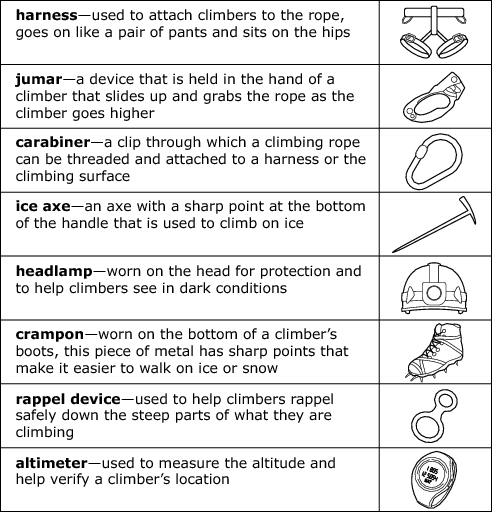
Climbers need specialized mountain gear. The list of necessary climbing equipment includes the following:
The Extras

In addition to the mountain-climbing equipment, climbers wishing to attempt to reach the top of Mount Everest need to purchase permits from the government of Nepal. These permits can take up to six months to get and are very expensive. Climbers also need to hire Sherpas, or people that help to carry necessary gear. It is also essential to hire a climbing guide that is experienced and can lead the climbers to the top and deal with any situations that may arise.

The preparations that are necessary to attempt to climb Mount Everest are significant. It is an expensive adventure that requires careful and concise planning. However, if all of the proper planning is done, and the weather conditions are just right, the trek to the top of Mount Everest can be a very rewarding adventure!

References

Aquino, R. (n.d.). Mountain climbing tools. Trails.com. Retrieved from http://www.trails.com/list_39351_mountain-climbing-tools.html

de Garis, K., & O'Connell, D. (2003, March 30). How to climb Everest. The Observer. Retrieved from http://www.theguardian.com/world/2003/mar/30/everest.features3

How to climb Mount Everest. (n.d.). eHow. Retrieved from http://www.ehow.com/how_17485_climb-mount-everest.html

The equipment you need for climbing Mount Everest. (n.d.). Nepal Equipment. Retrieved from http://www.nepalequipment.com/
Asemmisa {{asɛmmisaAhyɛnsode}}
8.

Source #1 presents information about what is needed to climb Mount Everest. Choose one answer that identifies the source that most accurately supports the information in Source #1 and correctly explains why.

Asemmisa {{asɛmmisaAhyɛnsode}}
12.

Explain how some non-native plants can grow quickly in new environments and how some non-native plants can cause problems in these ecosystems. Provide two details from different sources to support your answer. Identify the source of each detail by title or number.

Asemmisa {{asɛmmisaAhyɛnsode}}
13.

Some non-native plants can actually become useful in new environments. Provide at least two examples from different sources that support this idea and explain how each example supports the idea. Cite evidence for each piece of information and identify the source by title or number.