Twa kɔ nsɛm atitiriw so
Log in
Sign up for FREE
arrow_back
Laabri

CAASPP Grade 11 ELA - Performance Task

star
star
star
star
star
Last updated 11 days ago
10 Nsɛmmisa
Mandatory Financial Literacy Classes Argumentative Performance Task
3D Printers Argumentative Performance Task
Sunflower Power Explanatory Performance Task
Ɛhia
2
W.11-12.8
Ɛhia
1
RL.11-12.1
Ɛhia
2
DOK 4
W.11-12.8
Ɛhia
10
DOK 4
W.11-12.1b
Ɛhia
1
DOK 3
W.11-12.8
Ɛhia
2
DOK 4
W.11-12.8
Ɛhia
10
DOK 4
W.11-12.1a

Part 1

Sources for Performance Task

Ɛhia
1
DOK 3
W.11-12.9a
W.11-12.9b
Ɛhia
2
DOK 3
W.11-12.9a
W.11-12.9b
Ɛhia
10
DOK 4
W.11-12.2.a

Source #1

This article, from April 9, 2010, is from the New York Times, and is about the potential benefits of financial literacy courses.

Working Financial Literacy in With the Three R's

by Tara Siegel Bernard

Most Americans aren't fluent in the language of money. Yet we're expected to make big financial decisions as early as our teens—Should I take on thousands of dollars of student debt? Should I buy a car?—even though most of us received no formal instruction on financial matters until it was too late.

While no course in personal finance could have prevented many Americans from getting caught up in the housing bubble1, it's clear that most of us need some help, preferably starting when we're still in school. And I'm not just talking about learning to balance your checkbook. It's understanding concepts like the time value of money, risk and reward, and, yes, the importance of savings.

All of this raises the question: What's happening inside our classrooms? And how many schools even broach the topic? As it turns out, for a country that prizes personal responsibility, we're doing very little.

"We need to teach the basics of economics and finances so people can make financial decisions in a changing world," said Annamaria Lusardi, economics professor at Dartmouth College and a research associate at the National Bureau of Economic Research. "It's the compounding of interest2, the problem of inflation3. These are the principles. And these are really scientific topics."

While more states are beginning to require some sort of personal finance instruction, there aren't enough that do, financial literacy experts say, and there is little consistency in the quality of the education. Just 13 states require students to take a personal finance course or include the subject in an economics course before they graduate from high school, up from seven states in 2007, according to the Council for Economic Education. Meanwhile, 34 states (including those 13) have personal finance within their curriculum guidelines, up from 28 states in 2007. ...

But that hasn't stopped enterprising teachers like Mathew Frost, who teaches 11th and 12th graders American history and economics at Sunset High School in Dallas, from working the topic into his student's school day. The Texas economics curriculum carves out time for personal finance, but it doesn't test students on the material. Mr. Frost says it's just too important to ignore. So he tries to bring the lesson to life for his students by pairing them up as married couples and giving them a couple of children. The students must then create a budget based on the average income range for their neighborhood, or about $21,000 to $40,000 a year. As in the board game

"Life," the students are dealt real-world circumstances.

Mr. Frost has them randomly pick "chance cards" from a bag, which might tell them they need new brakes for their car, broke an arm, suffered a death in the family, or found $20.

"I try to make it as realistic as possible," he said. "We talk about building budgets, expenses, investing money," he added, as well as "how to use credit wisely, insurance and careers."

One of his students later wrote about the experience. The 11th grader, who simulated life with a wife and two children on $21,000 a year, told of balancing needs versus wants, trying to find an apartment in a safe neighborhood that fit the family budget, and the effect of an unexpected rent increase on their savings.

"I first learned that real life isn't going to be as nice as this game," he said. "I also learned that good budgeting has to be maintained throughout a person's life no matter the income, no matter the living conditions."

Research shows that this type of financial education tends to resonate with the students later.

Michael S. Gutter, an assistant professor of family financial management at the University of Florida, studied the issue in 2009, after he surveyed 15,700 students at 15 universities who came from states with different (or nonexistent) personal finance schooling requirements. The study was financed by the National Endowment for Financial Education, a nonprofit organization in Denver that provides financial education curriculums.

"College students who came from states where there was a course required were more likely to budget, were more likely to be saving, and were less likely to have maxed out their credit cards in the last year and were more likely to be paying off their credit cards fully," Professor Gutter said. But his research also suggested that "social learning is also very powerful as well," he said. "What your parents tell you matters." ...

"It's hard because there is no silver bullet to get this into every school," said Matthew Yale, deputy chief of staff to Education Secretary Arne Duncan. "It's not as simple as saying, 'We're going to institute this in the 100,000 public schools in America.' But our plan for reauthorization does make room for financial literacy in schools, which is a really big, big deal." Mr. Yale was referring to the Obama administration's plan to revise the Elementary and Secondary Education Act, commonly known as No Child Left Behind.

He said the Department of Education's next step is to work with districts and teachers and help them find the money they need, whether it's through the many literacy-minded nonprofits or the private sector. Mr. Yale also said that department officials were working on competitive grant programs, which would allow schools to compete for money to pay for the financial literacy programs. As a joint effort with the Treasury Department, the Education Department is currently running the National Financial Capability Challenge, an online exam for high school students that measures financial know-how and recognizes outstanding performers, to help raise awareness.

President Bush created the first Advisory Council on Financial Literacy in 2008, and President Obama plans to assemble his own team. In its annual report, the first council recommended that Congress or state legislatures mandate financial education in all schools for students in kindergarten through 12th grade. But will the new administration follow through with that recommendation? Mr. Yale said education officials were "not interested in introducing unfunded mandates."

So what can we do? According to Scott Truelove, who teaches personal finance as part of a work-study program for seniors at Chesterton High School in Indiana, "It will take a parent movement."

Mr. Truelove has already seen the power of financial education in his school's hallways, where a student told him and another personal finance teacher that she set up a Roth I.R.A.4 given what she learned in class.

"That, to me, is huge," Mr. Truelove said.

1housing bubble: when housing prices rapidly increase to unsustainable levels and then collapse

2compound interest: interest paid on both the original amount of money invested and on the interest it has already earned

3inflation: a general increase in prices that decrease the purchasing power of money

4Roth I.R.A.: a type of individual retirement account

Bernard Siegal, Tara. (2010, April 9). Working Financial Literacy in With the Three R's. The New York Times. Retrieved from http://www.nytimes.com/2010/04/10/your-money/10money.html.
Asemmisa {{asɛmmisaAhyɛnsode}}
1.

Paraphrase information from Source #1 that refutes information from Source #2 without plagiarizing.

Key Elements:

Source #1 (Working Financial Literacy in With the Three R's)

  • Students in Matthew Frost's American history and economics class reported that they had positive outcomes from participating in the personal finance portion of this course. One student said he learned about the importance of budgeting money. Another student reported that the class prompted her to open a Roth I.R.A.

  • A study conducted by a professor at the University of Florida found that students who were required to take financial literacy classes in high school were more likely to budget and save their money, and less likely to accrue credit card debt.

Source #2 (Financial Education Leaving Americans Behind)

  • There is evidence that financial literacy courses don't work and can potentially even harm the students who take them by making them overconfident in their ability to make good financial decisions.

  • Willis says that financial literacy classes can actually keep people from attaining their financial literacy goals. She cites examples of students whose financial literacy skills stayed the same or decreased after taking financial literacy classes.

  • A Harvard Business School study concluded that common financial literacy programs used in the past two decades did not alter the choices participants made about their finances.

Asemmisa {{asɛmmisaAhyɛnsode}}
2.

Click on the boxes to show the claim(s) that each source supports. Some sources will have more than one box selected.

Source #1:

Working

Financial

Literacy in

With the Three R's

Source #2:

Financial

Education

Leaving

Americans

Behind

Source #3:

Financial

Literacy, Beyond the Classroom

Source

#4: Finance Course Prompts Debate

People should take financial literacy classes when they are young so they are prepared to make good financial decisions as young adults.

Some people support financial literacy despite

evidence that it does not work.

Financial literacy education could be effective if we rethink the way it is taught.

Resources for improving financial literacy should be spent on financial regulation instead.

Asemmisa {{asɛmmisaAhyɛnsode}}
3.

All of the sources provide information about financial literacy education. Which source

would most likely be relevant to students researching new approaches to increasing

people's financial literacy? Support your response with two details from the source. Justify your answer and support it with information from the source.

Asemmisa {{asɛmmisaAhyɛnsode}}
4.

Part 2

You will now review your notes and sources, and plan, draft, revise, and edit your writing. You may use your notes and refer to the sources. Now read your assignment and the information about how your writing will be scored; then begin your work.

Your Assignment:

After completing your research, you share your findings with your teacher, who suggests that you write an argumentative essay about financial literacy courses for the upcoming school board meeting.

Today, in preparation for the school board meeting, you will write a multi-paragraph argumentative essay in which you take a stance on the topic of financial literacy courses. Make sure you establish an argumentative claim, address potential counterarguments, and support your claim from the sources you have read. Develop your ideas clearly and use your own words, except when quoting directly from the sources. Be sure to reference the sources by title or number when using details or facts directly from the sources.

Argumentative Essay Scoring:

Your argumentative essay will be scored using the following:

  1. Organization/purpose: How well did you state your claim, address opposing claims, and maintain your claim with a logical progression of ideas from beginning to end? How well did your ideas thoughtfully flow from beginning to end using effective transitions? How effective was your introduction and your conclusion?

  2. Evidence/elaboration: How well did you integrate relevant and specific information from the sources? How well did you elaborate your ideas? How well did you clearly state ideas in your own words using precise language that is appropriate for your audience and purpose? How well did you reference the sources you used by title or number?

  3. Conventions: How well did you follow the rules of grammar usage, punctuation, capitalization, and spelling?

Now begin work on your argumentative essay. Manage your time carefully so that you can

  • plan your multi-paragraph argumentative essay

  • write your multi-paragraph argumentative essay

  • revise and edit the final draft of your multi-paragraph argumentative essay

Word-processing tools and spell check are available to you.

For Part 2, you are being asked to write a multi-paragraph argumentative essay so be as thorough as possible. Type your response in the space provided. The box will expand as you type.

Remember to check your notes and your rewriting/planning as you write and then revise and edit your argumentative essay.

Source #1

Here is a document that outlines the District of Columbia Public Library's 3D Printing Policy.

DC Public Library 3D Printing Policy

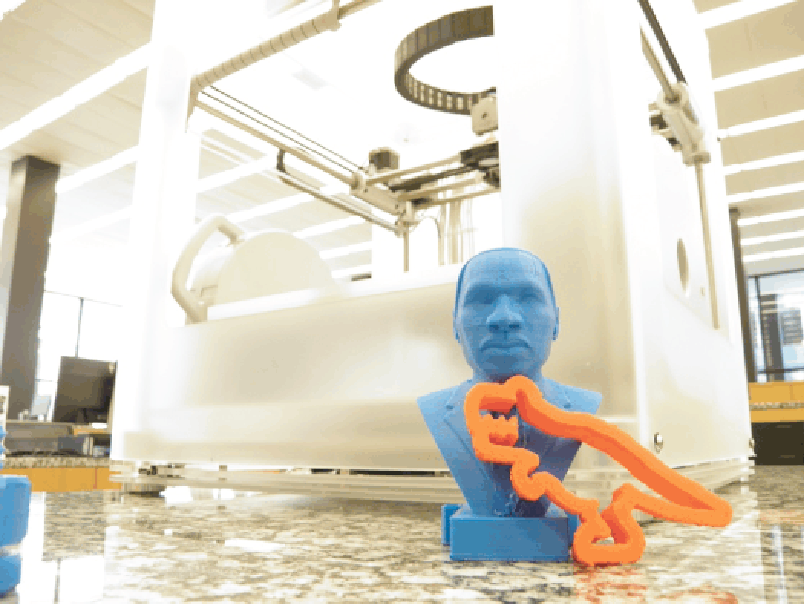
The 3-D printer at the Martin Luther King Jr. Memorial Library in Washington, D.C.

The Digital Commons, located in the Martin Luther King Jr. Memorial Library, provides access to new technology, including 3D printing for a fee, which is collected at the time of file submission. This is a staff-mediated service and is available on a first-come, first-served basis.

The DC Public Library reserves the right to refuse production of any content at any time at the discretion of Library staff. Examples of specific content that will not be produced include, but are not limited to:

  • Content that…infringes upon the safety and security of minors.

  • Content that may be construed as having intent to harm.

  • Content that may infringe upon the intellectual property rights of a third party.

By submitting content, the customer agrees to assume all responsibility for, and shall hold the library harmless in, all matters related to patented, trademarked, or copyrighted materials.

The DC Public Library is not responsible for any damage, loss, or security of data arising from the use of its computers or network, nor for the functionality or quality of content produced on the 3D printer. Refunds are not permitted.

Customers will be notified when their print job has been completed, and all files will be deleted from the system at that time. Projects that are not picked up within fourteen (14) calendar days following notification will not be retained.

“3D Printing Policy,” from DC Public Library. In the public domain.

Asemmisa {{asɛmmisaAhyɛnsode}}
5.

Different sources can be used to support different claims about 3D printers. For each of the claims listed in the left column, click the box that identifies the source that can most credibly provide evidence to support that claim.

Source #2: Beyond 3-D Printers’ Magic

Source #4: 3D Printing Fits Within the Existing Online Copyright System

Source #5: Mission Creep

3D printing will present patent and copyright holders with new challenges.

Librarians disagree about whether or not public libraries should have 3D printers.

The 3D printing community can police itself when it comes to copyright and patent law.

Asemmisa {{asɛmmisaAhyɛnsode}}
6.

Source #1 explains the 3D printing policy of a public library that has decided to add 3D printing to its services. What evidence is there that the writers of that policy have taken into account the issues or concerns from the other sources? Identify any two separate issues or concerns from the other sources and explain how the policy in Source #1 addresses those issues or concerns. Cite your sources using the name or number of the source.

Asemmisa {{asɛmmisaAhyɛnsode}}
7.

Student Directions for Part 2

You will now review your sources, take notes, and plan, draft, revise, and edit your letter. You may use your notes and refer to the sources. Now read your assignment and the information about how your argumentative letter will be scored; then begin your work.

Your assignment:
The head librarian at the public library where you are an intern has asked you for a recommendation about whether or not the library should purchase a 3D printer for use by the general public. She wants your recommendation in a letter addressed to the library’s board of directors.

Your assignment is to use the research sources to write a multi-paragraph argumentative letter supporting or opposing the acquisition of a 3D printer. Make sure you establish an argumentative claim, address potential counterarguments, and support your claim from the sources you have read. Develop your ideas clearly and use your own words, except when quoting directly from the sources. Be sure to reference the sources by title or number when using details or facts directly from the sources.

Argumentative Scoring

Your argumentative letter will be scored using the following:

  • Organization/purpose: How well did you state your claim, address opposing claims, and maintain your claim with a logical progression of ideas from beginning to end? How well did your ideas thoughtfully flow from beginning to end using effective transitions? How effective were your introduction and your conclusion?

  • Elaboration/evidence: How well did you integrate relevant and specific information from the sources? How well did you elaborate your ideas? How well did you clearly state ideas in your own words using precise language that is appropriate for your audience and purpose? How well did you reference the sources you used by title or number?

  • Conventions: How well did you follow the rules of grammar usage, punctuation, capitalization, and spelling?

Now begin work on your argumentative letter. Manage your time carefully so that you can:

  • plan your multi-paragraph letter

  • write your multi-paragraph letter

  • revise and edit the final draft of your multi-paragraph letter

For Part 2, you are being asked to write a multi-paragraph letter, so please be as thorough as possible. Type your response in the space provided. The box will expand as you type.

Remember to check your notes and your prewriting/planning as you write and then revise and edit your letter.

Source #1

This article is from the U.S. Department of Agriculture's quarterly publication BAR Digest and is about studies being conducted on the use of sunflowers for biofuels.

Biofuel from Sunflower: A Bright Opportunity for the Sun-loving Bloom

by Rita T. dela Cruz

In a bid to decrease the country's overdependence on fuel, various research institutions started to focus their leads in studying and identifying some of the most cost-effective and environment-friendly energy sources to produce biofuels. Biofuels, such as bioethanol, biodiesel and biogas, are renewable fuels that are generally produced from agricultural crops or organic matter.

This effort to find an alternative bio-source is also in accordance with the recent passing into law of the Biofuel Acts or SB 2226 and the Department of Agriculture (DA)'s drive towards energy independence. The law requires that "a minimum of 1% biodiesel by volume shall be blended into all diesel engine fuels sold in the country subject to domestic supply and availability of locally sourced biodiesel component." Violators are penalized with one to five years' imprisonment and a fine.

Among the crops identified as potential sources of bioethanol are: sugarcane, sweet sorghum, coconut, corn, cassava, and jathropa. And now, sunflower is also coming into the picture as another potential bio-source for ethanol.

The potential of sunflower (along with grapeseed) is also being studied in Taipei in their effort to look for more domestic feedstocks coupled with best available and affordable technology.

Even the Brazilian agricultural experts are now optimizing the potential of sunflower by learning how to transform sunflowers into biofuel in the most cost-effective means. Other renewable energy sources that they are looking into are soybean and oilseed rape.

Meanwhile, an Italian farming association is working on biofuels produced from sunflowers and sugar beets. Its sunflower oil-powered boat premiered at the recent Kyoto Protocol conference in Montreal. It sounded a bit off-beat, but the boat ran fine.

According to experts, if this project pushes through in the market, this biofuel is going to be relatively inexpensive. It was also reported that everything smelled faintly like French fries after the demonstration.

Sunflowers in the Philippines

Sunflower (Helianthus annuus) is an annual plant that belongs to the family of Asteraceae and is native in North and South America. Although it is not commonly grown in the Philippines, it can thrive in its soil. The giant sunflowers (grows up to 12 feet with head up to 3 inches wide) are native in the eastern United States. The common and recommended variety of sunflower in the Philippines is the hybrid type, which grows up to 105 days after planting.

Sunflowers in the Philippines are grown for ornamental purposes and for [their] edible oil. Specifically, at Central Luzon State University (CLSU), they have been growing sunflower since the early 70s, mainly for its edible oil. Sunflower oil, extracted from the seeds, is used for cooking. Its oil is less expensive (and healthier) than olive oil. Its fatty acid content is composed of high oleic type that contains higher level of healthy

monounsaturated fats.

At the moment, CLSU is reviving its sunflower production not for the edible oil but for biofuel. The sunflower seeds contain 36-42% oil and 38% protein meal.

"Biofuel from Sunflower: A Bright Opportunity for the Sun-Loving Bloom" by Rita T. dela Cruz, from

http://www.bar.gov.ph/digest-home/digest-archives/64-2007-1st-quarter/1496-janmar07-sunflower-5.

Copyright ©2012 by Bureau of Agricultural Research. Reprinted by permission of Rita T. dela Cruz.

Asemmisa {{asɛmmisaAhyɛnsode}}
8.

Look at the claims in the table. Decide if the information in Source #1, Source #4, both sources, or neither supports each claim. A source description may have more than one claim selected.

Source #1: Biofuel from Sunflower

Source #4: Shrinking Violets They Aren't

Both

Neither

Agriculture is the new resource for biofuels.

Sunflowers can be used as food sources.

The so-called waste products of sunflower production also can be used to create fuel sources.

Sunflowers can help restore healthy soil.

Currently, biofuel is utilized by blending it with regular engine fuel.

Asemmisa {{asɛmmisaAhyɛnsode}}
9.

Explain why many people are cultivating sunflowers. Provide two details from different sources to support your answer. Cite evidence and identify the source of each piece of information by title or number.

Asemmisa {{asɛmmisaAhyɛnsode}}
10.

Student Directions for Part 2

You will now review your sources, take notes, and plan, draft, revise, and edit your essay. You may use your notes and refer to the sources. Now read your assignment and the information about how your explanatory essay will be scored; then begin your work.

Your assignment:
Your Environmental Science class is preparing contributions for the school's Go Green Initiative. Your contribution will be an explanatory essay on sunflowers. The audience for your essay will be other students, teachers, and parents.

Using more than one source, craft a thesis to explain the ways in which sunflower seeds can be used to create biofuel and the economic implications of this process. Once you have a thesis, select the most relevant information to support your thesis. Then, write a multi-paragraph explanatory essay explaining your thesis. Clearly organize your essay and elaborate on your ideas. Develop your ideas clearly and use your own words, except when quoting directly from the sources. Be sure to reference the source title or number when quoting or paraphrasing details or facts from the sources.

Explanatory Scoring
Your explanatory essay will be scored using the following:

1.Organization/purpose: How well did you state your thesis, and maintain your thesis with a logical progression of ideas from beginning to end? How well did you narrow your thesis so you can develop and elaborate the conclusion? How well did you consistently use a variety of transitions? How effective were your introduction and your conclusion?

  • Elaboration/evidence: How well did you integrate relevant and specific information from the sources? How effective were your elaborative techniques? How well did you clearly state ideas using precise language that is appropriate for your audience and purpose?

  • Conventions: How well did you follow the rules of grammar usage, punctuation, capitalization, and spelling?

Now begin work on your explanatory essay. Manage your time carefully so that you can:

  • plan your multi-paragraph essay

  • write your multi-paragraph essay

  • revise and edit the final draft of your multi-paragraph essay

For Part 2, you are being asked to write a multi-paragraph essay, so please be as thorough as possible. Type your response in the space provided. The box will expand as you type.

Remember to check your notes and your prewriting/planning as you write and then revise and edit your essay.