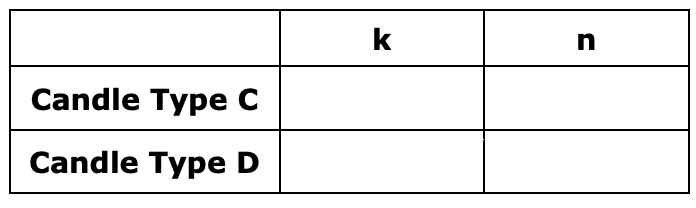
Now, choose either Candle A or Candle B to create an equation that will tell Abbie the height of the candle at t hours after it is lit.
Determine what the numerical values for k and n should be for the candle you chose.
Using these k and n values, write an equation that tells Abbie the height h of the candle, in cm, at t hours after it is lit.
Your friend Abbie is making a movie. She is filming a fancy dinner scene and she has two types of candles on the table. She wants to determine how long the candles will last.
She takes a picture, lights the candles, and then lets them burn for 1 hour. She then takes a second picture. You can assume that each candle burns at the its own constant rate.
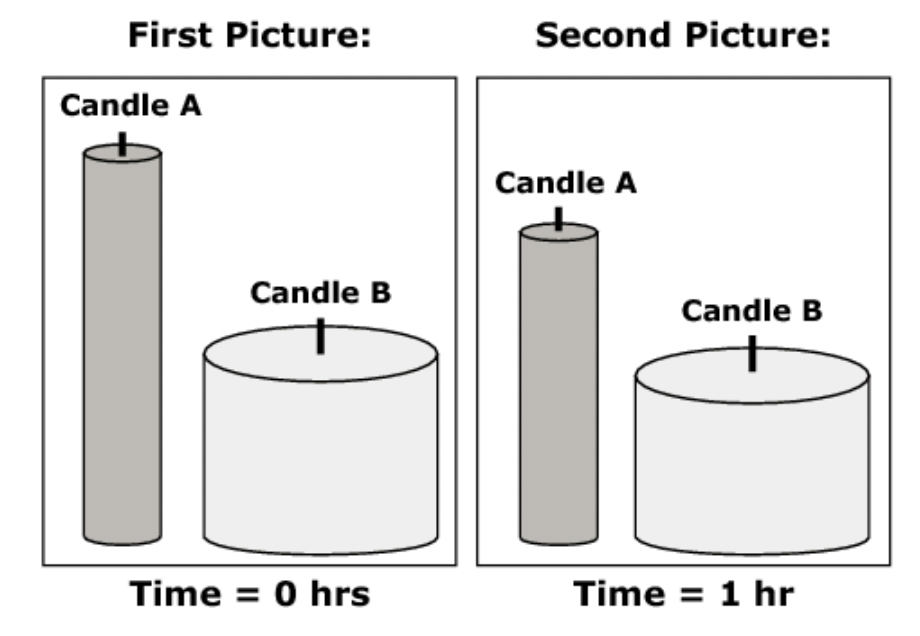
Candle Type A Initial height = 20 cm
Candle Type B Initial height = 10 cm
Candle Type A height after burning for 1 hour = 16 cm
Candle Type B height after burning for 1 hour = 9 cm
You will use this information to help Abbie think about the candles she might use for her film.
Candles of each type were lit at the same time. Abbie thinks that since Candle Type A burns more quickly than Candle Type B, that it will burn out (have a height of 0 cm) first.
Julie thinks that since Candle Type B starts out much shorter than Candle Type A, it will be the candle to burn out first.
Which candle will burn out first? Give a mathematical explanation to convince Abbie and Julie of your solution. Clearly identify the quantities involved.
Abbie has 3 hours left to film. She lights a new Candle Type A and Candle Type B and then starts filming.
In the 3 hours she has left, will Abbie capture the moment when the candles are exactly the same height?
Explain to Abbie how you can determine the answer.
You have decided to use functions to help Abbie think about the candles.
You show her how to represent the height of a candle, h, as a function of time, t, using this equation:
h = k + nt
First, explain to Abbie what k and n represent in order to model the different candles. Be specific in your explanation.