HG U8D3 Conditional Probability Dec3
An Introduction to Conditional Probability
Imagine the last time you entered to win a raffle at a fair or carnival. You look at your ticket, 562104. As they begin to call off the winning ticket, you hear 562, but everyone has the same first 3 digits. Then 1 and 0 are called off. You know that excited feeling you get? Did you know there is a lot of math behind that instinct you feel that you might just win the prize?
Now imagine those times when you are waiting to get your latest grade back on your English test. You’re not sure how you did, but as your teacher starts to talk about test results, her body language just isn’t positive. She keeps saying things like “Well, you guys tried hard.”
Again, there is significant math happening behind that sinking feeling you now have. In this task, you will be investigating how probability can be used to formalize the way real-life conditions change the way we look at the world.
Thinking about a winning raffle ticket, the fact that the probability in a given situation can change greatly affects how a situation is approached and interpreted. This sort of idea is prevalent across society, not just in games of chance. Knowledge of conditional probability can inform us about how one event or factor affects another.
A Formula for Conditional Probability
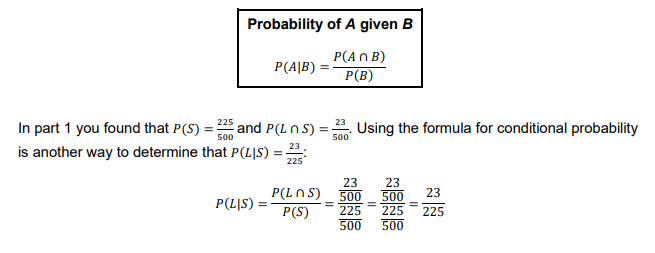
The formulaic definition of conditional probability can be seen by looking at the different probabilities you calculated in part 2. The formal definition for the probability of event A given event B is the chance of both events occurring together with respect to the chance that B occurs. As a formula,