Practice: Air Fronts, Air Masses, & Weather Test

Last updated 9 months ago
13 questions

PART 1: Cold vs Warm Fronts

Air Mass

A large body of air that has a similar temperature and water content or humidity throughout is called an air mass. Air masses have similar temperature and moisture/dryness. When different air masses meet it causes the weather to change.

Fronts

When two different air masses collide a front forms. Typically this is the boundary between cold and warm air masses.

Weather

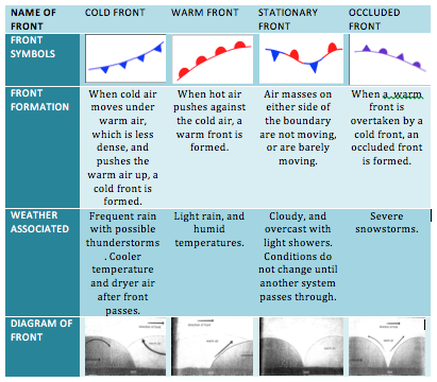
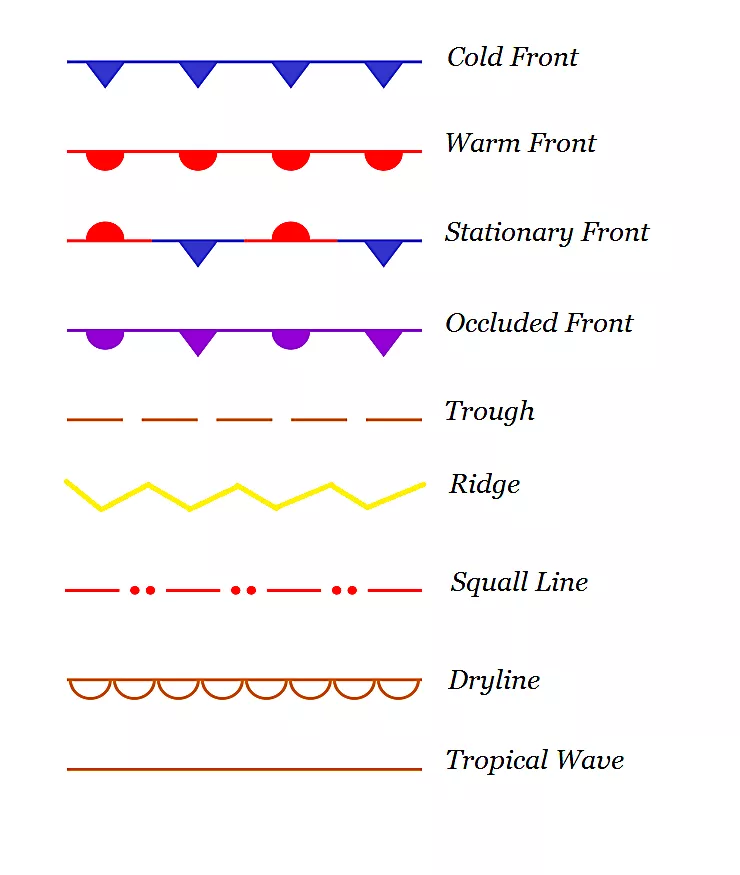
Weather fronts appear as different colored lines that extend outward from the pressure center. They mark the boundary where two opposite air masses meet.

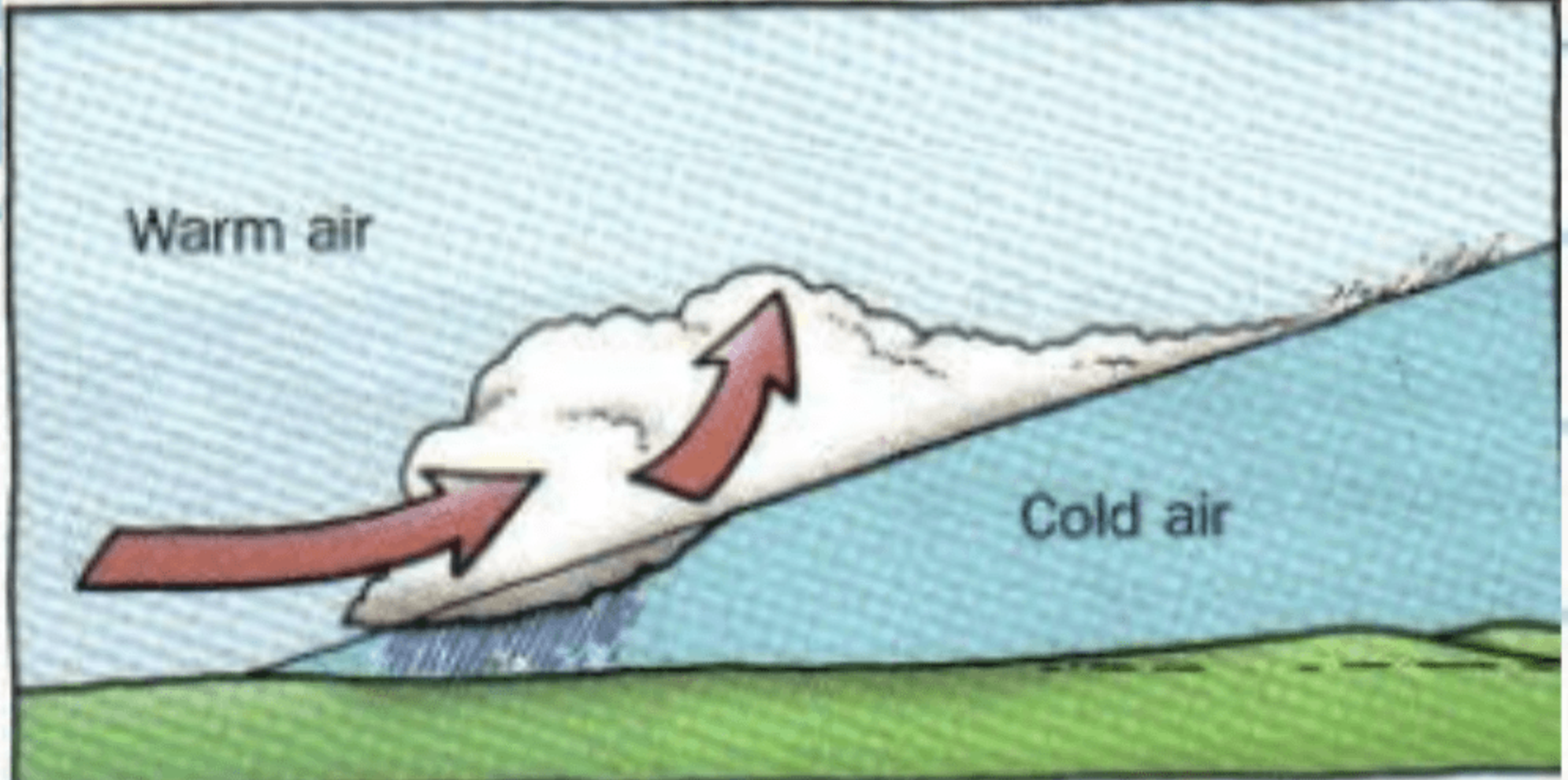
Warm fronts are indicated by curved red lines with red semicircles.
  • Light rain and humid temperatures
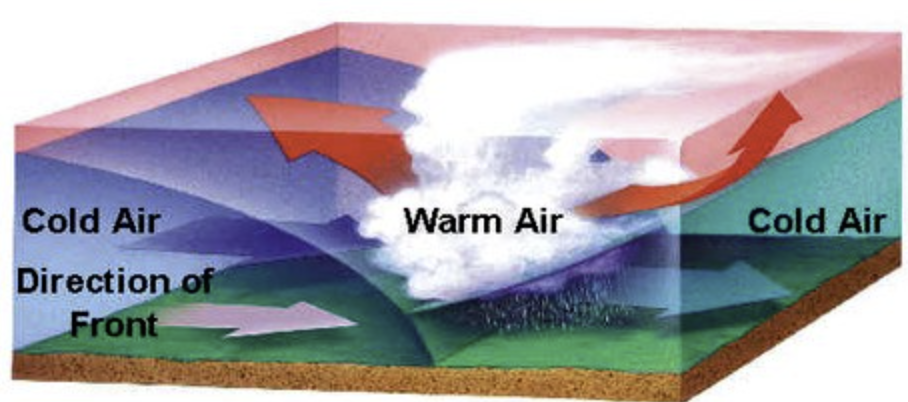
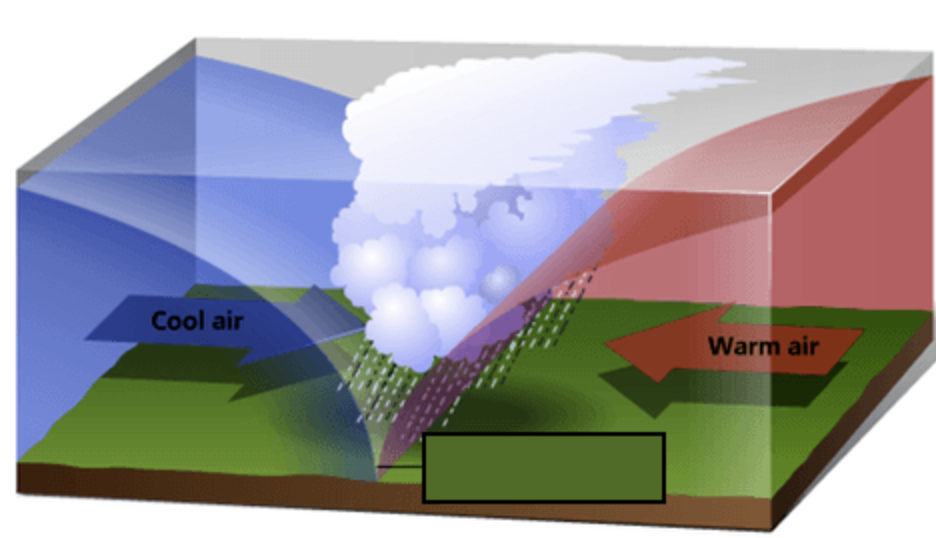
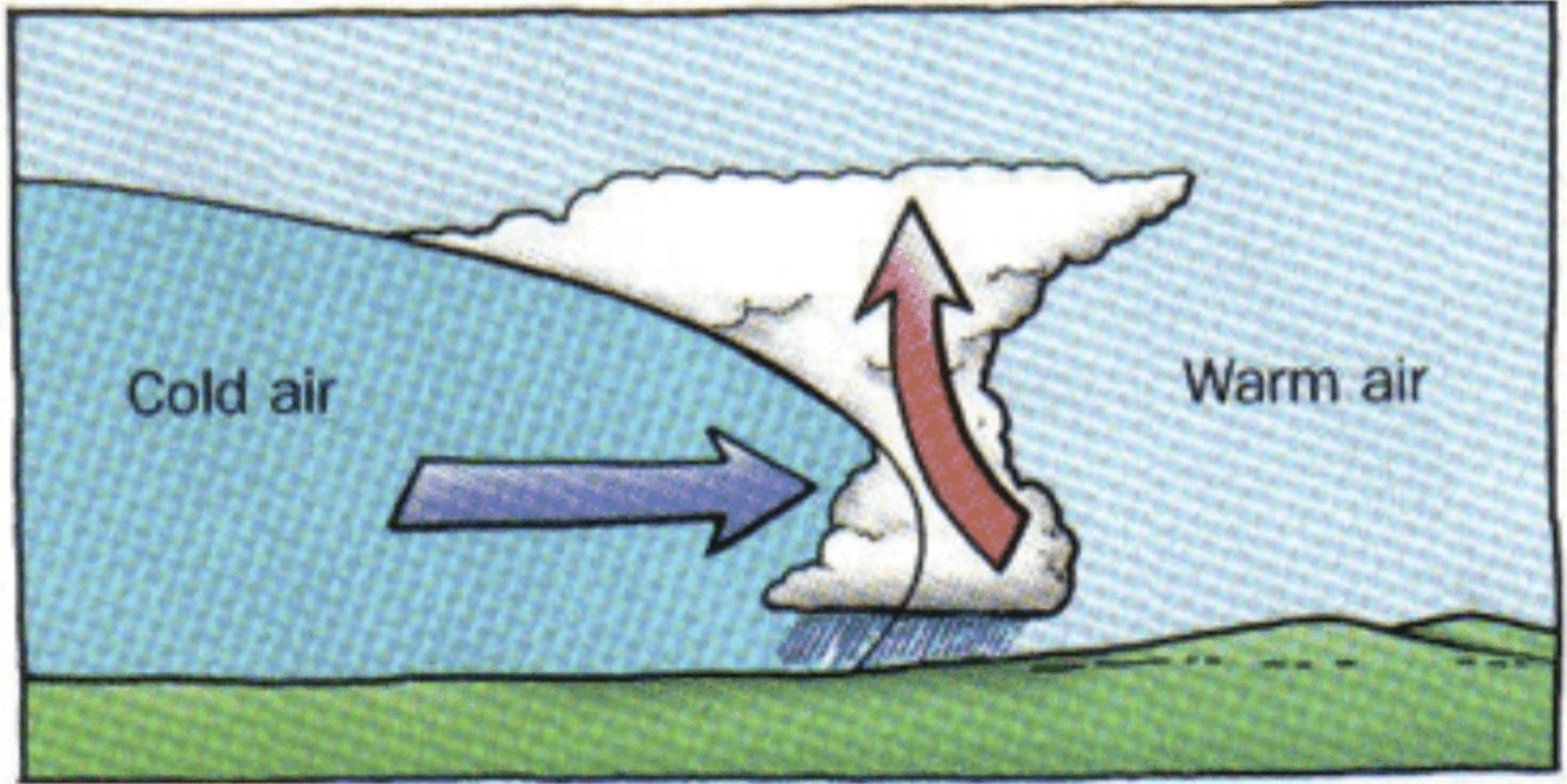
Cold fronts are curved blue lines with blue triangles.
  • likely to produce thunderstorms
  • violent storms generally form

Stationary fronts have alternating sections of red curves with semicircles and blue curves with triangles.
  • Neither air mass that meets is stronger, so it doesn't move
  • it can stay over one area for a long time

Occluded fronts are curved purple lines with both semicircles and triangles. Weather fronts are found only on surface weather maps.

1

Categorize the following

  • Associated with violent weather and thunderstorms because they move quickly.
  • Cold air is traveling and meets warm air. Cold air goes under the warm air because it is more dense.
  • Associated with gentle rain and, cirrus clouds and humid temperatures
  • Warm air is traveling and meets cold air. Warm air is less dense than cold air and rises above the cold air.
  • Cold front
  • Warm Front
1

Categorize the following

  • Associated with rain or snow. Cumulonimbus clouds and nimbostratus clouds.
  • Associated with gentle rain and, cirrus clouds and humid temperatures
  • Warm air and cold air meet but do not move in either direction. Winds blow side to side , which helps air stay in one place.
  • Occurs when a warm front is taken over by a cold front, which is generally faster than a warm front. The warm air is trapped between two cooler air masses.
  • Stationary front

  • Occluded front

4

Categorize the fronts

  • Warm front
  • Cold front
  • Occluded front
  • Stationary front
1

Categorize the following

  • Cold Front
  • Warm Front
  • Stationary Front
  • Occluded Front
4


Mrs. Misty went to bed last night and it was cold but not really cold. When she woke up this morning it is much colder and it had snowed over 5 inches over night. What kind of Front do you think caused the weather last night? __________

It has been raining on and off today, gently. The rain has finally stopped and Mr. Guesno takes his dog Indigo for a walk but it is very warm outside so they don't walk long. What kind of Front do you think caused today's weather? __________

It has been thundering and lightning today and Ms. Maddy's dog has been so scared. When it finally calms down she takes her dog Shiloh out to use the bathroom. Burr she should have put a jacket on it is very cool outside but at least it is not raining anymore. What kind of Front do you think caused the weather today? __________

It has been raining for days and Mrs. Shreve wants to wash her car. What kind of front do you think could have caused all this rain. __________

PART 2: Types of Air Masses

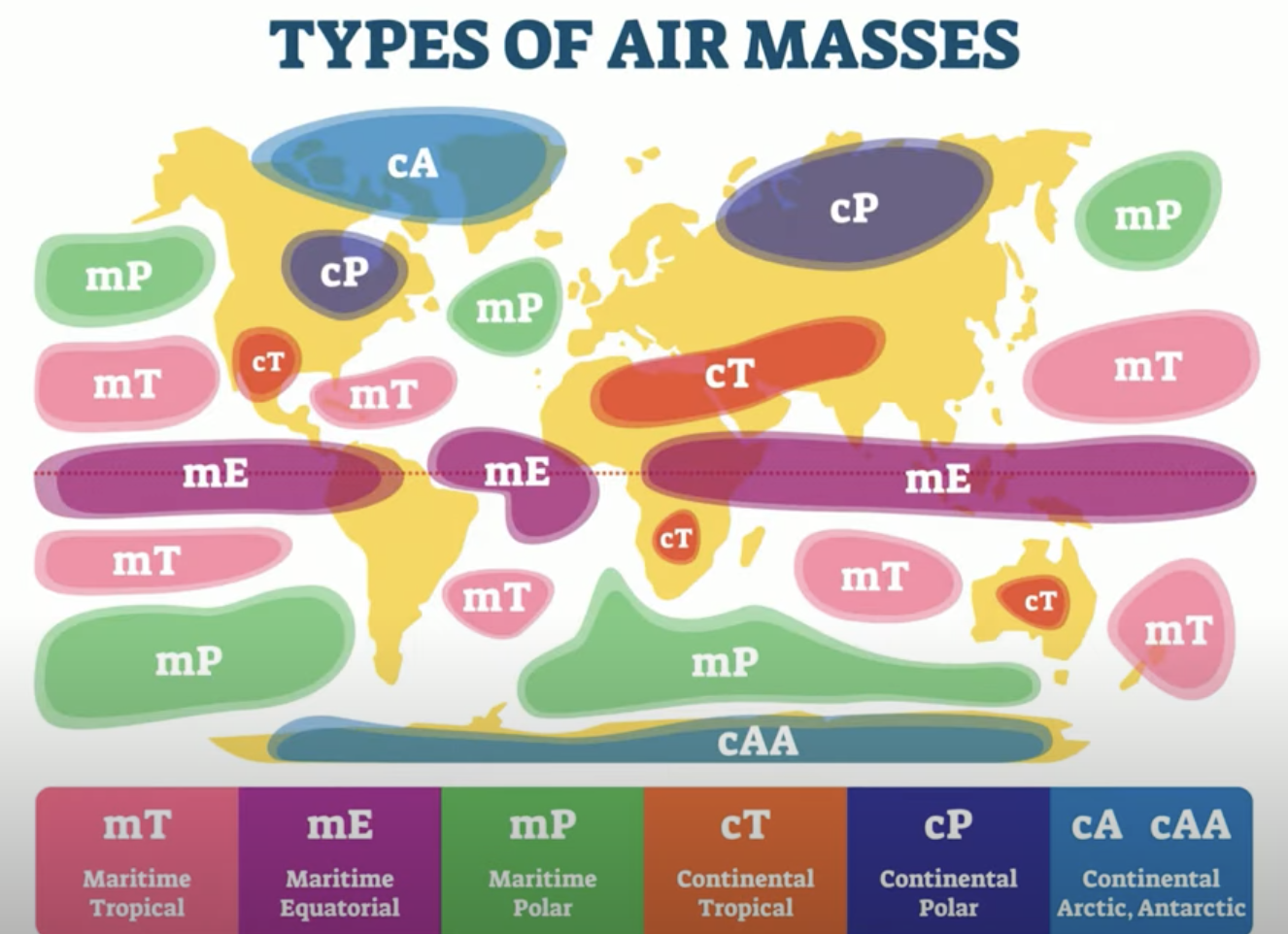
An air mass is a large body of air with generally uniform temperature and humidity. The area over which an air mass originates is what provides its characteristics. The longer the air mass stays over its source region, the more likely it will acquire the properties of the surface below.

There are two broad overarching divisions of air masses based upon moisture content.

Continental air masses, designated by the lowercase letter "c", originate over continents or land and are therefore dry air masses.

Maritime air masses, designated by the letter "m", originate over the oceans and are therefore moist air masses.

Each of the two divisions are then divided based upon the temperature of the surface over which they originate.
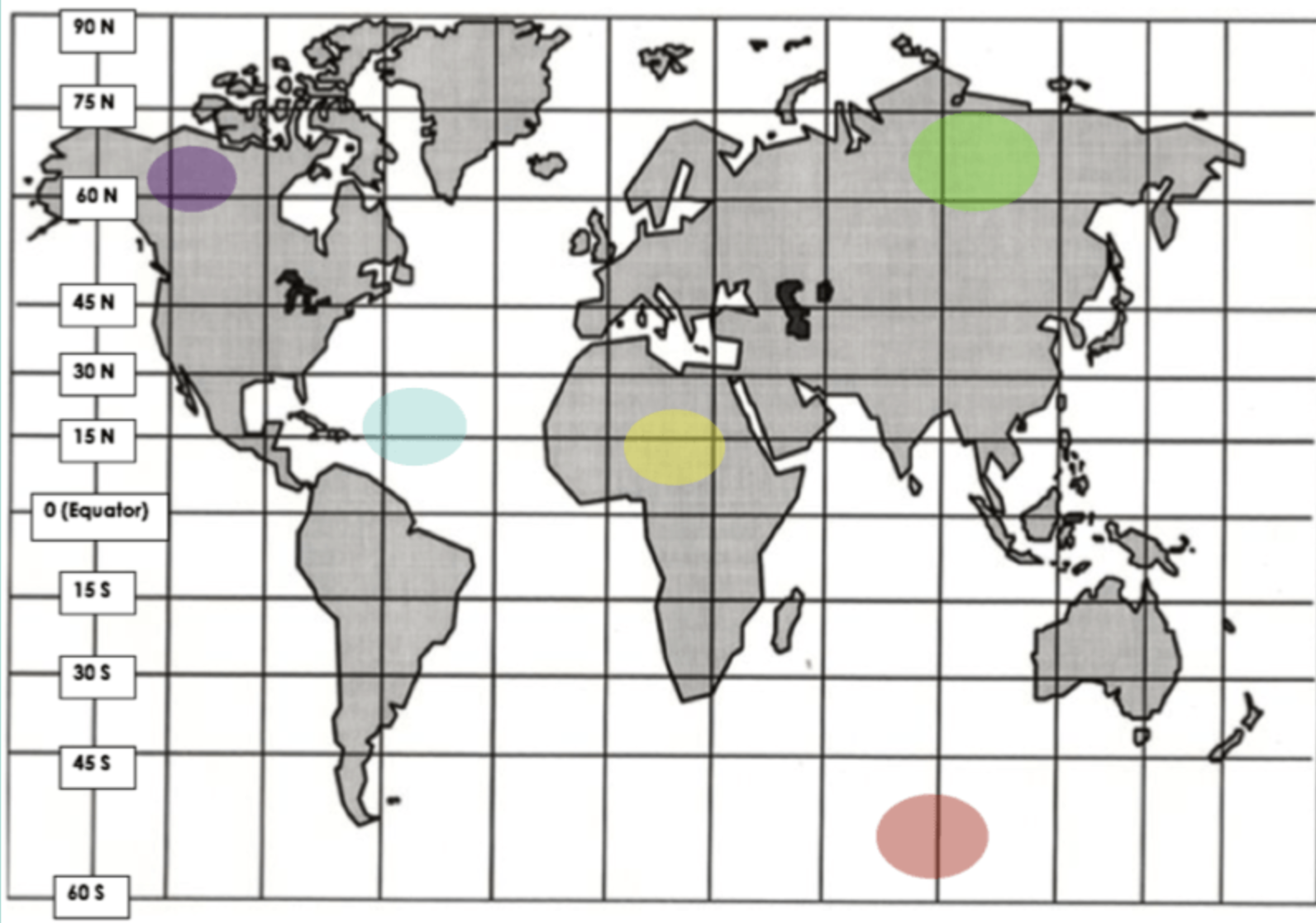
  • Arctic air masses, designated by the letter "A", originate over the Arctic or Antarctic regions and therefore are very cold.
  • Polar air masses, designated by the letter "P", originate over the higher latitudes of both land and sea and are therefore not as cold as Arctic air masses.
  • Tropical air masses, designated by the letter "T", originate over the lower latitudes of both land and sea and therefore are warm/hot.
Putting both designations together, we have, for example, a "continental arctic" air mass designated by "cA", which originates over the poles and is therefore very cold and dry.

  • Continental polar (cP) is not as cold as the Arctic air mass but is also very dry.
  • Maritime polar (mP) is also cold but moist due to its origin over the oceans.
  • The desert region air masses (hot and dry) are designated by "cT" for "continental tropical".
  • Hot and moist maritime Tropical (mT) air masses develop due to the fact that this air mass develops near the equator over the ocean.
As these air masses move around the Earth, they can acquire additional attributes.

For example, in winter, an arctic air mass (very cold and dry air) can move over the ocean, picking up some warmth and moisture from the warmer ocean and becoming a maritime polar air mass (mP) – one that is still fairly cold but contains moisture. If that same polar air mass moves south from Canada into the southern U.S., it will pick up some of the warmth of the ground, but due to lack of moisture, it remains very dry. This is called a continental polar air mass (cP).
4
________________is when air mass forms over land.
_____________ is when air mass forms over the ocean.
_____________is when air mass forms near the equator.
__________is when air mass forms near the poles.
Other Answer Choices:
Polar
Tropical
Continental
Maritime
4

Warm and dry weather __________.
WARM and WET weather __________.
COLD and WET weather __________.
COLD and DRY weather __________.
7
A) Air masses most likely form in __________
B) An air mass is a portion of the atmosphere that has similar...__________
C) The temperature and humidity of a location depend partially on __________
D) __________ explains dry or moist (wet) conditions, while __________ describes how hot or cold something is.
E) How are air masses moved? __________
F) The INTERACTION between air masses can impact, __________
6
A) Which air mass would be classified as Maritime Polar (mP)?__________
B) Which air mass would be classified as Maritime Tropical (mT)? __________
C) Which air mass would be classified as Continental Tropical (cT)? __________
D) Which air mass would be classified as Continental polar (cP)? __________
Which air mass would bring warm and wet weather? __________
Which air mass is higher in humidity (amount of water vapor)? __________
4
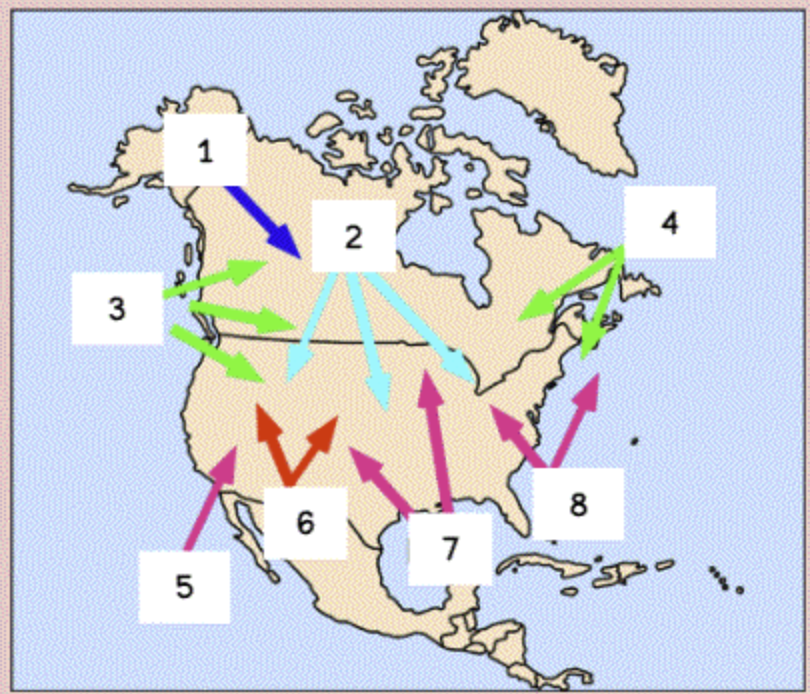
Which type of air mass would form at Point 8 on the MAP? __________
Which type of air mass would form at Point 2 on the MAP? __________


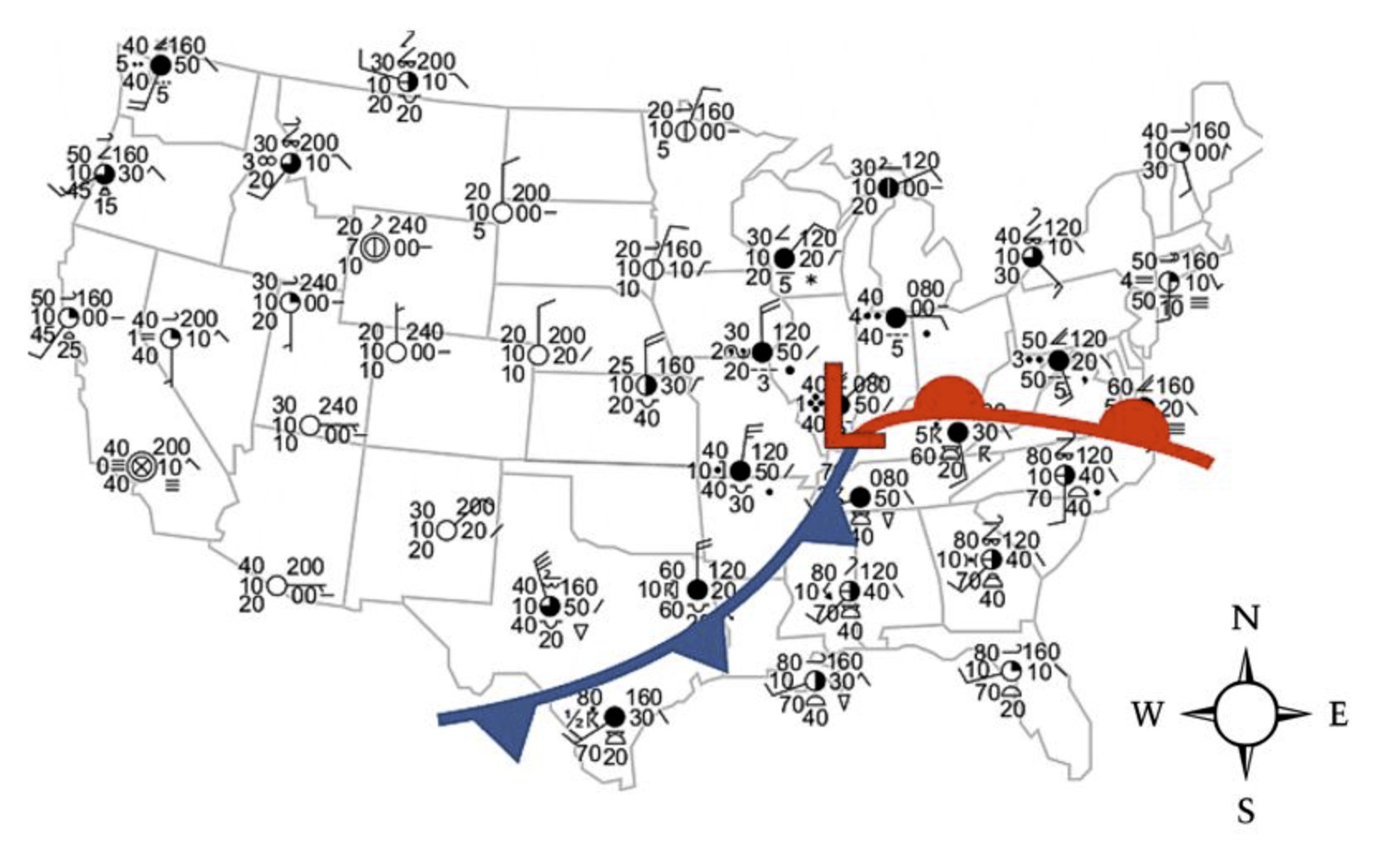
What direction is the cold front moving on the map? __________
What direction is the warm front moving on the map? __________
4

Create your own planet!!! Give your planet a name. Draw the equator for your planet. Add ocean and land masses.

Label air mass parts of your planet:

A) maritime polar mP
B) maritime tropical mT
C) continental polar cP
D) continental tropical CT

PART 3: Weather Vs. Climate

1

Disperse the following into climate and weather categories

  • Cloud cover
  • Can change in a few hours
  • Wind speed
  • Hurricane season
  • Years worth of data
  • Long-term
  • Analyzes years of patterns
  • Short-term
  • Relative humidity for the next
    two hours
  • Amount of precipitation today
  • Air pressure
  • Weather
  • Climate
2

What is the difference between weather and climate change?

Weather refers to short term atmospheric conditions while climate is the weather of a specific region averaged over a long period of time. Climate change refers to long-term changes.


Please match the description to either explaining Weather OR Climate

  • The heatwave in Milwaukee lasted 3 days
  • San Fransisco has mild winters and dry summers
  • On our way to the mall, we were caught in a hail storm!
  • I need to wear a sweater today, it looks like it is going to be cold today
  • Alaska averages of temperature of 25 degrees every summer.
  • There is typically a pattern of more rain in the spring than in the summer in New England
  • Climate (long-term weather patterns)

  • Weather (short-term)