1
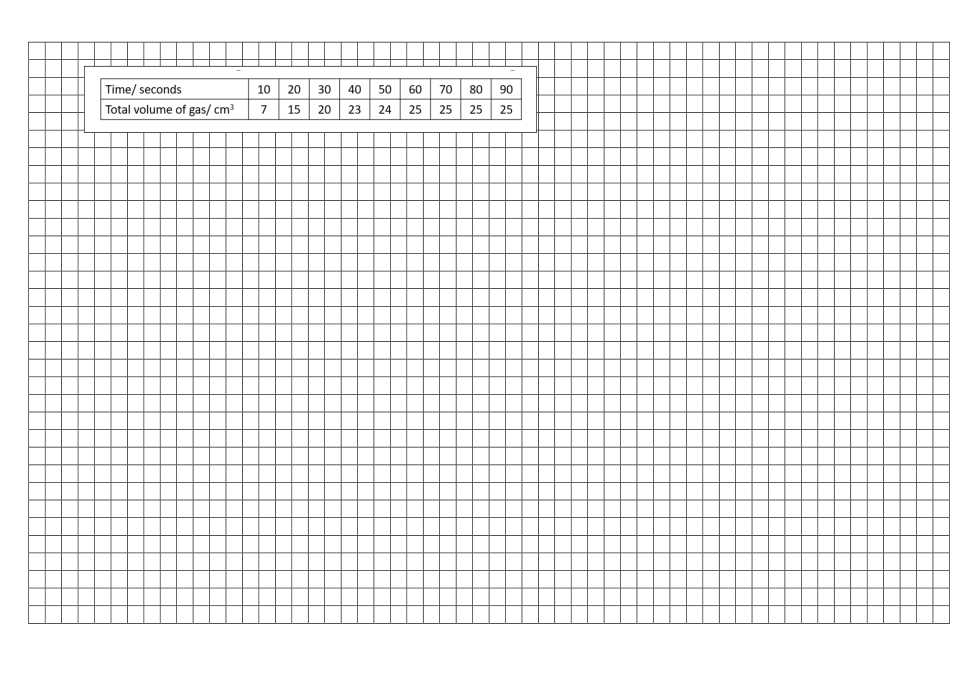
Plot the following from a reaction between HCl and Mg.
Plot the following from a reaction between HCl and Mg.
The rate of a reaction between hydrochloric acid and calcium carbonate can be increased by increasing the concentration of the acid. Explain why, using ideas about collisions between particles.
Describe and explain the effect that increasing pressure has on the rate of a reaction between oxygen and nitrogen.
Explain why, using ideas about collisions between particles.
Limestone (calcium carbonate) reacts with hydrochloric acid to produce calcium chloride, water and carbon dioxide. A student notices a greater rate of effervescence when they use powdered limestone, compared to larger chunks.
Explain why, using ideas about collisions between particles.
Plot the following from a reaction between HCl and Mg.
Describe the pattern in the graph
Use the graph to calculate the rate of reaction over the first 20 seconds.
The experiment was repeated using magnesium powder. Draw a line of best fit for this new reaction.