A2 - CS - End of Unit 19 test

Last updated 6 months ago
9 questions
Answer all the questions.
7
Data is stored in the array NameList[1:10]. This data is to be sorted.
Complete this pseudocode algorithm for an insertion sort. [7]

FOR ThisPointer ← 2 TO _______
// use a temporary variable to store item which is to
// be inserted into its correct location
Temp ← NameList[ThisPointer]
Pointer ← ThisPointer – 1
WHILE (NameList[Pointer] > Temp) AND _______
// move list item to next location
NameList[_______] ← NameList[_______]
Pointer ← _______
ENDWHILE
// insert value of Temp in correct location
NameList[_______] ← _______
ENDFOR
5

Joseph is taking a toy apart. Each time he removes an item from the toy, he writes the name of the item at the bottom of a paper list. When he rebuilds the toy, he puts the items back together working from the bottom of the list.

Joseph writes a computer program to create the list using a stack, Parts.

(a) Describe a stack structure. [1]
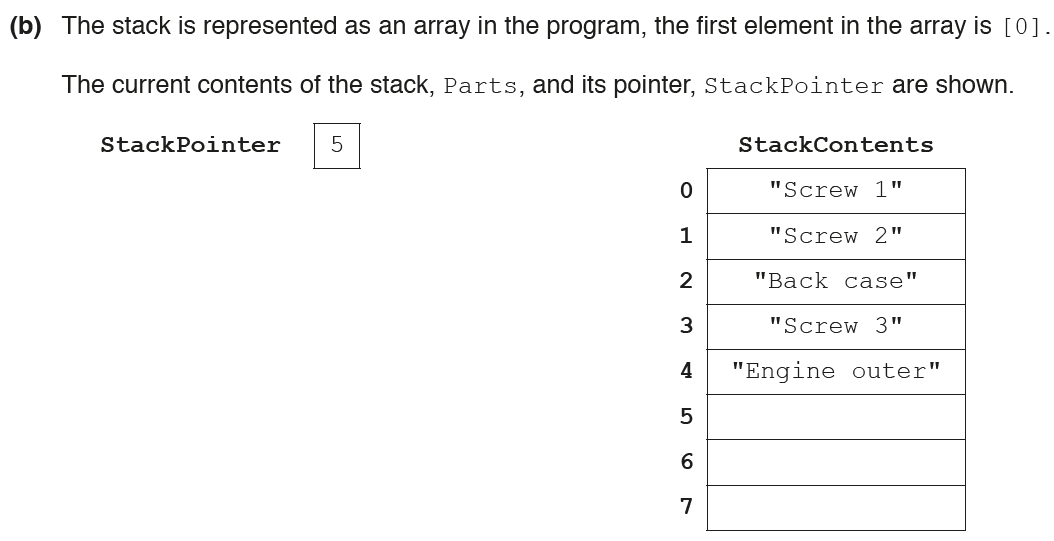
(i) Describe the purpose of the variable StackPointer. [1]
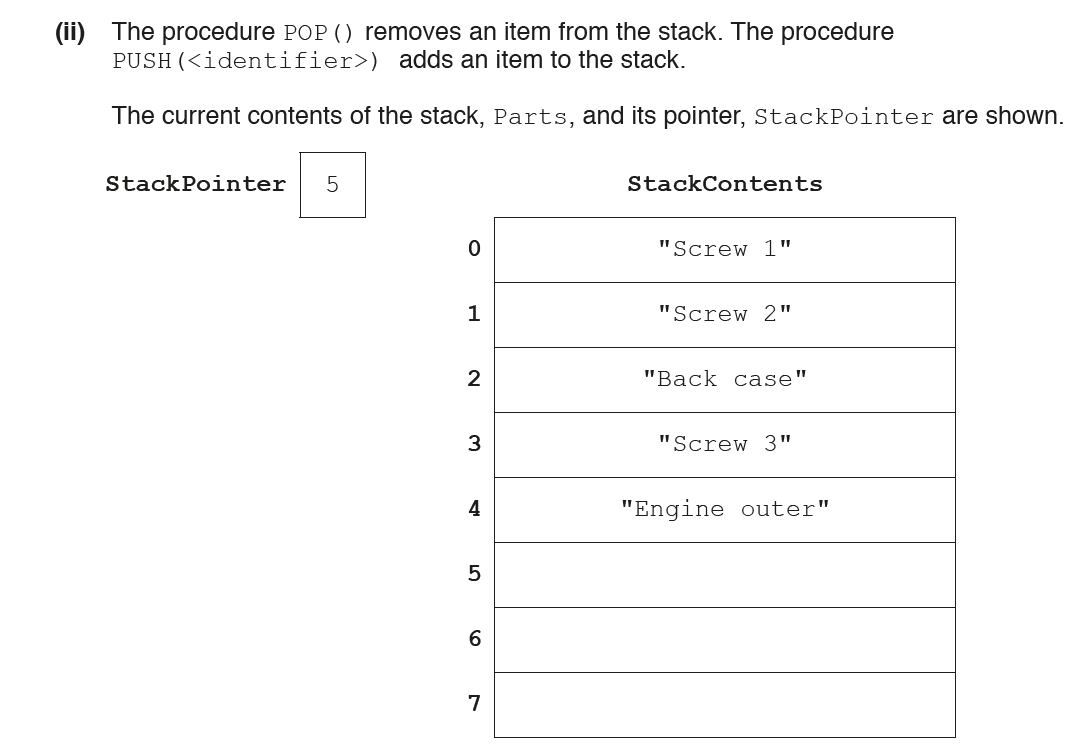
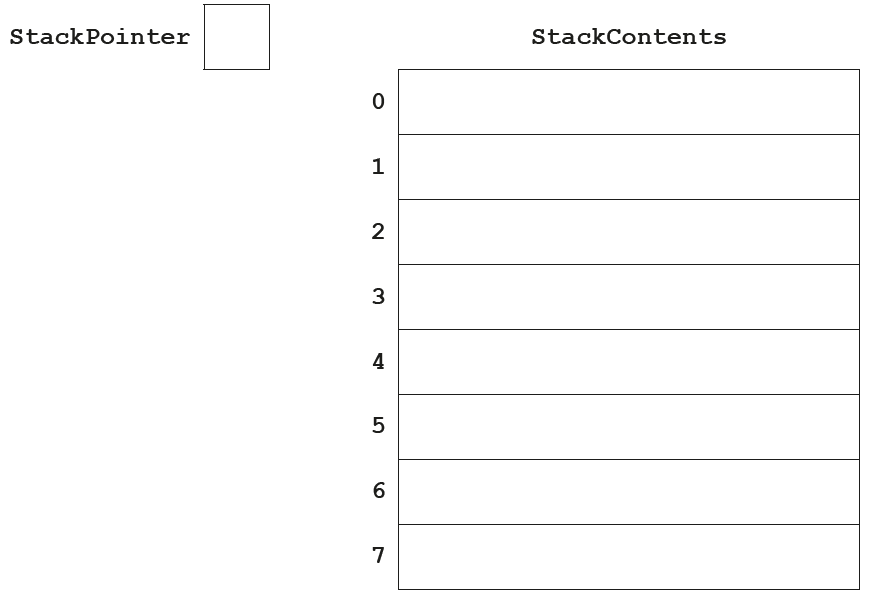
Use the table below to show the contents of the stack, Parts, and its pointer after the following code is run. [3]
POP()
POP()
PUSH("Light 1")
PUSH("Light 2")
PUSH("Wheel 1")
POP()
POP()
5
A 1D array, Parts, is used to implement the stack in Q2 Parts is declared as:
DECLARE Parts : ARRAY[0 : 19] OF STRING
The procedure POP outputs the last element that has been pushed onto the stack and replaces it with a '*'. Complete the pseudocode for the procedure POP.

PROCEDURE POP
IF _______ = _______
THEN
OUTPUT "The stack is empty"
ELSE
StackPointer ← _______
OUTPUT _______
Parts[StackPointer] ←_______
ENDIF
ENDPROCEDURE
4
In the above question, the procedure PUSH() puts the parameter onto the stack.
Complete the pseudocode for the procedure PUSH().

PROCEDURE PUSH(BYVALUE Value : String)
IF StackPointer > _______
THEN
OUTPUT "Stack full"
ELSE
_______ ← _______
StackPointer ←_______
ENDIF
ENDPROCEDURE
2

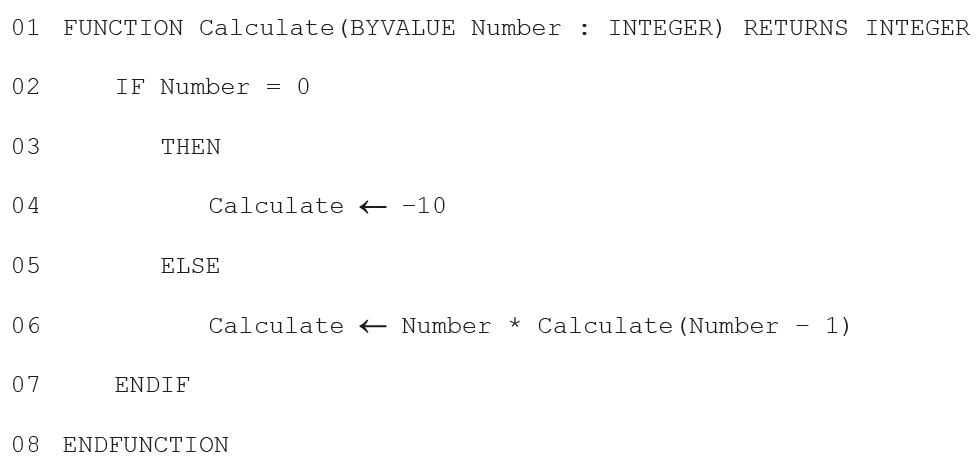
The recursive algorithm for the Calculate() function is defined as follows:
(i) State what is meant by a recursive algorithm. [1]
(ii) State the line number in Calculate() where the recursive call takes place. [1]

6

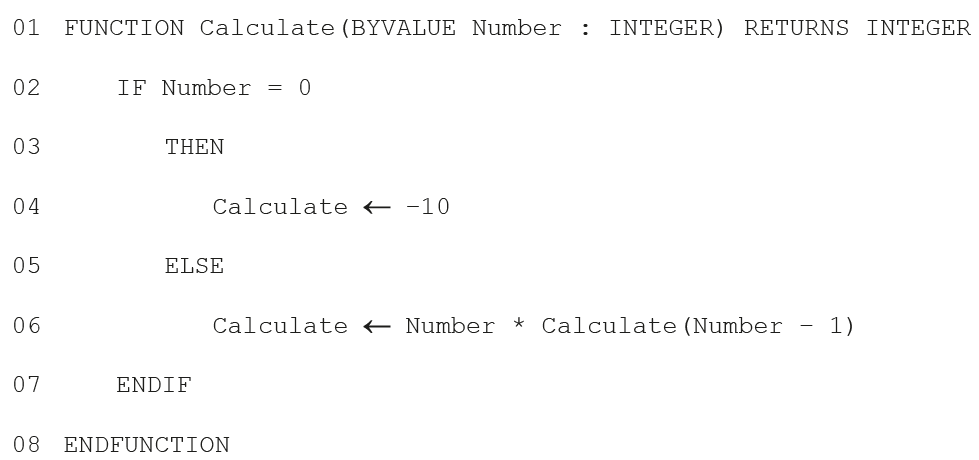
The function in Q5 is called with Calculate(3).
Dry run the function and complete the trace table below. State the final value returned. Show your working. [6]

7

A recursive algorithm within a subroutine can be replaced with an iterative algorithm.

(i) Describe one problem that can occur when running a subroutine that has a recursive algorithm. [2]
(ii) Rewrite the Calculate() function (of above question) in pseudocode, using an iterative algorithm. [5]

5

A linked list abstract data type (ADT) is created. This is implemented as an array of records. The records are of type ListElement.
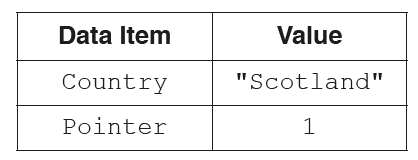
An example of a record of ListElement is shown in the following table.
(i) Use pseudocode to write a definition for the record type, ListElement. [3]
(ii) Use pseudocode to write an array declaration to reserve space for only 15 nodes of type ListElement in an array, CountryList. The lower bound element is 1. [2]

5
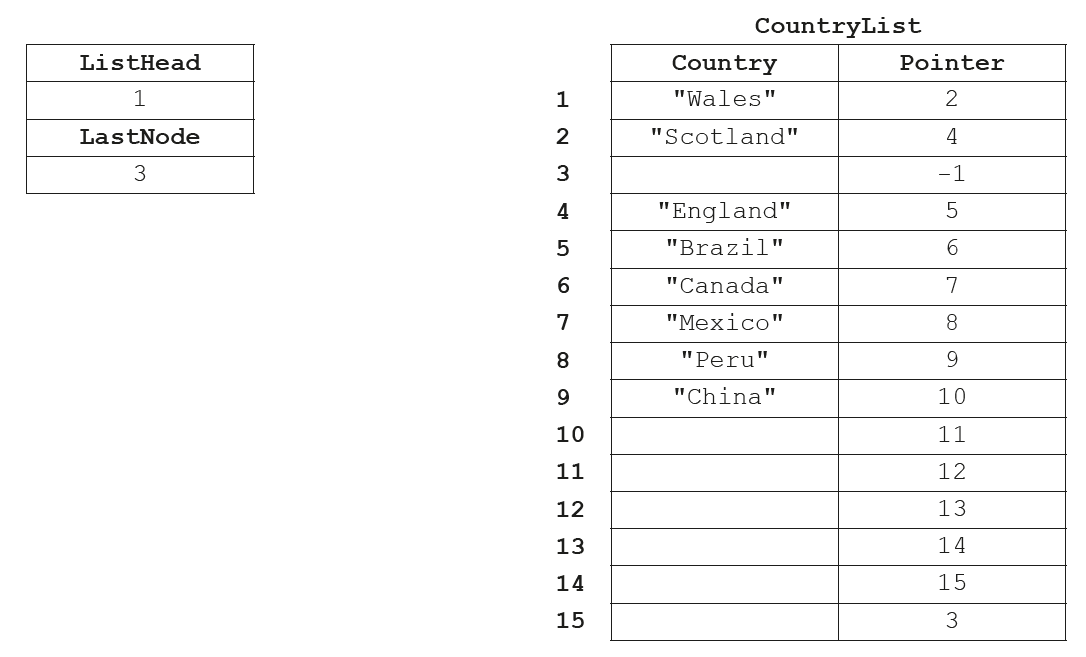
The program in Q8 stores the position of the last node in the linked list in LastNode. The last node always has a Pointer value of -1. The position of the node at the head of the list is stored in ListHead.
After some processing, the array and variables are in the following state.
A recursive algorithm searches the list for a value, deletes that value, and updates the required pointers. When a node value is deleted, it is set to empty "" and the node is added
to the end of the list.

A node value is deleted using the pseudocode statement
CALL DeleteNode("England", 1, 0)
Complete the following pseudocode to implement the DeleteNode procedure.

PROCEDURE DeleteNode(NodeValue: STRING, ThisPointer : INTEGER, PreviousPointer : INTEGER)
IF CountryList[ThisPointer].Value = NodeValue
THEN
CountryList[ThisPointer].Value ← ""
IF ListHead = _______
THEN
ListHead ←_______
ELSE
CountryList[PreviousPointer].Pointer ← CountryList[ThisPointer].Pointer
ENDIF
CountryList[LastNode].Pointer ←_______
LastNode ← ThisPointer
_______
ELSE
IF CountryList[ThisPointer].Pointer <> -1
THEN
CALL DeleteNode(NodeValue, _______, ThisPointer)
ELSE
OUTPUT "DOES NOT EXIST"
ENDIF
ENDIF
ENDPROCEDURE