Log in
Sign up for FREE
arrow_back
Library

s2w7 Introduction to Stars

star
star
star
star
star
Last updated 8 months ago
16 questions
1
Required
1
Required
1
Required
1
Required
1
Required
1
Required
1
Required
1
Required
1
Required
1
Required
1
Required
1
Required
1
Required
1
Required
1
Required
1
Question 1
1.

Read chapter 11.1-11.3 (pages 329-340) do you have any questions

Question 2
2.

Give a three sentence summary of one of the three sections of the reading.

Question 3
3.

What is pressure, and what does it have to do with the sun not collapsing?

Question 4
4.

Give an example of pressure on earth being balanced

Question 5
5.

Give an example of pressure on earth being unbalanced and the consequences of that imbalance.

Question 6
6.

review - name the four fundamental forces in the universe?

Question 7
7.

Of those four, which is the weakest?

Question 8
8.

Draggable itemarrow_right_altCorresponding Item
arrow_right_alt
arrow_right_alt
arrow_right_alt
arrow_right_alt
arrow_right_alt
arrow_right_alt
Question 9
9.

When discussing planets and dwarf planets before, we said that a planet had hydrostatic equilibrium when it was mostly round. what is involved in a star having hydrostatic equilibrium (in addition to being round).

Question 10
10.

Come up with a definition of convection. Where do you see this on earth?

Question 11
11.

What is your best explanation of a Neutrino?

Question 12
12.

Watch the following video. What questions do you have?

Question 13
13.

Question 14
14.

Question 15
15.

Question 16
16.
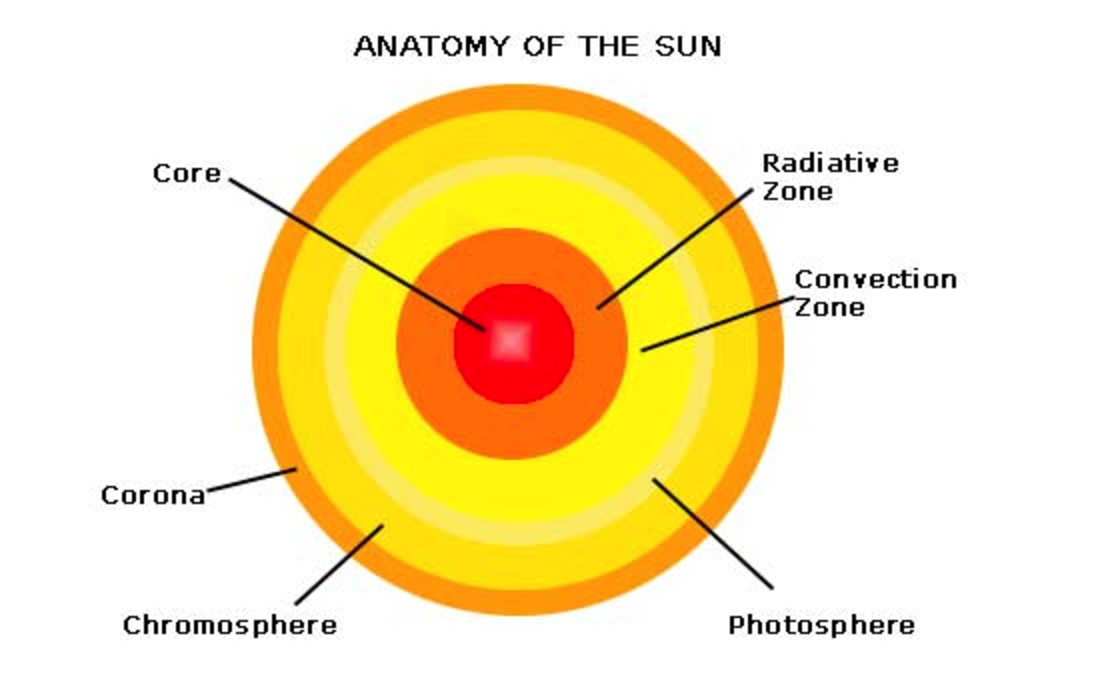
Match the layer of the sun to an aspect of that layer
Chromosphere
Energy is released by fusion
corona
Energy is moved by photons being released, reabsorbed, and released again
Radiative zone
Energy is carried by moving atoms rather than photons
Core
transition layer where gases move from being transparent to opaque
Convection zone
thin layer with strong red-emission lines that can be seen during an eclipse
photosphere
third hottest layer of the sun that has lowest amount of energy because of its low density
What are neutrinos?
Massive atomic particles
Nearly massless subatomic particles that rarely interact with matter
Large molecules found in space
Electrons with special properties
What makes neutrinos unique among subatomic particles?
They have an extremely large mass
They carry a strong electric charge
They can pass through matter with very little interaction
They are always stationary
Why are neutrinos important for understanding solar processes? A) B) They provide insights into nuclear reactions happening in the sun's core C) D) They measure the sun's rotation speed
They directly reveal the temperature of the sun's surface
They provide insights into nuclear reactions happening in the sun's core
They show the sun's magnetic field strength
They measure the sun's rotation speed
What happens in each layer of the sun
how fusion works
what is hydrostatic equilibrium?
What is the relationship between temperature and pressure?
how e=mc^2 works in terms of powering the sun
What is a neutrino?
I've got this
I'm fuzzy
Im so confused.