Log in
Sign up for FREE
arrow_back
Library

Unit 4 Micro CSA #1 -A

star
star
star
star
star
Last updated 4 months ago
20 questions
Required
1
BM2.3
HS.E2.1
2
BM2.3
HS.E2.1
Required
1
BM2.3
HS.E2.1
Required
1
BM2.3
Required
1
BM2.3
Required
1
BM2.3
Required
1
BM2.3
Required
1
Required
1
Required
1
Required
1
Required
1
BM2.6
Required
1
BM2.6
Required
0.5
BM2.3
HS.E2.1
Required
0.5
BM2.3
HS.E2.1
Required
0.5
BM2.3
HS.E2.1
Required
0.5
BM2.3
HS.E2.1
Question 5
5.

Question 6
6.
Other Answer Choices:
toxic waste
multiple uses
single use
undesireable
clean water
air
unlimited
water
desireable
limited
Question 7
7.

Question 8
8.

Question 9
9.

Question 10
10.

Question 11
11.

Question 12
12.

Question 13
13.

Question 14
14.

Question 15
15.

Question 16
16.

Question 17
17.

Required
1
BM2.3
Required
1
BM2.3
Required
1
BM2.3
The baker arrives early in the morning at the bakery shop in the center of town. He begins to prep by getting out the flour and eggs to make dough. Once the dough is mixed he has his assistant pour the mix into the doughnut pan and place it in the oven. Shortly after the doughnuts are finished Betty, the bakery owner, arrives to taste test items before the store opens for the day.
Question 1
1.
Other Answer Choices:
Oven
Betty
Pour
Flour
Baker
Land
Eggs
Capital
Mixed
Doughnut Pan
Labor
Entreprenuer
Question 2
2.
Other Answer Choices:
Mixed
Flour
Product
Labor
Service
Eggs
Betty
Baker
Capital
Doughnut Pan
Oven
Land
Pour
Entreprenuer
Question 3
3.
Other Answer Choices:
Land
Service
Flour
Betty
Product
Labor
Capital
Eggs
Oven
Doughnut Pan
Entreprenuer
Baker
Mixed
Pour
Question 4
4.
Other Answer Choices:
Product
Betty
Mixed
Pour
Service
Baker
Land
Flour
Capital
Labor
Eggs
Oven
Doughnut Pan
Entreprenuer
What is the opportunity cost of a decision?
the different ways that a different person might have made the decision
the series of alternative decisions that could have been made
the most desirable alternative given up for the decision
What is an example of something that is scarce ________________. How do we know that it is scare ____________ _______________ __________________
Scenario: You own a successful clothing company and want to open a new store in either New York City or Los Angeles. If you choose New York City, what is the opportunity cost?
The loss of potential profit/customers in Los Angeles
The cost of renting the storefront in New York
The access to international customers on an online store-front
What is scarcity?
we have unlimited wants but limited resources
we have unlimited wants and unlimited resources
we have limited wants but unlimited resources
Why are resources considered limited?
Everyone has them, and they change.
There are not enough available for everyone to have as much of them as desired.
There are so many that people must decide which ones to choose at any one time.
The resources used to make all goods and services are the
opportunity costs.
production trade-offs.
factors of production.
How are trade-offs and opportunity costs different?
The opportunity cost is the most desirable trade-off.
A trade-off is the most expensive opportunity cost.
A trade-off can be put on a decision-making grid, but an opportunity cost cannot.
What are the three economic questions?
What produced, How much produced & for Who to consume
What produced, How produced, & Who should produce it
What produced, How produced, & for Who to consume
Individuals and businesses own the means of production and distribution with limited government regulation in a __________ economy.
market
communist/command
traditional
In a command economy, who decides how the economic questions will be answered?
Individuals
Businesses
Government
Government owns the basic means of production, but there is some private ownership of businesses under
entrepreneurship.
socialism (heavy left)
capitalism.
If the marginal cost of producing one more unit is $5 and the marginal benefit is $8, what should the firm do?
stop production immediately
produce the additional unit
ignore marginal analysis
A diner has already eaten three slices. They consider buying a fourth slice for $4.
  • Marginal Benefit: Slight satisfaction, but they’re already full.
  • Marginal Cost: $4 payment and possible discomfort from overeating.
What principle applies here?
Marginal cost exceeds marginal benefit, so don’t buy
Opportunity cost doesn’t matter in food decisions
Average cost principle supports buying more


Question 18
18.

Question 19
19.

Question 20
20.

What is one of the factors of production
_________ what is an example from the text for this factor of production _________
What is a second factor of production __________what is an example from the text for this factor of production_________
What is a Third factor of production ____________ what is an example from the text for this factor of production_________________
What is a Fourth factor of production _________________what is an example from the text for this factor of production__________


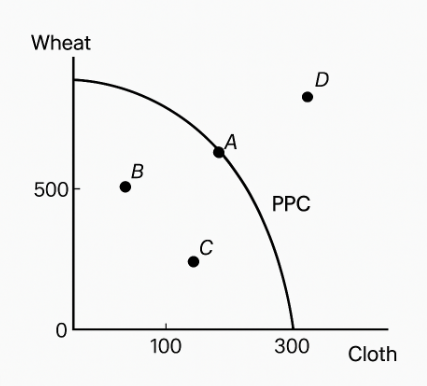
If production occurs at a point inside the PPC curve, what does this represent?
Efficient use of resources
Inefficient use of resources
Impossible production combination
If the PPC shifts outward, what does this indicate?
Economic growth or improved resources/technology
Inefficient resource allocation
A reduction in production capacity
If Point D lies outside the PPC curve, what does this mean?
It is attainable with current resources
It represents inefficiency
It is unattainable with current resources and technology