Preskoči na glavni sadržaj
Prijava
Sign up for FREE
arrow_back
Biblioteka

Voltaic cells - SL

star
star
star
star
star
Posljednje ažuriranje 5 months ago
21
1
Pitanje 12
12.

Give the cell diagram for the voltaic cell that has the following overall equations:

a Ag+(aq) + Cu(s) → Ag(s) + Cu2+ (aq)

b Cu(s) + 2NO3−(aq) + 4H+(aq) → Cu2+ (aq) +2NO2(g) + 2H2O(l)

c 5IO4−(aq) + 2Mn2+(aq) + 3H2O(l) → 5IO3−(aq) +2MnO4−(aq) + 6H+(aq)

1

In a voltaic cell, the substance that is most easily

oxidised will give up its electrons to the external circuit

and is the anode of the cell.

1
Pitanje 1
1.

In a simple voltaic cell made from two metals and solutions of their ions, would the metal higher in

the activity series form the anode or the cathode of the cell?

1
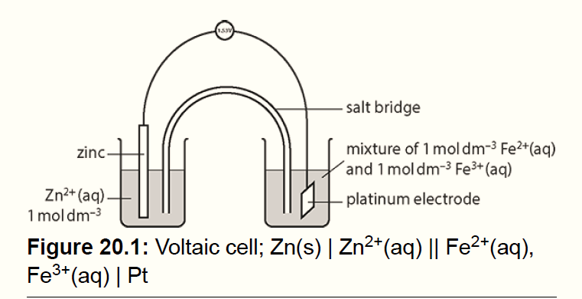
In the voltaic cell in Figure 20.1, Fe3+ ions are reduced

to Fe2+ ions, and zinc atoms are oxidised to Zn2+ ions.

1
Pitanje 3
3.

a What is the purpose of the salt bridge?

1
Pitanje 4
4.

b Give equations for the reactions in each half-cell

1
Pitanje 5
5.

c What changes would be observed in each beaker?

1
Pitanje 6
6.

.Copy and Label the diagram to show the following:

● the direction of electron flow through the external circuit

● the anode

● the cathode

● the positive electrode

● the negative electrode

● the direction of ion flow in the salt bridge

Cell notation is used as shorthand to describe voltaic

cells, for example:

Cu(s) | Cu2+ (aq) || H+(aq), Cr2O72−(aq), Cr3+ (aq) | Pt(s)

1
Pitanje 7
7.

a What is the single vertical line used to represent?

1
Pitanje 8
8.

b What is the double vertical line used to represent?

1
Pitanje 9
9.

c What are the two electrodes made from in this

cell?

1
Pitanje 10
10.

d Give the half-equations occurring at each

electrode.

1
Pitanje 11
11.

e Give the overall equation for the cell.

Pitanje 13
13.

Use the activity series in the IB data book to put the following voltaic cells in increasing order of the voltage they produce. Assume that any differences in conditions, such as concentration and temperature, can be ignored.

A Zn2+ + Mg → Mg2+ + Zn

B 2Cr3+ + 3Zn → 2Cr + 3Zn2+

C 3Mg2+ + 2Cr → 2Cr3+ + 3Mg

1
Pitanje 14
14.

a Rechargeable batteries can be both charged and discharged. What do these two terms mean?

1
Pitanje 15
15.

b In a rechargeable battery, does oxidation occur at the anode or cathode when the cell is being discharged?

1
1
1
1

When the engine of a vehicle containing a lead–acid battery is running, the lead–acid battery is charged up by the following reactions:

anode: PbSO4(s) + 2H2O(l) → PbO2(s) + 2e−+ 4H+

(aq) + SO42− (aq)

cathode: PbSO4(s) + 2e− → Pb(s) + SO42− (aq)

Lead(II) sulfate occurs as an insoluble coating on the surface of both metal electrodes.

1
Pitanje 20
20.

a Give the equations when the lead–acid battery is being discharged.

1
Pitanje 21
21.

b Using the equations, identify a suitable electrolyte in a lead–acid battery.

Pitanje 2
2.

In a voltaic cell, in which direction do the electrons

flow in the external circuit?

Pitanje 16
16.

c In a rechargeable battery, does oxidation occur at the anode or cathode when the cell is being charged?

Pitanje 17
17.

d When a rechargeable battery is being discharged, is the anode negative or positive?

Pitanje 18
18.

e When a rechargeable battery is being charged, is the anode negative or positive?

Pitanje 19
19.

f Electrons flow in the external part of an electrochemical cell. What type of particle moves through the electrolyte of a cell?