PSSA Grade 6 ELA
star
star
star
star
star
Last updated 12 months ago
12 questions
Kangaroos, Clouds, and Coffee
by Amy Poffenbarger
High up in the cloud forests of New Guinea, a small brown face peers down from a tree Could it possibly be—a kangaroo?
Lisa Dabek hopes so. She works at the Woodland Park Zoo in Seattle, Washington, and she has come to Papua New Guinea to study her favorite animal, the elusive Matschie’s tree kangaroo. Even with binoculars, the small, shy marsupials are hard to find. Their reddish-brown fur blends in perfectly with the moss growing thickly on the trees.
A Face in the Forest
Surprisingly, 10 different species of kangaroos live in trees instead of hopping along the ground. Matschie’s tree kangaroos live in the mountain cloud forest of Papua New Guinea. Weighing about 20 pounds (9 kg), these kangaroos are great climbers, but they’re kind of lazy. They spend 15 hours a day sleeping or lounging in trees, munching on leaves, moss, and bark. Sometimes they take a giant leap to the ground to nibble flowers, ferns, and grass shoots.
Tree kangaroos are loners—they don’t hang out together very much. Mothers carry their babies, called joeys, in a pouch, like other kangaroos. But when the joeys are about 18 months old, they go off to live by themselves.
People live in the cloud forest too, in the YUS area between the Yopno, Uruwa, and Som Rivers. For thousands of years, they have cut trees for wood and fuel and hunted animals and birds for food.
No Pets for Lisa
On the other side of the world, in New York City, Lisa Dabek grew up loving animals, even though she was allergic to them. Since she couldn’t have a pet, she watched ants that lived on her garage roof. She dreamed of being an animal trainer someday.
When she got older, Dabek studied marine mammals and animal behavior. She became interested in environmental studies and conservation, like her hero, Jane Goodall. But it wasn’t until she went to work at the Woodland Park Zoo that Dabek saw her first tree kangaroo. “I was totally intrigued,” she says.
Dabek set up a program at the zoo to educate people about tree kangaroos and cloud forests. But it was many years before she got to see one in the wild.
When she finally got to Papua New Guinea, asthma made mountain travel difficult, but she didn’t let it stop her. Dabek saw her first wild tree kangaroos after five weeks of hiking through the forest. But they are so rare that it was seven years before she saw another one. Now she returns every year to study the kangaroos and the forest. You can read about her work in a book called Quest for the Tree Kangaroo.
Friends in High Places
The people of YUS own most of the land where the tree kangaroos live. They showed Dabek their special forest, and she told them about her interest in the tree kangaroos. At first they were surprised. They had no idea that the Matschie’s tree kangaroo only lives in their cloud forest.
She met with teachers and students too. “I really believe the future of conservation is with kids,” Dabek says. “The more kids around the world understand the importance of protecting plants and animals, the better off we’ll be.”
The people of YUS have always known that their forest is special. After talking with Dabek and other scientists, they decided to set aside more than 180,000 acres to create a cloud forest nature preserve. This became the YUS Conservation Area, the first in all of Papua New Guinea. Hunting, mining, and cutting down trees are now forbidden there.
The protected area gives the special cloud forest plants and animals a safe place to live and raise families. And that helps keep the whole forest healthy.
In the past, the people of YUS had often set aside special parts of the forest as tambu, or sacred places. So preserving a home place for tree kangaroos made sense.
Kangaroo Coffee
The people of YUS are happy to protect their unique forest. But this left them with a problem. If they didn’t hunt or cut down trees, how were they going to make a living?
Dabek and the Tree Kangaroo Conservation Program worked with the villagers to find a solution. The answer came in another plant that likes to grow on cool, foggy mountains—coffee.
People all over the world like to drink coffee. They will pay a lot of money for coffee beans—which aren’t really beans, but the seeds of a small bushy tree. Some coffee trees already grew around YUS With more trees and a way to ship and sell the beans, maybe they could turn it into a business.
Together, Dabek, the villagers, and the Tree Kangaroo Conservation Program came up with a plan to grow, transport, and market their coffee. Once the coffee is harvested, the bags of beans are carried to a grass airstrip in the village and flown by small planes to the city of Lae—since there are no roads up the mountain. From there, the beans travel to the United States on cargo ships.
When people buy the YUS coffee, it helps the people of YUS keep their forests safe for tree kangaroos and other wildlife. When one coffee buyer in Seattle heard about the tree kangaroo coffee project, he wanted to help. So his company, Caffe Vita Coffee, started buying YUS beans to roast and sell. YUS Conservation Coffee is now sold at coffee shops, at the Woodland Park Zoo, and online. So far, the project is working. And it may be just the beginning. Cocoa beans—the source of chocolate—grow well in lower parts of the YUS country. Will Tree Kangaroo Chocolate be next?
Required
1
Read the sentences from the passage.
“She works at the Woodland Park Zoo in Seattle, Washington, and she has come to Papua New Guinea to study her favorite animal, the elusive Matschie’s tree kangaroo. Even with binoculars, the small, shy marsupials are hard to find.”
What does the word elusive mean as used in the passage?
Read the sentences from the passage.
“She works at the Woodland Park Zoo in Seattle, Washington, and she has come to Papua New Guinea to study her favorite animal, the elusive Matschie’s tree kangaroo. Even with binoculars, the small, shy marsupials are hard to find.”
What does the word elusive mean as used in the passage?
Required
1
This question has two parts. Answer Part One and then answer Part Two.
Part One: Which word best describes Dabek?
This question has two parts. Answer Part One and then answer Part Two.
Part One: Which word best describes Dabek?
Required
1
Part Two: Which evidence from the passage best supports the answer in Part One? Choose one answer.
Required
1
Read the sentences from the passage. “This became the YUS Conservation Area, the first in all of Papua New Guinea. Hunting, mining, and cutting down trees are now forbidden there.”
How do these sentences convey a central idea of the passage?
Read the sentences from the passage.
“This became the YUS Conservation Area, the first in all of Papua New Guinea. Hunting, mining, and cutting down trees are now forbidden there.”
How do these sentences convey a central idea of the passage?
Required
1
How does the author support the argument that the people of the YUS are able to start businesses?
Required
1
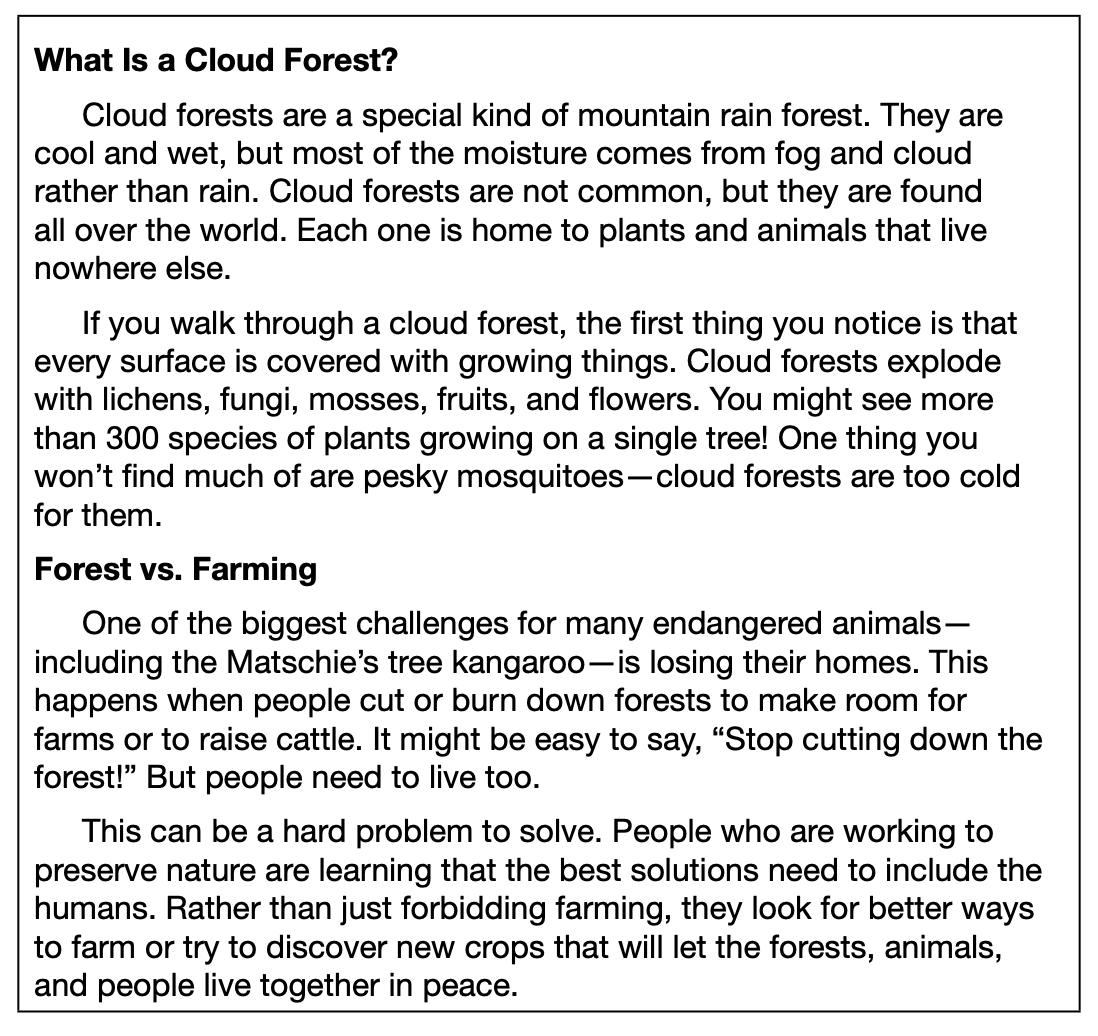
Read the details from the text box at the end of the passage.
“One of the biggest challenges for many endangered animals—including the Matschie’s tree kangaroo—is losing their homes. This happens when people cut or burn down forests to make room for farms or to raise cattle.”
Which statement is best supported by these details?
Read the details from the text box at the end of the passage.
“One of the biggest challenges for many endangered animals—including the Matschie’s tree kangaroo—is losing their homes. This happens when people cut or burn down forests to make room for farms or to raise cattle.”
Which statement is best supported by these details?
Required
1
This question has two parts. Answer Part One and then answer Part Two.
Part One: How do both sections in the text box at the end of the passage relate to the idea that the cloud forest in Papua New Guinea should be protected?
This question has two parts. Answer Part One and then answer Part Two.
Part One: How do both sections in the text box at the end of the passage relate to the idea that the cloud forest in Papua New Guinea should be protected?
Required
1
Part Two: Which evidence from the text box supports the answer in Part One? Choose two answers.
Misty Copeland
by Margaret Fuhrer
Misty Copeland has the kind of natural facility most dancers only dream about. But Misty, who was a late bloomer in ballet terms, didn’t begin studying dance seriously until she was 13. Since joining ABT II (the American Ballet Theatre, it was then called the “Studio Company”) in 2000, she’s been wowing audiences with her magnetic stage presence, natural charm, and athletic ability. Now a soloist with the American Ballet Theatre, she’s putting her distinctive stamp on both classical and contemporary roles, excelling as the delicate Gulnare in Le Corsaire one night and tearing up Jorma Elo’s gymnastic Glow-Stop the next. She’s even had a taste of the commercial world: The late Prince once asked her to be in the music video for his remake of “Crimson and Clover”!
Obviously it’s easy to idolize Misty. And as one of the very few African American ballerinas dancing today, she’s an especially inspiring role model. Here, as she answers your questions (and some of ours), she gives us a peek at her unique path to stardom.
When and why did you first start dancing?
I’d never really thought about dance until I was 13, when a teacher in my middle school told me that I had the physique of a dancer and that I should consider taking classes. I was curious and decided to go to a local Boys and Girls Club, where Cynthia Bradley, who would become my first serious dance teacher, was giving free classes. So my first ballet class was on a basketball court. I wore socks and gym clothes!
Since you had a late start, was it difficult for you to catch up with your classmates?
— Heather Vales, 22, Pinellas Park, FL
It was hard to learn the names of all the steps! I went away to my first ballet summer program, at San Francisco Ballet, when I’d only been dancing for a year and a half, and there were still steps that I didn’t know. I was placed in the highest level because physically I could do things, but it was really embarrassing because often I just wouldn’t understand what they were telling me to do.
What advice do you have for other late beginners?
If you know that ballet is truly what you want to do, it’s possible to make up for the lost time. You just have to be that much more focused and dedicated. Put in the extra work—you’ll get there.
Who were your first role models?
When I was growing up, Paloma [Herrera, principal dancer with ABT] was it. She was the first dancer I saw perform live, and I was obsessed. Later, when I came to ABT’s summer program, I finally met her I was totally starstruck!
Was there a moment when you knew you’d “made it”?
Probably my first time performing on the Metropolitan Opera House stage. I’d just gotten my corps de ballet contract, and the first thing I danced was a Little Swan in Swan Lake. I was terrified—it was the biggest stage I’d ever been on!—but at the same time I was thinking, “Wow, I’m here. I’ve arrived.”
Do you have a pre-performance ritual?
No, and everyone makes fun of me because I don’t! I’m really laid-back. I do my makeup in 15 minutes. If I get there two hours early, I feel like it’s too much time to think about things. I get stressed out.
Was there a point in your career when you felt “stuck”? If so, how did you move forward?
— Kayla K , 13, Sacramento, CA
There was a period when I was really down on myself because I desperately wanted to move up through ABT’s ranks, and it wasn’t happening. I didn’t understand how long a process that usually is! But I have a sponsor [a non-dancer mentor and supporter] at ABT, Susan Fales-Hill, and she helped me believe that I would make it eventually. It was nice to hear her words of encouragement, because once you get into a big company, you don’t have people giving you positive feedback all the time.
What is your proudest career moment?
Being promoted I’ll always remember that day: It was almost the end of the Met season, and everyone was exhausted. I was in my dressing room relaxing before a show and I got called into Kevin’s office [Kevin McKenzie, artistic director of ABT]—which is normal. But instead of giving me a correction, he told me he was promoting me to soloist. I was in shock! I think I said, “Oh, OK.” It didn’t really hit me until I spoke to my mother and my sponsor.
What’s the story behind the Prince video?
A little while ago, I got a call from one of his people, who asked if it would be OK if he called me. Of course I said yes. The next thing I know, I’m talking to Prince on my cell! He said he’s been a huge fan of mine for years and that I inspire him to create music. I was so flattered—and totally floored. He asked me to do the video, and soon I was on a plane to L.A. It was quick, in and out, just a day of shooting. Aside from the crew people, it was only Prince and me on the set. He just put on the music and said, “Do whatever you want.” So I improvised. Prince was funny; I kept asking him for advice or if there was anything specific he thought I should do, and he said, “No, just do what you’re doing!”
What are your career goals? Any more music videos?
[Laughs] You never know, but I don’t think so. As far as my ballet career goes, ABT is definitely where I want to be. I can’t imagine a better environment. And I would love to be a principal dancer—ABT’s first African American female principal.
Because you’re one of the only African American classical ballerinas, you symbolize a lot to many people. How does that affect you?
I try my best to be a good role model, to show people that it’s possible to do what I’ve done. If I can inspire even one person, encourage her not to be discouraged because of the color of her skin, that’s fantastic.
What is your favorite ballet step? Your least favorite?
— balletdancer231, via e-mail
I love grand jetés! They’re so free and fun. I’d say my least favorite is probably fouettés. Turning is definitely something I’ve had to work on, strength-wise.
What do you like to do in your time off?
I’m really into cooking. I’d love to go to culinary school when I’m done dancing. I do a good broiled salmon with sweet potato mash. And unsurprisingly I spend a lot of time with my boyfriend. We love to travel. The Dominican Republic, Greece, and Japan are my favorite destinations.
Why do you dance?
I was shy as a child, and I never really expressed myself verbally. Dancing was the first time I felt like I had a voice. It brings me joy—and I can share that joy with other people.
Required
1
Misty Copeland is an artist and her art is dance. Write an essay analyzing how Copeland shows dedication to her art. Use evidence from the passage to support your response.
Writer’s Checklist for the Text-Dependent Analysis Prompt
PLAN before you write- Make sure you read the prompt carefully.
- Make sure you have read the entire passage carefully.
- Think about how the prompt relates to the passage.
- Organize your ideas on scratch paper. Use a thought map, outline, or other graphic organizer to plan your essay.
FOCUS while you write- Analyze the information from the passage as you write your essay.
- Make sure you use evidence from the passage to support your response.
- Use precise language, a variety of sentence types, and transitions in your essay.
- Organize your paper with an introduction, body, and conclusion.
PROOFREAD after you write
- I wrote my final essay in the answer booklet.
- I stayed focused on responding to the prompt.
- I used evidence from the passage to support my response.
- I corrected errors in capitalization, spelling, sentence formation, punctuation, and word choice.
Misty Copeland is an artist and her art is dance. Write an essay analyzing how Copeland shows dedication to her art. Use evidence from the passage to support your response.
Writer’s Checklist for the Text-Dependent Analysis Prompt
PLAN before you write
- Make sure you read the prompt carefully.
- Make sure you have read the entire passage carefully.
- Think about how the prompt relates to the passage.
- Organize your ideas on scratch paper. Use a thought map, outline, or other graphic organizer to plan your essay.
FOCUS while you write
- Analyze the information from the passage as you write your essay.
- Make sure you use evidence from the passage to support your response.
- Use precise language, a variety of sentence types, and transitions in your essay.
- Organize your paper with an introduction, body, and conclusion.
PROOFREAD after you write
- I wrote my final essay in the answer booklet.
- I stayed focused on responding to the prompt.
- I used evidence from the passage to support my response.
- I corrected errors in capitalization, spelling, sentence formation, punctuation, and word choice.
Required
1
Which sentence contains a misspelled word?
Required
1
Read the paragraph.
(1) In many areas around the world, highways pass directly through the habitats of many animals. (2) Crossing the roads got really, really hard for some animals. (3) As a result, people have designed and built special bridges and tunnels just for wildlife. (4) These new wildlife crossings allow animals to move over or under the highway safely.
Which sentence should be revised to maintain the style of the paragraph?
Read the paragraph.
(1) In many areas around the world, highways pass directly through the habitats of many animals. (2) Crossing the roads got really, really hard for some animals. (3) As a result, people have designed and built special bridges and tunnels just for wildlife. (4) These new wildlife crossings allow animals to move over or under the highway safely.
Which sentence should be revised to maintain the style of the paragraph?
Required
1
Read the paragraph.
(1) On the day of the student council elections, my opponents and I were nervous. (2) We candidates for president each had to give a speech at the assembly. (3) At the end of the day, the council sponsor announced that I, the last candidate to speak at the assembly, was the winner. (4) My fellow officers and me promised that we would work hard.
Which change should be made to the paragraph to correct the error in pronoun usage?
Read the paragraph.
(1) On the day of the student council elections, my opponents and I were nervous. (2) We candidates for president each had to give a speech at the assembly. (3) At the end of the day, the council sponsor announced that I, the last candidate to speak at the assembly, was the winner. (4) My fellow officers and me promised that we would work hard.
Which change should be made to the paragraph to correct the error in pronoun usage?