PSSA Grade 8 ELA

Last updated 12 months ago
13 questions
Read the following passage about scientist Richard Feynman’s interest in rainbows.

Feynman and the Rainbow

by Stephen Whitt

Like most people, Richard Feynman admired rainbows. Rainbows need light, something the physicist thought about often.

One kind of rainbow appears in soap bubbles or in oily water puddles. These rainbows form because of something called interference—the idea that bits of light, called photons, can actually cancel each other out. In fact, the color you see in a soap bubble or on an oil slick is just the color left over after some of the photons have canceled each other out.

This idea of interference led to one of Feynman’s great contributions, a way of explaining something he called “the two-slit experiment.” For Feynman, this experiment contained all the weirdness of the strange science called quantum mechanics. When dealing with other problems in quantum mechanics, he would say, “You remember the case of the two-slit experiment? It’s the same thing.”

Pieces of Light

For the past 100 years, scientists have known that light is made of tiny pieces called photons. You might think of photons as small, fuzzy balls bouncing about at the speed of light. Keep in mind that this is just a model. To really “see” a photon, you have to absorb it in your eye, and this destroys the photon. But our model will be useful for the ideas to come.

Slits in Walls

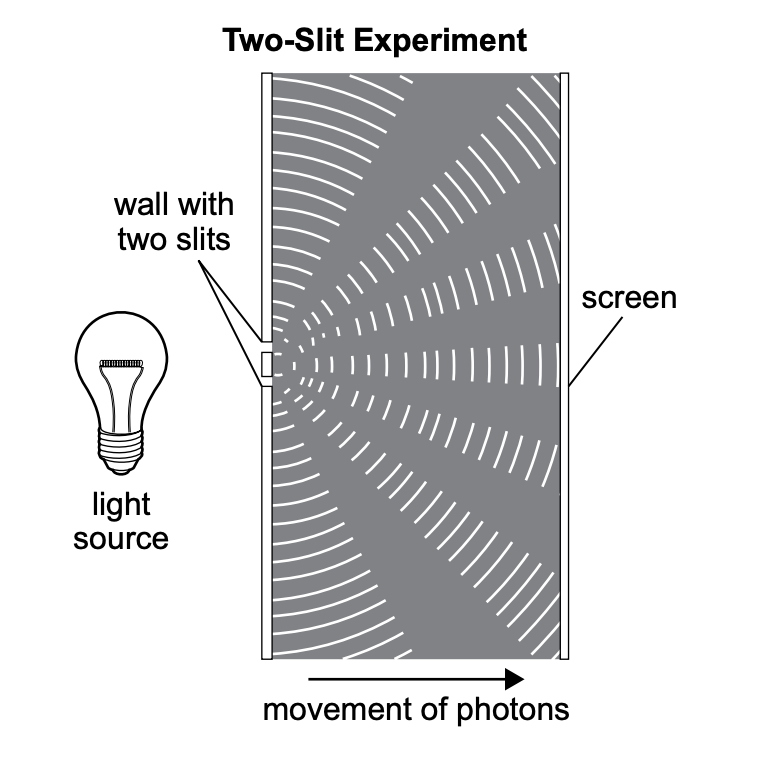
Imagine a light bulb so dim that it makes only one photon each second. The photon leaves the bulb and flies toward a wall. Usually the photon hits the wall, but occasionally a photon passes through a single thin slit in the wall. As it passes through the slit, the photon might be deflected up, deflected down, or keep going straight—you’re never sure just where the photon will go. After a short time, the photon runs into a screen that records the spot where the photon lands.

Most of the photons pass through the slit without much deflection, while a few are deflected up or down quite a bit. Now let’s add a second slit very near the first.

Photons may now pass through either slit to reach the screen. You might think that this second slit would just increase the number of photons that reach the screen. And you’d be partly right—the total number of photons does go up. But in certain regions the number of photons actually goes down.

A Deep Mystery

How can this be? How can opening a second slit in the wall actually make fewer photons reach a particular spot? This is the great beauty and mystery of the double-slit experiment. It turns out that—just as with our oil-slick rainbow—the photons interfere with one another; they cancel each other out. But remember: These photons arrive at different times!

Think, for a moment, about how strange this is. A photon that leaves at 10:30 and passes through one slit apparently “knows” that another photon will leave at 11:00 and pass through the other slit, traveling just the right distance to cancel out the first photon. As a result, the first photon doesn’t land in that “forbidden” spot. How can it know ahead of time which spots are forbidden? How can it know anything about a slit through which it doesn’t pass?

Answers and Questions

Feynman had an answer. He told us that the photon doesn’t pass through one slit. It passes through both slits. But wait, there’s more. Each photon actually “sniffs out” every possible path to reach the screen, all at the same time! Every possible path means just what it says. One path goes through the bottom slit. Another goes through the top slit. A third goes past your elbow, or maybe through a cat’s whiskers, before reaching the screen, and so on. And—here is the key point—as some of those paths interfere with each other, the photon won’t take those paths. In effect, the photon is interfering with itself.

No Peeking

At this point, you’re probably thinking, “This is silly. Why not just look to see which slit the photon goes through?” But to “look,” you have to change the setup of your experiment, and this changes the results. For example, to make sure that the photon passed through the top slit, you might block off the bottom slit. But with the bottom slit blocked, you get the single-slit pattern.

It’s almost as if nature is covering her tracks, making sure that you can’t peek inside to see what’s “really” happening. When you peek, the weirdness disappears.

If by now you’re a little dizzy, take heart. Quantum mechanics describes the way nature behaves. It predicts perfectly the way light bounces off mirrors, passes through windows, and makes rainbows on oily puddles. Yet even scientists who work with quantum mechanics admit that they don’t understand why it works that way. Feynman said, “Nobody understands quantum mechanics... If you will simply admit that maybe nature does behave like this, you will find her a delightful, entrancing thing... But nobody knows how it can be like that.”
Required
1

How does the section “Slits in Walls” contribute to the overall structure of the passage?

Required
1

Read the sentence from the passage.

“Most of the photons pass through the slit without much deflection, while a few are deflected up or down quite a bit.”

What does the word deflection mean as used in the sentence?

Required
1

Read the claim from the section “No Peeking.”

“When you peek, the weirdness disappears.”

How does the author support the claim?

Required
1

Which evidence most suggests that Richard Feynman is a prominent physicist?

Required
1

Read the sentence from the section “No Peeking.”

“If by now you’re a little dizzy, take heart.”

What is meant by the phrase “take heart”?

Required
1

Which claim is supported by the section “Answers and Questions”?

Required
1

This question has two parts. Answer Part One and then answer Part Two.

Part One
Which central idea about the study of science is developed in the passage?

Required
1

Part Two
Which evidence from the passage best supports the answer in Part One? Choose one answer.

Read the following passage that is a Greek myth. Then answer question 8 in your answer booklet.

The Picture Minerva Wove

retold by Carolyn Sherwin Bailey

Arachne, the wonderful girl weaver of Greece, took a roll of white wool in her skilled hands and separated it into long white strands. Then she carded it until it was as soft and light as a cloud. She was at work out of doors in a green forest, and her loom was set up under an old oak tree with the sunlight shining down between the leaves to brighten the pattern that she set up on it. In and out her shuttle flew without stopping until she had woven at last a fair piece of fabric.

Then Arachne threaded a needle with wool dyed in rainbow colors. She had all the colors of this long arch, that the sunbeams shining through raindrops make, to use in her work.

“What design will the clever Arachne embroider on her tapestry today?” one of the nymphs of the forest who had clustered about her to watch her work asked. Then all the nymphs, looking like a part of the forest in their soft green garments, crowded close as Arachne began to embroider a picture. The grass seemed to grow in it beneath her needle, and the flowers bloomed just as they always bloom in the spring.

“You weave and sew as if the great Minerva herself had taught you her arts,” a nymph said timidly to Arachne.

The girl’s face flushed with anger. It was true that the goddess Minerva, who presided over the arts that weavers need to know, spinning, weaving, and needlework, had taught Arachne her skill, but the girl was vain and always denied it.

“My skill is my own,” she replied. “Let Minerva try to compete with me, and if she is able to finish a rarer piece of work than mine, I am willing to pay any penalty.”

It was a thoughtless, daring boast which Arachne had made. As she spoke the leaves of the trees fluttered, for the nymphs, frightened at a mortal’s presumption, were moving away from Arachne. She looked up and in their place saw an old dame standing beside her.

“Challenge your fellow mortals, my child,” she said, “but do not try to compete with a goddess. You ought to ask Minerva’s forgiveness for your rash words.”

Arachne tossed her head in disdain. “Keep your counsel,” she replied, “for your hand-maidens. I know what I say and I mean it. I am not afraid of the goddess. I repeat it; let Minerva try her skill with mine if she dare venture.”

“She comes!” said the old dame, dropping her disguise and appearing before Arachne in the shining silver mail of the goddess Minerva.

Arachne grew pale with fear at first, but her presumption overcame her fear. Her heart was full of her foolish conceit, and she set a new piece of work on her loom as Minerva produced a second loom, and the contest began. They attached the web to the beam and began tossing their slender shuttles in and out of the threads. They pushed the wool up into place with their fine reeds until the fabric was compact. Then the needlework was begun.

Arachne, though, had decided to work something that was forbidden by the gods. She was going to use her skill of hand and all her art for evil instead of good.

She began embroidering a picture that would be displeasing to the gods, and she was able to make it seem as if it were alive, because of the figures and scenes she could outline with her needle and fill in with her colored wools. The picture Arachne embroidered was that of the fair Princess Europa tending her father’s herds of cattle beside the sea. One of the bulls seemed so tame that Europa mounted his back, and he plunged into the sea with her and carried her far away from her native shores to Greece. Arachne pictured this bull as the great god Jupiter.

Minerva’s embroidery was of a very different pattern from this. She was the goddess of wisdom, and her gift from Mount Olympus to the earth had been the beautiful olive tree that gave mortals shade, and fruit, and oil, and wood for their building. Minerva stitched the pattern of a green olive tree on the tapestry she was embroidering.

Among the leaves of the olive tree Minerva embroidered a butterfly. It seemed to live and flutter in and out among the olives. One could almost touch the velvet nap that lay on its wings and the silk down which covered its back; there were its broad, outstretched horns, its gleaming eyes, its glorious colors. Minerva’s workmanship was more wonderful than Arachne could ever hope to learn. As they finished she knew that she was outdone.

Minerva looked at Arachne’s tapestry, woven of pride and a desire for vain conquest. It could not be allowed to stand beside hers that showed the gift of life to humans in the olives and such beauty as that of the butterfly. The goddess struck Arachne’s tapestry with her shuttle and tore it in pieces.

Arachne was suddenly filled with an understanding of how she had wasted her skill, and she longed to get away from all sight and sound of her weaving. A vine trailed down to the ground from a nearby tree. Arachne twisted it about her body and tried to pull herself up by it to the tree, but Minerva would not allow this. She touched Arachne’s form with the juices of aconite and at once her hair came off, and her nose and her ears as well. Her body shrank and shriveled and her head grew smaller. Her fingers fastened themselves to her side and served for legs. She hung from the vine which changed to a long gray thread.

Arachne, the skillful weaver of Greece, was changed to Arachne, the spider of the forest. Through all the centuries since then she has been spinning her fragile threads and weaving her frail webs that a breath of wind, even, can destroy.
Required
4

A theme of the passage is vanity can be the cause of reckless actions. Write an essay analyzing how this theme is revealed by the events throughout the passage. Use evidence from the passage to support your response.

Writer’s Checklist for the Text-Dependent Analysis Prompt

PLAN before you write
  • Make sure you read the prompt carefully.
  • Make sure you have read the entire passage carefully.
  • Think about how the prompt relates to the passage.
  • Organize your ideas on scratch paper. Use a thought map, outline, or other graphic organizer to plan your essay.

FOCUS while you write
  • Analyze the information from the passage as you write your essay.
  • Make sure you use evidence from the passage to support your response.
  • Use precise language, a variety of sentence types, and transitions in your essay.
  • Organize your paper with an introduction, body, and conclusion.
PROOFREAD after you write …
  • I wrote my final essay in the answer booklet. …
  • I stayed focused on responding to the prompt. …
  • I used evidence from the passage to support my response. …
  • I corrected errors in capitalization, spelling, sentence formation, punctuation, and word choice.

Required
1

Read the paragraph.

(1) It is time to replace the curtains in the school auditorium. (2) Yesterday during play practice, the curtains stopped on their track twice when they were supposed to close the scene. (3) Also, the curtains have tears and holes in them. (4) Someone told us the curtains were bought by some group a long time ago and cost a lot of money. (5) If needed, students in the drama program could organize fundraisers to help with the expense of new curtains.

Which sentence should be revised to provide more precise information?

Required
1

Read the paragraph.

The ancient Sumerians developed the first system of writing. It was called cuneiform. Cuneiform consisted of wedge-shaped marks made on clay tablets. How did writers make the marks? They used a thick reed as a stylus. Traders and merchants first used cuneiform to record transactions. Later, scribes and priests used the system to record stories and religious beliefs.

Which revision would most improve the paragraph?

Required
1

Read the sentences from a story.

Over lunch in the cafeteria, Joe sat with Jennifer as they listened to Bill talk about his favorite hobby: building model cars.

“That’s really interesting,” said Jennifer. “What model car are you building now?”

Suddenly, Joe remembered that he needed to meet with his math teacher before class. He rose to leave.

“I’m working on a 1965 Corvette Joe, don’t leave yet and I plan to take it to the show next Saturday,” said Bill, as he, too, rose from the table to follow Joe.

Which revision correctly punctuates the underlined group of words to indicate a break in thought?

Required
1

Read the paragraph.

(1) Have you ever accidentally shaken a soda bottle and had it erupt when you opened the cap? (2) This is similar to the violent eruption of a stratovolcano, which has a deep magma reservoir beneath the surface. (3) Pressure builds in the magma chamber as gases which have been under immense heat and pressure are dissolved into liquid rock. (4) Because these types of volcanoes form in a system of underground channels, stratovolcanoes sometimes blow out the sides of their cone, as well as the crater at the summit.

Which revision should be made to the paragraph?