----Please read before starting your midterm. ----
Begin the midterm. When finished, do something quietly (seriously, quietly!!).
Midterm Test-Taking Tips:
*****READ THE ENTIRE QUESTION *********
Read the entire question!!
Read tips (a.) and (b.) from above.
Check your work before submitting.
If you’re not sure, try to eliminate options that you know are wrong (with multiple choice questions).
DON’T leave any questions blank. Always at least try. Leaving questions blank and later saying, “I don’t know” is a bad look. Trust me. The person typing this right now is also the person grading this. Hint hint.
Read tips (a.) and (b.) again. Geeeeeeeeeeeez.
Academic Honesty Statement
At ISDenver, we value honesty, integrity, and fairness in all academic work. By taking this exam, you agree to adhere to the principles of academic honesty, which include:
Not using unauthorized materials, devices, or assistance during the exam.
Not communicating with other students or external sources during the exam.
Submitting only your original work.
Reporting any concerns about academic honesty to a teacher or exam supervisor.
By signing below, I confirm that I understand and will follow the Academic Honesty Policy. I acknowledge that violations may result in disciplinary action, including receiving a zero on the exam.
Required
0 points
0
Question 1
1.
I (type your name) _______ acknowledge that I have read the "Academic Honesty Statement" above on this date (enter date) _______ .
Your midterm officially begins now. Good luck!
1 point
1
Question 2
2.
All living organisms are made up of cells.
1 point
1
Question 3
3.
Decomposers, such as fungi, make their own food through photosynthesis.
1 point
1
Question 4
4.
Asexual reproduction requires two parents.
1 point
1
Question 5
5.
During natural selection, traits that increase the chances of survival are passed on to future generations.
1 point
1
Question 6
6.
Traits like beak size can affect an organism’s ability to survive in its environment.
1 point
1
Question 7
7.
All physical traits are also adaptations.
1 point
1
Question 8
8.
Eukaryotic cells are more complex cells, and have internal compartments such as a nucleus.
1 point
1
Question 9
9.
Bacteria belong to the domain Eukarya.
1 point
1
Question 10
10.
A producer is an organism that gets energy by eating other organisms.
1 point
1
Question 11
11.
Organisms from the Archaea domain are multicellular organisms.
1 point
1
Question 12
12.
One or more species make up a genus.
1 point
1
Question 13
13.
An organism's scientific name is made of two parts: its _______ and _______ .
1 point
1
Question 14
14.
Which of the following is a characteristic of living things?
1 point
1
Question 15
15.
Which organism is an example of a producer/autotroph?
1 point
1
Question 16
16.
A mushroom grows on a dead, rotting oak tree lying in the forest. Which of the following best describes the tree and mushroom?
1 point
1
Question 17
17.
In the Bird Beak Lab, what did the type of beak represent?
1 point
1
Question 18
18.
Which type of reproduction leads to identical offspring?
1 point
1
Question 19
19.
What domain do humans belong to?
1 point
1
Question 20
20.
Which domain includes extremophiles, or organisms that can live under harsh conditions?
1 point
1
Question 21
21.
Which kingdom has both unicellular and multicellular organisms?
1 point
1
Question 22
22.
In the Bird Beak lab, what was the dependent variable?
1 point
1
Question 23
23.
Who traveled to the Galapagos Islands and studied finches to later come up with the theory of evolution?
1 point
1
Question 24
24.
If a population of organisms is unable to adapt to its environment, it will likely
1 point
1
Question 25
25.
Which of the following is an example of artificialselection?
1 point
1
Question 26
26.
A ________ uses a series of paired statements to identify organisms.
1 point
1
Question 27
27.
What best describes the relationship between a stimulus and a response?
1 point
1
Question 28
28.
In nature, what typically comes before competition or is needed for competition to happen?
1 point
1
Question 29
29.
An organism that eats other organisms for energy is called a _______
1 point
1
Question 30
30.
_______ is the process by which populations change over time.
1 point
1
Question 31
31.
When organisms reproduce, they pass copies of all or part of their _______ to their offspring.
1 point
1
Question 32
32.
A(n) _______ is a membrane-covered structure that contains all of the materials necessary for life.
1 point
1
Question 33
33.
The kingdom _______ obtain energy by absorbing materials, such as decaying matter.
2 points
2
Question 34
34.
Match the definition with the correct super duper important science word:
Draggable item
arrow_right_alt
Corresponding Item
Organisms made up of more than one cell.
arrow_right_alt
Producers
Organisms that make their own food using sunlight.
arrow_right_alt
Eukarya
Cells with a nucleus or internal compartments.
arrow_right_alt
Adaptation
Cells without a nucleus or internal compartments.
arrow_right_alt
Prokaryotes
A beneficial trait that helps an organism survive.
arrow_right_alt
Multicellular
A domain that includes plants, animals, fungi, and protists.
arrow_right_alt
Eukaryotes
1 point
1
Question 35
35.
Re-order the classification system so it's in the correct order. The top of the list should represent the most general classification, or the one that would include the most organisms.
Order
Class
Phylum
Kingdom
Domain
Family
Genus
Species
1 point
1
Question 36
36.
Check the five characteristics of living things:
4 points
4
Question 37
37.
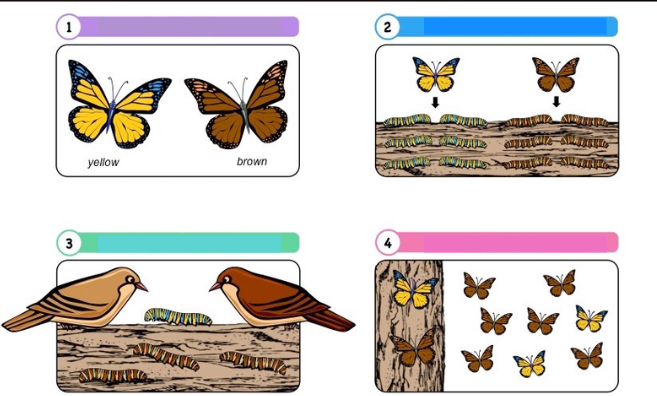
Explain how natural selection leads to evolution. Use the image above to help explain your answer. Some key words that probably should be used in your answer include: natural selection, evolution, traits, and adaptations. I really really hope you read the full question this time.
Required
3 points
3
Question 38
38.
**NEW SPECIES DISCOVERED** We need your help to identify what kingdom it belongs to. Read the description below and decide what Eukarya Kingdom you think it belongs to. Make a claim, provide your evidence, and state your reasoning.
--- Alien Species: Lumorbius Solaris --
Description of Lumorbius Solaris:
The Lumorbius Solaris is a fascinating organism discovered on the distant planet Xenotera. Scientists have observed the following key characteristics:
Appearance: Lumorbius Solaris has a glowing, dome-shaped structure that changes color depending on its environment.
Size: Most are microscopic, but some can grow large enough to be visible to the naked eye.
Cell Structure: It is unicellular but can form colonies with other Lumorbius Solaris.
Nutrition: It absorbs sunlight to produce its own energy through a process similar to photosynthesis.
Movement: It has tiny hair-like structures that allow it to move in water.
Reproduction: Reproduces both sexually and asexually, depending on environmental conditions.
Required
3 points
3
Question 39
39.
Read the two statements below. Tell me which one you think is correct and why. AND WHY!!
a) Evolution is a process that leads to natural selection.
b) Natural selection is a process that leads to evolution.
Required
3 points
3
Question 40
40.
Think back to the characteristics of living things.
Describe ONE piece of evidence that supports the argument that viruses should be considered living.
Then, describe at least ONE piece of evidence that supports the argument that viruses should NOT be considered living.
Elaborate and include details to make your reasoning clear in order to earn full credit.