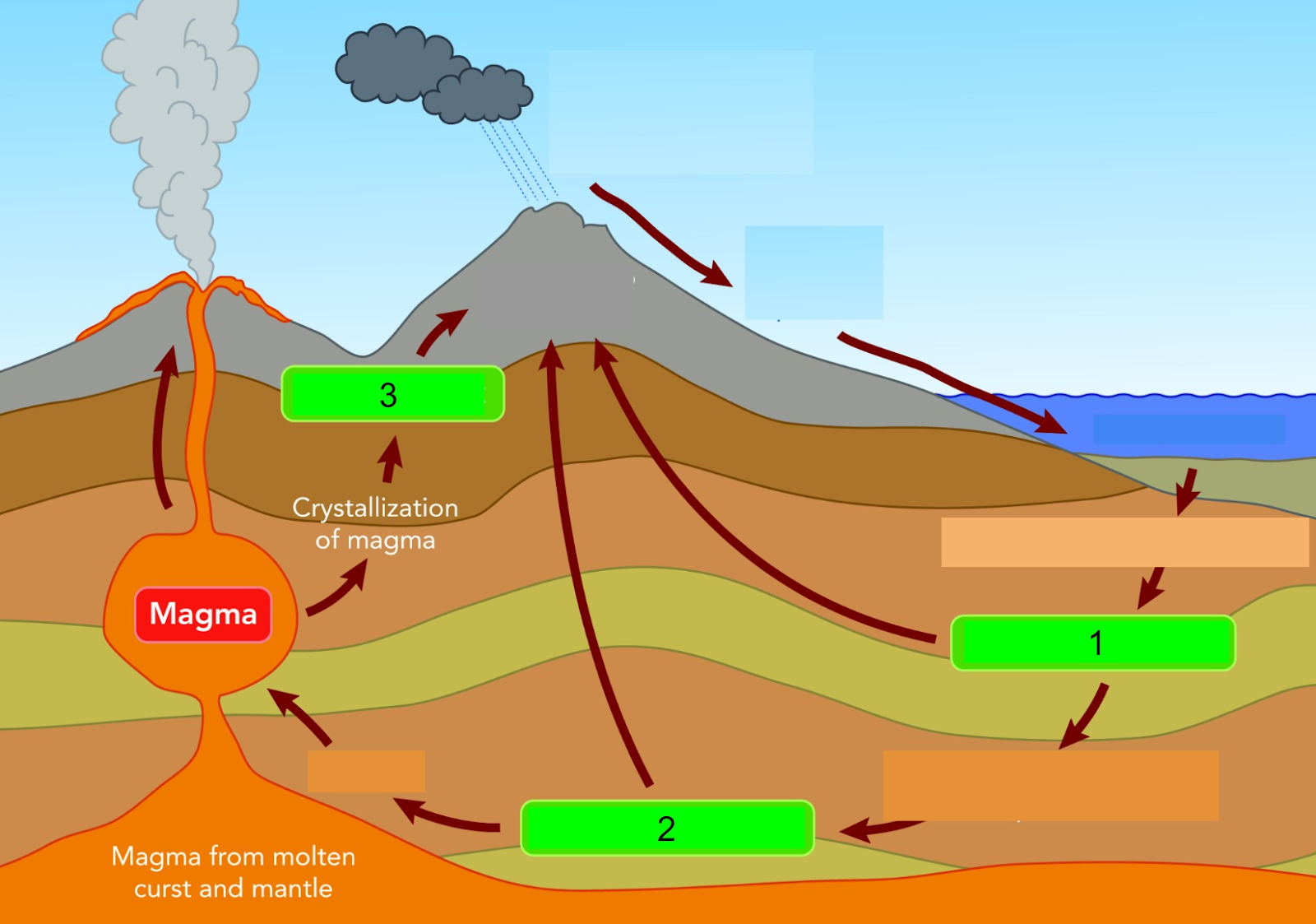
Look at the numbered spaces in the diagram (click to enlarge). Which of the 3 major rock types in the rock cycle is most likely to be found at each of those locations?
1:
2:
3:
----Please read before starting your midterm. ----
Begin the midterm. When finished, do something quietly (seriously, quietly!!).
Midterm Test-Taking Tips:
*****READ THE ENTIRE QUESTION *********
Read the entire question!!
Read tips (a.) and (b.) from above.
Check your work before submitting.
If you’re not sure, try to eliminate options that you know are wrong (with multiple choice questions).
DON’T leave any questions blank. Always at least try. Leaving questions blank and later saying, “I don’t know” is a bad look. Trust me. The person typing this right now is also the person grading this. Hint hint.
Read tips (a.) and (b.) again. Geeeeeeeeeeeez.
At ISDenver, we value honesty, integrity, and fairness in all academic work. By taking this exam, you agree to adhere to the principles of academic honesty, which include:
Not using unauthorized materials, devices, or assistance during the exam.
Not communicating with other students or external sources during the exam.
Submitting only your original work.
Reporting any concerns about academic honesty to a teacher or exam supervisor.
By signing below, I confirm that I understand and will follow the Academic Honesty Policy. I acknowledge that violations may result in disciplinary action, including receiving a zero on the exam.
I (type your name)
The crust is a thicker layer than the mantle.
A transform boundary is where two tectonic plates slide past each other.
The Law of Superposition states that younger rock layers are found below older rock layers.
Understanding the science of a volcano from 2 millions years ago by understanding a volcano from today is an example of ______.
Index fossils are used to determine the age of rock layers.
Folding occurs when rock layers are bent due to pressure.
Divergent boundaries create new crust.
Conformity in rock layers means there is a gap in geological history.
Trace fossils provide evidence of the behavior of ancient organisms.
Permineralization occurs when minerals replace the original material in a fossil.
The Cambrian explosion is when the asteroid killed all the dinosaurs.
You're more likely to find earthquakes near a _____ boundary.
Which principle helps scientists determine the relative age of rock layers?
Subduction relates to which of the answers below:
What type of fossil is formed when an organism leaves an impression in the rock?
Which process or processes in the rock cycle form sedimentary rocks?
The process by which warm matter (air, liquid) rises and cool matter sinks or falls is called _______.
Which of the following is a body fossil?
Fossils of organisms that lived during a short, specific time period and are found worldwide are called
In the Rock Cycle Starburst lab, what rock cycle process was demonstrated when heating the Starburst pieces?
What type of rock is formed when magma cools and solidifies?
Which of the following describes a fault?
If 100 grams of an unknown substance has a half-life of 25 years, how much of the substance would remain after 75 years?
Different types of boundaries on Earth's crust show how ________ interact with each other.
In the cast fossil lab using seashells, what was the independent variable?
The Earth's outermost layer is called the
Look at the numbered spaces in the diagram (click to enlarge). Which of the 3 major rock types in the rock cycle is most likely to be found at each of those locations?
1:
2:
3:
In the rock cycle,
The process of
The
Match the boundary to its description
| Draggable item | arrow_right_alt | Corresponding Item |
|---|---|---|
This is where mountains and volcanoes may appear as plates come together | arrow_right_alt | Divergent |
This is where earthquakes most commonly happen | arrow_right_alt | Convergent |
This is when plates spread apart, away from each other | arrow_right_alt | Transform |
Match the major event on Earth to its correct eon.
| Draggable item | arrow_right_alt | Corresponding Item |
|---|---|---|
Simple life begins to evolve | arrow_right_alt | Phanerozoic Eon |
Earth begins to cool and chill itself out | arrow_right_alt | Hadean Eon |
Complex life starts to explode on earth | arrow_right_alt | Archean Eon |
Earth is bombarded by meteors and the moon forms | arrow_right_alt | Proterozoic Eon |
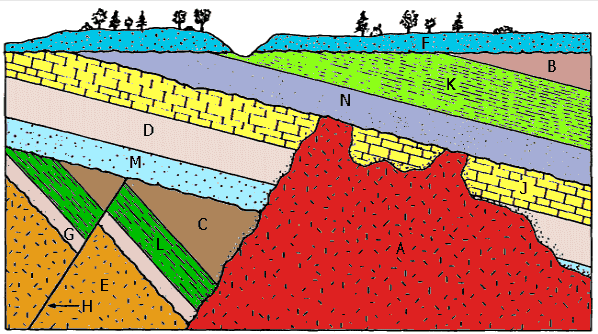
Place the layers in the correct order from oldest to youngest, WITH THE OLDEST LAYER AT THE BOTTOM OF THE LIST AND THE YOUNGEST LAYER AT THE TOP OF THE LIST.
A
M
H
K
N
B
E
G
F
D
J
L
C
Explain the relationship between the mantle, the crust, and the movement of tectonic plates.
What type of rock are fossils most often (if not always) found in? Explain why fossils are found in this type of rock and not others.
How would you explain to a skeptical or sassy student who asks, "Yeah, but how do we really know how old these rock layers and mountains are?" so they can better understand the methods scientists use to determine their age?
Many moons ago, we did a bottle flipping lab. Remember? Well, I hope so. Tell us what the independent variable, the dependent variable, and at least two controlled variables were from that lab AND WHY. It'd be wise to add a bit of detail to your answers to show us what you really know. Just saying.