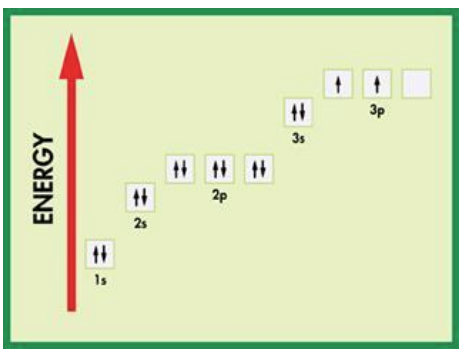
With the given orbital diagram, which of the following is true?
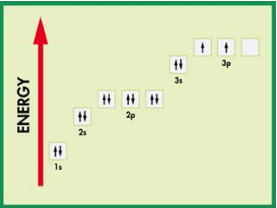
With the given orbital diagram, which of the following is true?
Which of the following correctly describes heat?
When energy is added to a substance at constant volume and pressure, its temperature increases except ________.
If one end of an iron bar is heated, what causes thermal energy to transfer to the other end?
Which of the following can cause objects to require different amounts of thermal energy to reach the same temperature?
When does the flow of thermal energy stop?
How does an exothermic reaction compare with an endothermic reaction?
A hot piece of metal is placed into cooler water. Which statement describes how the second law of thermodynamics relates to this process?
Is the flow of energy during vaporizing more like the flow of energy during melting or during freezing?
What does residence time describe?
Thermal energy is transferred throughout Earth by which of the following processes?
Which of the following is most responsible for the uneven distribution of solar energy on Earth?
What cycle includes ammonia and urea?
A scientist studying a swamp notes that it contains a high concentration of organic carbon. She should classify this region as ________.
What process drives mantle convection?
Which statement best explains why Earth's core contains such high percentages of iron and nickel?
Which is the correct order of Earth's structural layers, from top to bottom?
Match the following plate formations to their proper description.
| Draggable item | arrow_right_alt | Corresponding Item |
|---|---|---|
volcanic arcs | arrow_right_alt | These form when extensional forces on rock at a divergent boundary cause some rocks to move up and some to move down; this group moves upward. |
fault block mountains | arrow_right_alt | These may be inactive and become a place for water to collect, forming rivers and lakes |
folded mountains | arrow_right_alt | These form behind a subduction zone where two plates converge. |
rift valleys | arrow_right_alt | These form when converging plates compress against each other and form anticlines, pushing rock upward |
Match the following types of plate boundaries and formations to their description or example.
| Draggable item | arrow_right_alt | Corresponding Item |
|---|---|---|
subduction zones | arrow_right_alt | This occurs when two tectonic plates push together; this action can form mountains and volcanoes. |
convergent boundary | arrow_right_alt | The movement of tectonic plates that form mid-ocean ridges and rift valleys. |
deep-sea trenches | arrow_right_alt | This occurs when two tectonic plates slide past one another; this boundary occurs in southern California. |
transform boundary | arrow_right_alt | These occur at convergent boundaries between ocean-ocean or ocean-continental crust occur, but do not occur where two continental plates meet. |
divergent boundary | arrow_right_alt | These form the deepest parts of the ocean, with most located around the ring of fire. |
Pangaea became the continents we see today because of plate motion...
Continental drift separates two populations of the same species. Eventually, the two populations evolve into distinct species. In which of the following scenarios would this evolution likely be most pronounced?
A geologist is looking for evidence of early supercontinents. Why is the evidence difficult to find?
Where do volcanoes form?
A geologist learns that an explosive volcanic eruption occurred. Which of the following inferences is he most justified in making about the type of lava that erupted?
How do volcanoes form at hot spots?
The atomic number of lead is 82. Its mass number is 207. How many protons, neutrons, and electrons does this atom of lead contain?
Which combination best represent the mass and charge of a neutron?
An atom of hydrogen-2 contains one proton, one neutron, and one electron. Which particle(s) identify the atom as hydrogen?
An ion of oxygen contains eight protons and has a charge of 2-. What must occur for this ion to become a neutral oxygen atom?
Which atom has the greatest mass?
How did the uncertainty principle influence thinking about the arrangement of electrons in atoms?
Light can be characterized in terms of its wavelength. Light can also be characterized as having a discrete quantity of energy. What does this say about light?
With the given orbital diagram, which of the following is true?
What word is used to describe electrons in the outermost energy level?
Using the orbital diagram below, which of the following elements does it describe?
The noble gases include which of the following sets of elements?
How many groups are there in the periodic table?
Which of the following is true about halogens?
Which of the following is true about rows of the periodic table?
Metallic character tends to increase as you move in which direction on the period table?
Atomic radius tends to decrease as you move ________.
For which object(s) do Newton's laws of motion apply best?
An object is falling straight down. The minimum number of axes required in a frame of reference used to analyze its motion is
A student knows the following facts about an object. Which will help most in being able to use Newton's laws predict its motion?
In Newton's law of universal gravitation, what is the mathematical relationship of the force to the distance?
Which of the following best completes this sentence? In every interaction, forces occur in ___________.
If each vehicle below is traveling at 30 miles per hour on a straight road, which one would be the hardest to stop?
A bat with a force of 50 N hits a softball with a mass of 0.5 kg. What will the softball's acceleration rate be?
The same force acts on four objects with different masses. Which mass would experience the greatest acceleration?
Newton's first law states that an object must travel at a constant speed and in ________, unless some outside force compels it to change.
An object is accelerating when _______________.
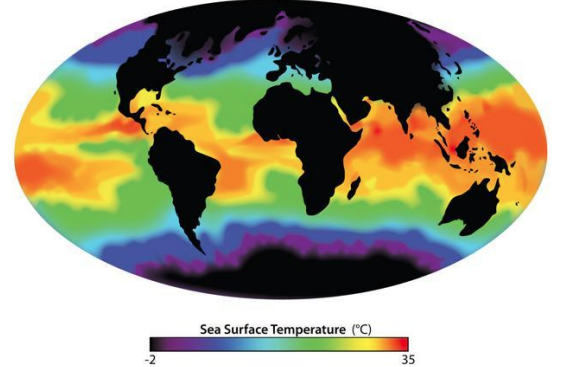
In this image, what type of quantity is indicated by the colors?
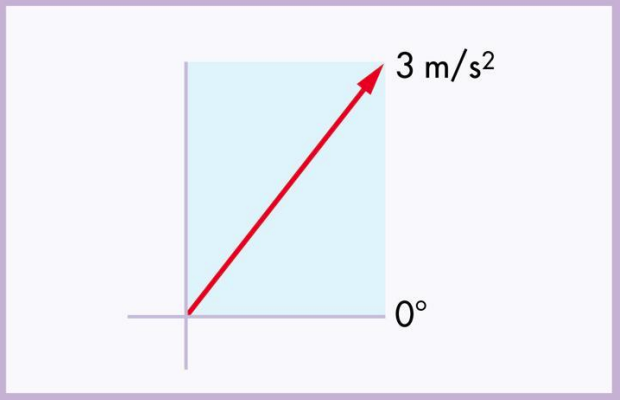
Which could be a description of this vector?
Add the following force vectors using the head-to-tail method: 3 N east; 2 N north; 2 N west; 4 N north; 2 N west; 3 N south; 1 N east. What is the resultant vector?
A satellite orbits Earth at a constant altitude and speed. There are no physical connections, such as cables, between Earth, and the satellite. Why does it follow a circular path?
Speed is related to velocity in the same way that distance is related to _______
Combine these three velocity vectors into a resultant: 3.0 m/s north, 4.0 m/s east, 1.0 m/s west. Identify the resultant vector.
A velocity's magnitude may be changed without changing its direction by ________.
What is the average acceleration of a car that is initially at rest at a stoplight and then accelerates to 24 m/s in 9.4 s?
A boy pushes on a heavy box, but it does not move. What force is resisting the boy's push?
Neglecting air resistance, the horizontal velocity of a projectile ________.
A car suddenly slams on its brakes and skids west for 8 m before stopping. The force of friction acting on the car was directed ...
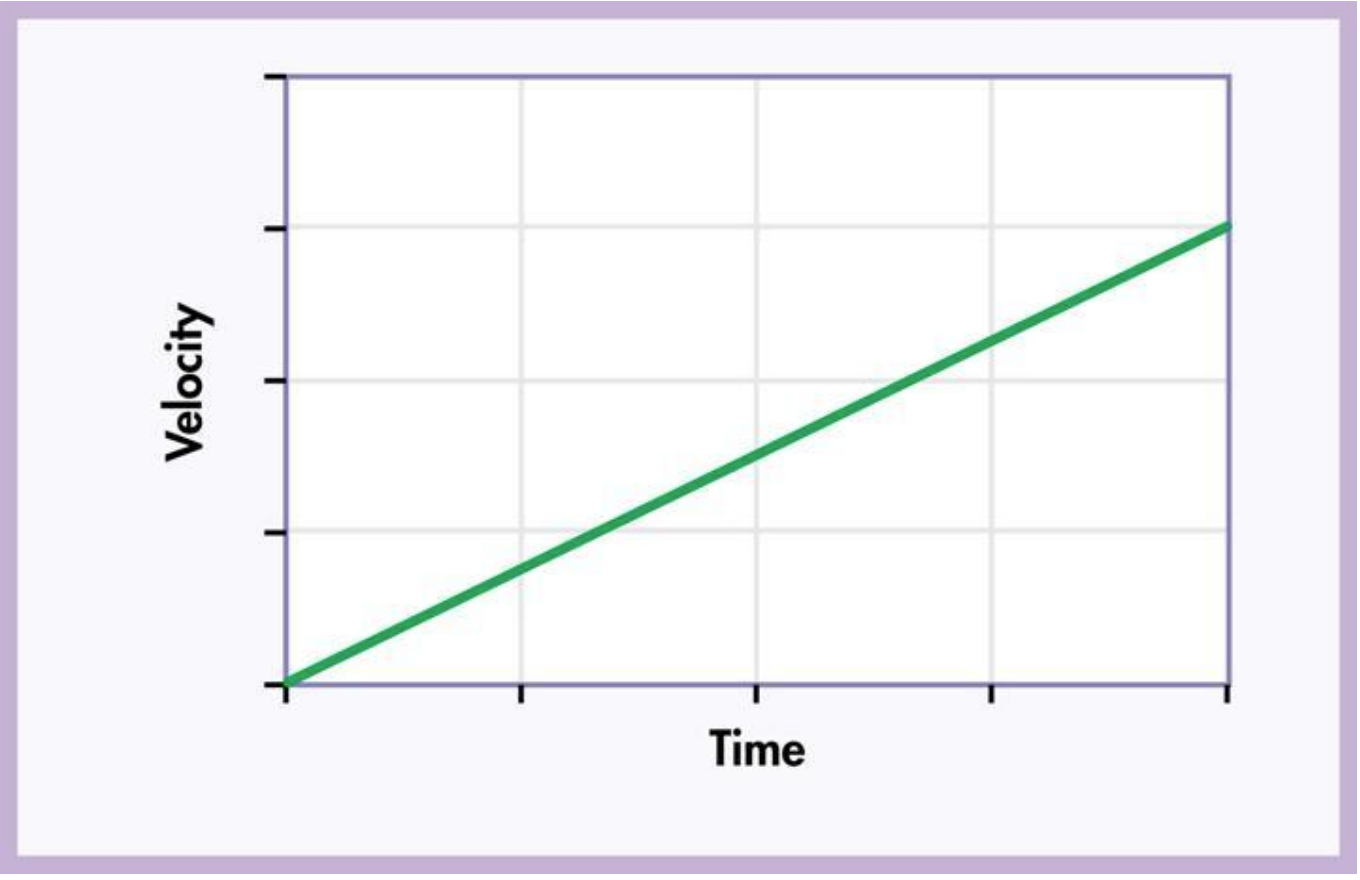
The velocity--time graph shown below indicates which of the following about the object's motion?
Two objects in a closed system collide. After the collision, one object has lost speed, but the other object has gained speed. Explain why this has happened.
Calculate the speed of a 2.4 kg object with a momentum of magnitude 76 kg m/s.
When two objects collide in a perfectly elastic collision, what is true about the total momentum and total kinetic energy before and after?
The kinetic energy of an object is equal to what expression?
What symbol is used to denote momentum?