LR247.3.1: Cell Organelles

Last updated about 1 year ago
32 questions
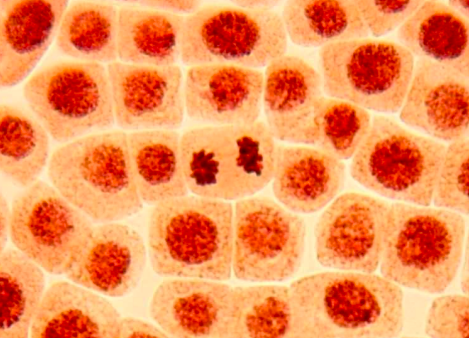
Cells make up all living things, including your own body. The image below
shows a group of cells. Not all cells look alike. Cells can differ in shape and sizes.
And the different shapes usually mean they do different things.


A cell is the smallest structural and functional unit of an organism. Some
organisms, like bacteria, consist of only one cell. Large organisms, like humans,
consist of trillions of cells. Compare a human to a banana. On the outside, they
look very different, but if you look close enough you’ll see that their cells are
actually very similar.
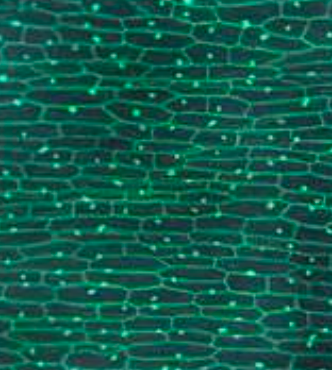
Most cells are so small that you cannot see them without the help of a
microscope. It was not until 1665 that English scientist Robert Hooke invented a
basic light microscope and observed cells for the first time, by looking at a piece
of cork, which he got from a tree. You may use light microscopes in the
classroom. You can use a light microscope to see cells like the image below.


In 1858, after using microscopes much better than Hooke’s first microscope,
Rudolf Virchow developed the hypothesis that cells only come from other cells.
For example, bacteria, which are single-celled organisms, divide in half (after
they grow some) to make new bacteria. In the same way, your body makes new
cells by dividing the cells you already have. In all cases, cells only come from
cells that have existed before. This idea led to the development of one of the
most important theories in biology, the cell theory.

Cell theory states that:
1. All organisms are composed of cells.
2. Cells are alive and the basic living units of organization in all
organisms.
3. All cells come from other cells.

As with other scientific theories, many hundreds, if not thousands, of experiments
support the cell theory. Since Virchow created the theory, no evidence has ever
been identified to contradict it.
Required
1
__________make up all living things.
Required
1

Who came up with the first microscope?

Required
1

Which of these NOT part of cell theory? (choose 2)

Single-celled (unicellular) organisms like bacteria are composed of just one cell,
whereas multicellular organisms can be composed of trillions of cells.
Multicellular organisms include protists (though single-celled protists also exist),
fungi, plants and animals. Most plant and animal cells are between 1 and 100 μm
(micrometer) in size and therefore can only be observed under the microscope.

The one cell of a unicellular organism must be able to perform all the functions
necessary for life. These functions include metabolism, homeostasis, and
reproduction. Specifically, these single cells must transport materials, obtain and
use energy, dispose of wastes, and continuously respond to their environment.
The cells of a multicellular organism also perform these functions, but they may
do so in collaboration with other cells.

Although cells share many of the same features and structures, they also can be
very different. Each cell in your body is designed for a specific task. In other
words, the cell's function is partly based on the cell's structure. For example:

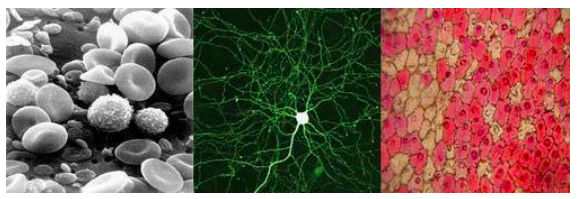
● Red blood cells are shaped with a pocket that traps oxygen and brings
it to other body cells. These cells also have a large surface area that
aids in oxygen transfer.

● Nerve cells are long and stringy in order to form a line of
communication with other nerve cells, like a wire. Because of this
shape, they can quickly send signals, such as the feeling of touching a
hot stove, to your brain.

● Skin cells are flat and fit tightly together to protect your body.

As you can see in the images below, cells are shaped in ways that help them do
their jobs. Multicellular (many-celled) organisms have many types of specialized
cells in their bodies.
Required
1
__________organisms like bacteria are composed of just one cell,
whereas __________ organisms can be composed of trillions of cells.
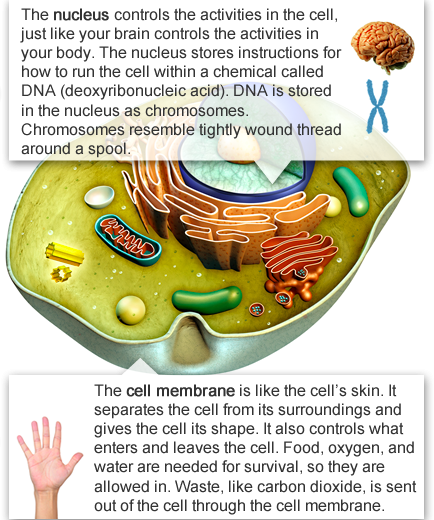
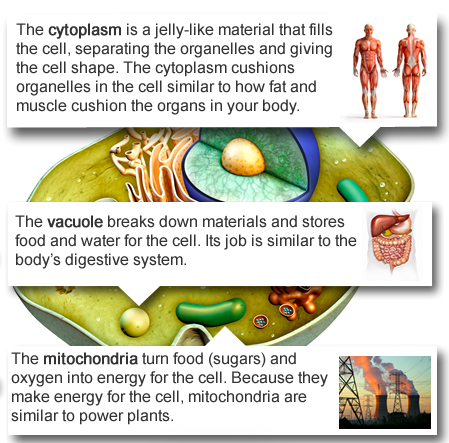
Cells have many organelles that perform specific tasks to help the cell survive. Even very different types of cells have many of the same organelles. Just like your body parts, it is important for a cell's organelles to work together. Click on the two organelles labeled in the animal cell below to learn more.


Required
1
An__________is a structure inside the cell that performs a specific function to help the cell survive. The__________acts as the control center of the cell, directing its activities. The
__________separates the cell from its surroundings.
Required
1

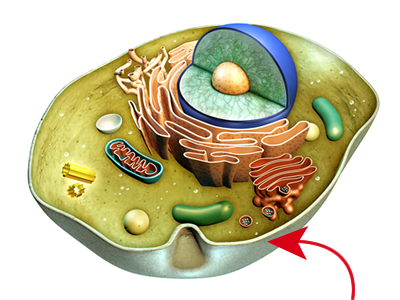
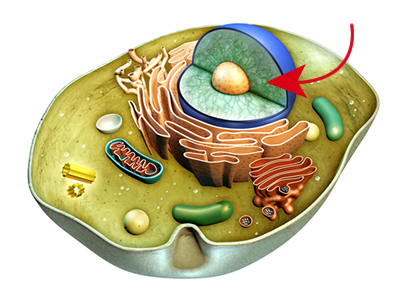
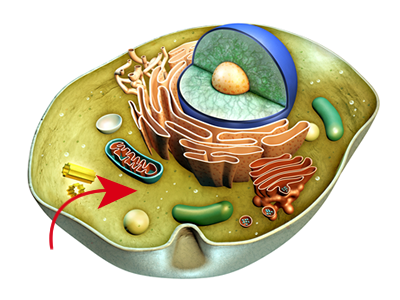
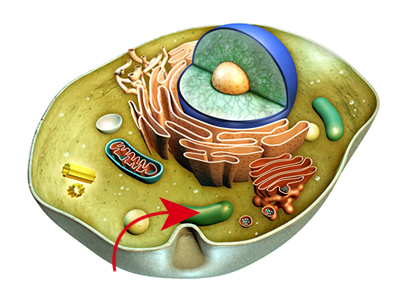
Which of the following is NOT functions of the organelle identified in this picture?

Required
1

Which of the following are functions of the organelle identified in this picture? (choose 2)

Required
1
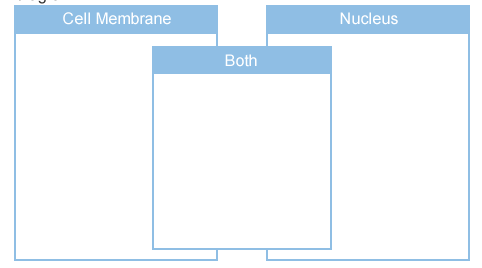
Place each of the terms below into the correct part of the Venn diagram.
Other Answer Choices:
stores chromosomes
allows food to enter the cell
in an animal cell
Required
1
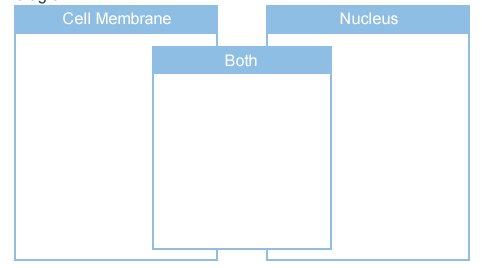
Place each of the terms below into the correct part of the Venn diagram.
Other Answer Choices:
sends food out of the cell
controls activities inside the cell
is an organelle
Required
1
The__________cushions organelles and gives the cell structure. The__________
breaks down materials and stores food and water for the cell. The__________
is like a power plant, making energy for the cell.
Required
1

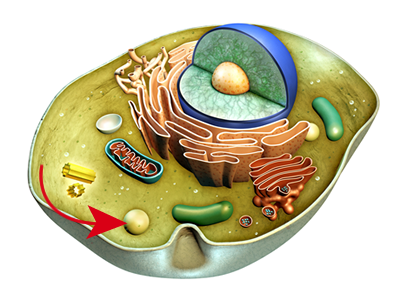
Which of the following is/are functions(s) of the organelle identified in this picture?

Required
1

Which of the following is/are functions(s) of the organelle identified in this picture?

Required
1

Which of the following is/are functions(s) of the organelle identified in this picture?

Required
1
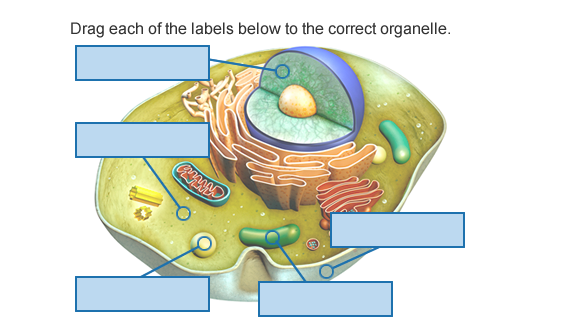
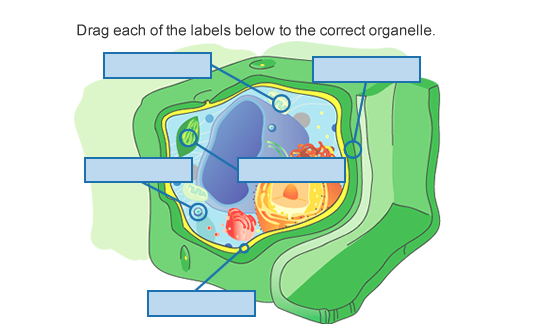
Drag each of the labels below to the correct organelle.
Other Answer Choices:
nucleus
mitochondria
vacuole
cell membrane
cytoplasm
Check for Understanding:

The cell's organelles perform specific functions to help the cell survive.

1. The cell membrane separates the cell from its surroundings and gives the cell shape. It also acts as a gatekeeper, controlling what enters and leaves the cell.

2. The nucleus controls the activities in the cell and stores the cell's DNA.

3. The vacuole stores water for the cell.

4. The mitochondria turn food (sugars) and oxygen into energy for the cell.

5. The cytoplasm is a jelly-like material that fills the cell, separating the organelles and giving the cell shape.
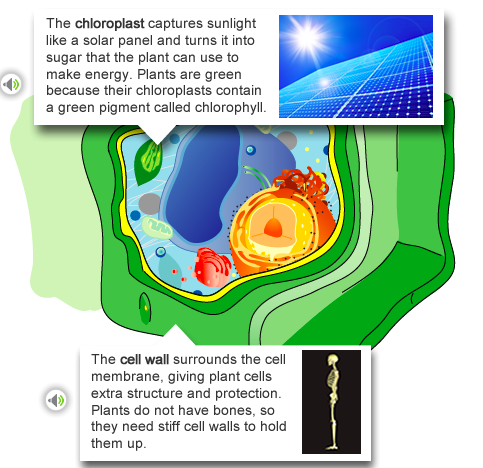
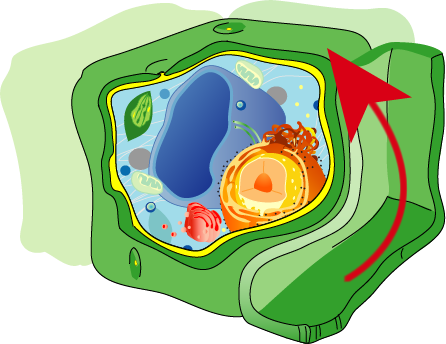
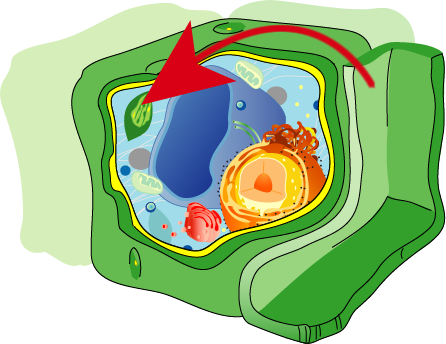
Because plants have different needs from animals, their cells have two extra organelles. Click on the buttons below to learn more.


Required
1
The plant's__________gives the plant extra structure and support. The__________
captures sunlight and turns it into sugars for the plant to use for energy.
Required
1

Which of the following are functions of the organelle identified in this picture? (choose 2)

Required
1

Which of the following are functions of the organelle identified in this picture?

Required
1
Drag each of the labels below to the correct organelle.
Other Answer Choices:
mitochondria
cell wall
cell membrane
vacuole
chloroplast
Check for Understanding:

Because plants have different needs from animals, their cells have two extra organelles.

1. The cell wall surrounds the cell membrane, giving plant cells extra structure and protection. Plants do not have bones, so they need stiff cell walls to hold them up.

2. The chloroplast captures sunlight like a solar panel and turns it into sugar that the plant can use to make energy. Plants are green because their chloroplasts contain a green pigment called chlorophyll.
Required
1

An organelle is __________.

Required
1

The cell membrane __________.

Required
1

The nucleus __________.

Required
1

The vacuole __________.

Required
1

The mitochondrion __________.

Required
1

The cytoplasm is __________.

Required
1

The cell wall __________.

Required
1

The chloroplast __________.

Required
1

How are cell membranes and cell walls different?

Required
1
The nucleus controls the functions of the cell. Its instructions are contained in a chemical called__________that is stored in the nucleus in a structure called__________.
Required
1

The definitions of which two organelles should be swapped?
•Nucleus: directs the cell's activities
•Mitochondrion: turns light energy into sugar (food)
•Chloroplast: turns food into energy for the cell
•Vacuole: breaks down materials and stores food and

Required
1

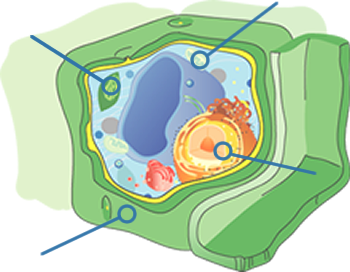
Which of the following organelles is NOT being pointed to in this image?

Required
1

Which of the following organelles are in plant cells but NOT animal cells?
Check all that are true.

Required
1

Imagine an amoeba needs to store excess water. What organelle might do this?