Year 8 making salts
star
star
star
star
star
Last updated 5 months ago
17 questions
4
Balanced chemical equations can include state symbols and this gives a guide to the method that should be used to make a salt.
| Draggable item | arrow_right_alt | Corresponding Item |
|---|---|---|
(l) | arrow_right_alt | solid |
(g) | arrow_right_alt | liquid |
(s) | arrow_right_alt | gas |
(aq) | arrow_right_alt | aqueous (dissolved in water) |
3
Method 1 Base + acid -> salt + waterhttps://www.focuselearning.co.uk/s/1ljciv1opx8e
(s) + (aq) →(aq) + (l)
Method
1. Add solid base to excess, 2. filter to remove the excess base3. Collect the filtrate4. Evaporate the excess water from the solution in an evaporating dish5. Place the concentrated solution in a crystallising dish.6. Place the crystallising dish in a warm dry place7. Wash and dry the crystals.
Method 2Acid + alkali -> salt + water.
https://www.focuselearning.co.uk/s/qp96anf2uap
https://billvining.com/mmlib_sims/#gen_4_2
(note this a more slightly more advanced method than you used last week)
(aq) + (aq) -> (aq) + (l)
Method:1. Add the acid to the alkali and use an indicator to work out the volumes of liquids needed.2. Repeat the reaction using the correct volumes and without the indicator.3. Evaporate the excess water from the solution in an evaporating dish4. Place the concentrated solution in a crystallising dish.5. Place the crystallising dish in a warm dry place6. Wash and dry the crystals.
Method 1
Base + acid -> salt + water
https://www.focuselearning.co.uk/s/1ljciv1opx8e
(s) + (aq) →(aq) + (l)
Method
1. Add solid base to excess,
2. filter to remove the excess base
3. Collect the filtrate
4. Evaporate the excess water from the solution in an evaporating dish
5. Place the concentrated solution in a crystallising dish.
6. Place the crystallising dish in a warm dry place
7. Wash and dry the crystals.
Method 2
Acid + alkali -> salt + water.
https://www.focuselearning.co.uk/s/qp96anf2uap
https://billvining.com/mmlib_sims/#gen_4_2
(note this a more slightly more advanced method than you used last week)
(aq) + (aq) -> (aq) + (l)
Method:
1. Add the acid to the alkali and use an indicator to work out the volumes of liquids needed.
2. Repeat the reaction using the correct volumes and without the indicator.
3. Evaporate the excess water from the solution in an evaporating dish
4. Place the concentrated solution in a crystallising dish.
5. Place the crystallising dish in a warm dry place
6. Wash and dry the crystals.
| Draggable item | arrow_right_alt | Corresponding Item |
|---|---|---|
Acid + alkali | arrow_right_alt | Method 1 |
Steps 4-7 for method 1 | arrow_right_alt | Method 2 |
Acid + base | arrow_right_alt | steps 3-6 for method 2. |
1
https://www.focuselearning.co.uk/s/1ljciv1opx8e
Which method should be used?
CuO(s) + H₂SO₄(aq) → CuSO₄(aq) + H₂O(l)
https://www.focuselearning.co.uk/s/1ljciv1opx8e
Which method should be used?
CuO(s) + H₂SO₄(aq) → CuSO₄(aq) + H₂O(l)
1
Which method should be used?
CuCO₃(s) + H₂SO₄(aq) → CuSO₄(aq) + H₂O(l) +CO₂
Which method should be used?
CuCO₃(s) + H₂SO₄(aq) → CuSO₄(aq) + H₂O(l) +CO₂
1
Which method should be used?
Mg(s) + H₂SO₄(aq) → MgSO₄(aq) + H₂(g)
Which method should be used?
Mg(s) + H₂SO₄(aq) → MgSO₄(aq) + H₂(g)
1
Which method should be used?
NaOH(aq) + HCl(aq) → NaCl(aq) + H₂O(l)
Which method should be used?
NaOH(aq) + HCl(aq) → NaCl(aq) + H₂O(l)
1
Which method should be used?
KOH(aq) + HCl(aq) → KCl(aq) + H₂O(l)
Which method should be used?
KOH(aq) + HCl(aq) → KCl(aq) + H₂O(l)
1
Which method should be used?
KOH(aq) + HNO₃(aq) → KNO₃ (aq) + H₂O(l)
Which method should be used?
KOH(aq) + HNO₃(aq) → KNO₃ (aq) + H₂O(l)
1
Which method should be used?
2NaOH(aq) + H2SO4(aq) → Na2SO4 (aq) + 2H₂O(l)
Which method should be used?
2NaOH(aq) + H2SO4(aq) → Na2SO4 (aq) + 2H₂O(l)
9
Sodium hydroxide + nitric acid -> ___________ ____________ + __________
Sodium hydroxide + sulfuric acid -> ___________ ____________ + __________
Sodium hydroxide + hydrochloric acid -> ___________ _____________ +__________
Other Answer Choices:
chloride
nitrate
sulfate
water
sodium
9
potassium hydroxide + nitric acid -> ______________ ____________ + __________
potassium hydroxide + sulfuric acid -> ______________ ____________ + __________
potassium hydroxide + hydrochloric acid -> ___________________________+ __________
(note in your books the reactants should be on the left hand side of the arrow and the products should be on the right hand side of the arrow).
Other Answer Choices:
sulfate
nitrate
chloride
water
potassium
9
Copper oxide + sulfuric acid -> _______________________ + __________
Copper carbonate + sulfuric acid -> ___________ ____________ +__________ + CO2
Copper oxide + hydrochloric acid -> ___________ _____________ + __________
(Note the hints are videos showing the first and third reactions)
Other Answer Choices:
sulfate
chloride
water
copper
5
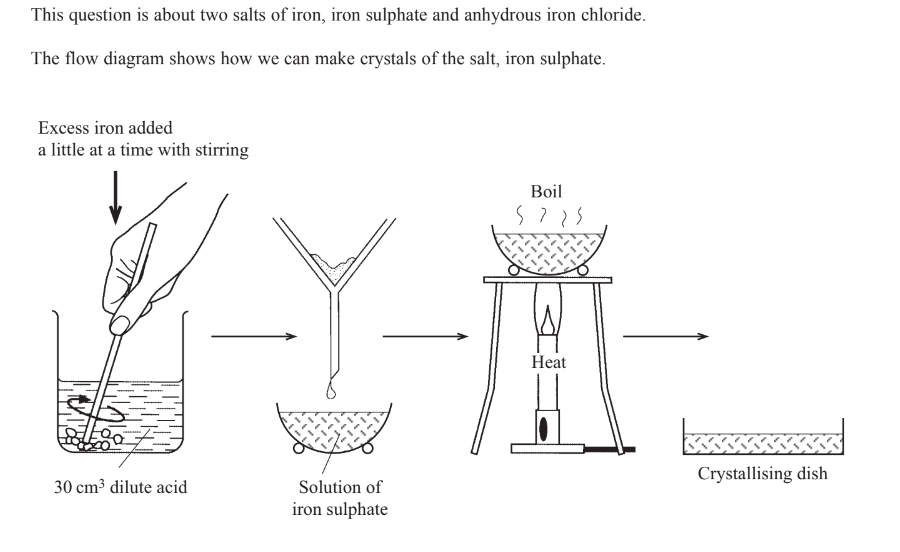
Put the steps for making pure dry iron sulfate into the correct order.
- Firstly add excess iron to the sulfuric acid (1)
- Wash the crystals with distilled water and dry the crystals with filter paper (5)
- Filter the excess iron from the iron sulfate (2)
- leave the concentrated filtrate in an evaporating dish in warm place (4)
- Heat the filtrate in an evaporating dish (3)
1
Which acid is used to prepare iron sulphate?(hint there is only one correct answer)
Which acid is used to prepare iron sulphate?
(hint there is only one correct answer)
1
Which acid is used to prepare iron citrate?(hint there is only one correct answer)
Which acid is used to prepare iron citrate?
(hint there is only one correct answer)
1
Which acid is used to prepare iron nitrate?(hint there is only one correct answer)
Which acid is used to prepare iron nitrate?
(hint there is only one correct answer)
4
Note some metal hydroxides are bases but not alkalis
This is shown by the state symbol for the hydroxideMagnesium sulfate (which is soluble in water) could be made by
MgO(s) + H₂SO₄(aq) → MgSO₄(aq) + H₂O(l)
Mg(OH)₂(s) + H₂SO₄(aq) → MgSO₄(aq) + 2H₂O(l)
MgCO₃(s) + H₂SO₄(aq) → MgSO₄(aq) + H₂O(l) +CO₂(g)
Hint Mg(OH)2 is insoluble
Note some metal hydroxides are bases but not alkalis
This is shown by the state symbol for the hydroxide
Magnesium sulfate (which is soluble in water) could be made by
MgO(s) + H₂SO₄(aq) → MgSO₄(aq) + H₂O(l)
Mg(OH)₂(s) + H₂SO₄(aq) → MgSO₄(aq) + 2H₂O(l)
MgCO₃(s) + H₂SO₄(aq) → MgSO₄(aq) + H₂O(l) +CO₂(g)
Hint Mg(OH)2 is insoluble