
What is the predicted charge for an atom with 7 valence electrons?
Which of the following substances would you expect to be a good electrical conductor?
Which property is likely to be similar in elements with the same valence electrons?
Which of the following are physical properties of matter?
In which model do electrons move in specific orbits?
Which model shows valence electrons as dots around the element?
Which model has concentric circles representing energy levels?
Which model helps predict how atoms interact to form molecules?
Which of these elements could form a covalent bond with phosphorus?
To form an ionic bond, Magnesium (Mg) will...
Select all of the products of the reaction: H2(g) + P(s) --> PH3(s)
In the chemical equation C6H12O6 -> 2 C2H5OH + 2 CO2, what is the number '12' ?
In the equation: 4 NH3 -> 6 H2O + 2 N2 what is the number 6?
How many nitrogen (N) atoms are represented in this chemical formula: 4 NH3
How many oxygen atoms are in the compound: Cu(NO3)2
Which statements best describe what happens at the particle scale when a salt dissolves in water (select all that are correct)?
Which molecule is polar due to unequal electron sharing?
Why do polar molecules have partial charges?
If 14g of nitrogen gas (N2) react with 3g of hydrogen gas (H2) to produce ammonia (NH3), what mass of ammonia will be produced, assuming the reaction follows the Law of Conservation of Mass?
If 46g of cellulose is completely burned, 100g of exhaust (water + CO2) will be produced. What mass of oxygen gas (O2) will be used in this combustion reaction, according to the Law of Conservation of Mass?
Balance the equation Al + CuCl2 -> AlCl3 + Cu. What is the coefficient for CuCl2 in the balanced equation?
Balance the equation: HCl + O2 -> Cl2 + H2O. What coefficient is needed for Cl2?
Which of these hypothetical exoplanets would be the most likely candidates on which we might find life (select all that would be good candidates)?
Based on their positions in the Periodic Table, which of the following elements would you expect to have similar chemical properties to those of Nitrogen (N)? (Select all that apply)
What are some reasons Hydrogen (H2) might be preferable to gasoline as a fuel for cars? (select all that apply)
Which statement describes a physical change?
Which statement describes a chemical change?
Which indicates a chemical change? (select all that apply)
Why do combustion reactions produce heat?
For the particle model show above, what is the chemical equation that most likely represents the same reaction?
How can an increase in the temperature of a gas cause a syringe plunger to move? (Select all components of a complete and correct answer)
Combustion is a
An atom becomes an ion by (select all possibilities)
What charge would a Gallium (Ga) ion have?
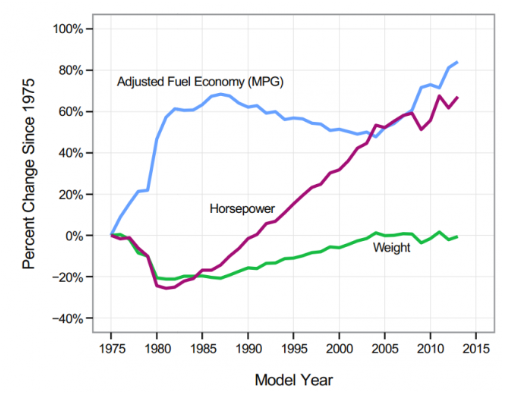
This graph shows changes in internal combustion engines over the past 35 years due to improvements in design. What claims could we make based on the data shown in the graph?
A student wants to determine the effect of temperature on the volume of a gas. They use a sealed syringe to measure the volume of the gas at 0, 20, 40, 60, 80 and 100 OC and make a graph of their results. In this experiment, what is the independent variable?
A student wants to determine the electrical conductivity of different salt solutions. They conduct an experiment in which they dissolve 5 grams each of 4 different salts (NaCl, KCl, NaBr and KBr) in different beakers, each containing 100 mL of water. They measure conductivity of each solution using a conductivity meter, record their results and make a bar graph. What is the dependent variable in this experiment?