Log in
Sign up for FREE
arrow_back
Library
Science Final 1 Semester
By Samuel Collier
star
star
star
star
star
Share
share
Last updated about 3 hours ago
50 questions
Add this activity
1
1
1
1
1
1
1
1
1
1
1
1
1
1
1
1
1
1
1
1
1
1
1
1
1
1
1
1
1
1
1
1
1
1
1
1
1
1
1
1
1
1
1
1
1
1
Question 1
1.
Which type of wave can travel through the vacuum of space?
Pressure
Sound
Light
Surface
Question 2
2.
What is a wave?
A disturbance that carries energy forward.
A disturbance that carries matter forward.
A disturbance that carries particles forward.
Question 3
3.
What is a medium?
The middle part of the wave.
The material that carries the wave.
A type of wave.
Question 4
4.
Which of the following is NOT correctly represented in the diagram below?
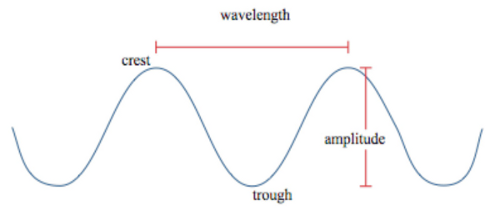
Trough
Wavelength
Crest
Amplitude
Question 5
5.
How is the frequency of a wave measured?
Frequency is measured from crest to trough that happens in one second
Frequency is measured by the number of wavelengths that pass in one second
Frequency is measured by the amount of amplitude that happens in one second
Question 6
6.
Which descriptions below describe a sound wave with low amplitude? Check all that apply.
Waves are shorter or are decreased in size.
Waves are tall or are increased in size.
Waves are short or are increased in size.
Decreased volume
Question 7
7.
This image depicts what kind of wave?
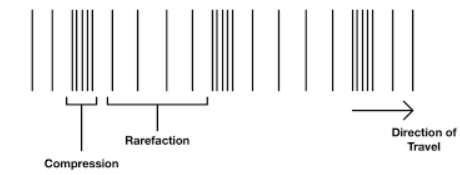
Sound
Surface
Greeting
Light
Question 8
8.
How is Amplitude and Frequency Related
Directly the same
Directly Inverse
No Relation
Inversely Proportional
Question 9
9.
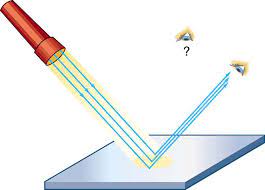
What wave phenomenon is depicted in the image, where a wave is bouncing back from a boundary?
Transmission
Refraction
Reflection
Absorption
Question 10
10.
In the provided image, a wave is bending as it passes from one medium to another. What is this called?
Transmission
Reflection
Refraction
Absorption
Question 11
11.
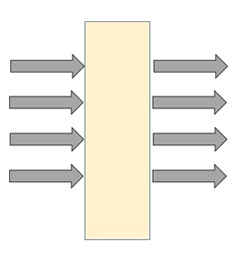
What is shown in the image where a wave is moving through a medium without being reflected or refracted?
Reflection
Refraction
Absorption
Transmission
Question 12
12.
What is the term of a wave being captured by a medium, with its energy being converted into other forms?
Reflection
Refraction
Transmission
Absorption
Question 13
13.
In order to change pitch of a soundwave you need to change the
Amplitude
Frequency
Trough
Crest
Question 14
14.
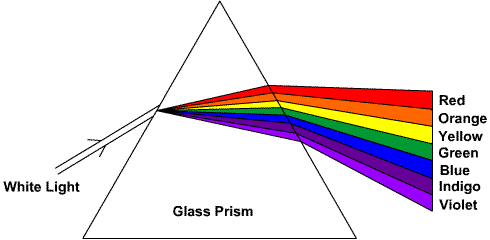
In order to change the color of a light wave, you need to change the
Amplitude
Frequency
Pitch
Trough
Question 15
15.
Leaves are green because greenlight is absorbed in the leaf, and the other colors are reflected
True
False
Question 16
16.
The relationship between wavelength and frequency is inverse
True
False
Question 17
17.
What makes sound waves different from light waves? Check all that apply.
Sound wave and light waves both require a medium
Sound waves are surface waves and light waves are transverse waves.
Sound waves are not visible, but light waves are.
Sound waves travel at a slow speed and light waves are very fast-moving waves.
Question 18
18.
What does the term 'solubility' refer to in science?
How well a substance can be dissolved
Amount of mass per given volume
The ability to combine chemically
Being attracted by a magnet
Question 19
19.
What does 'reactivity' mean in a scientific context?
How well a substance can be dissolved
A substance consisting of one type of atom
The ability of matter to combine chemically with other substances
A characteristic observed without changing the substance's identity
Question 20
20.
What is a property that can be observed or measured without changing the identity of a substance?
Chemical property
Electrical conductivity
Physical property
Reactivity
Question 21
21.
Which property can only be measured when matter undergoes a change to become an entirely different kind of matter?
Electrical conductivity
Chemical property
Physical property
Magnetism
Question 22
22.
What term refers to the ability of matter to combine chemically with other substances?
Reactivity
Magnetism
Solubility
Physical property
Question 23
23.
If silver tarnishes when exposed to air, what property does this demonstrate?
Chemical property
Malleability
Physical property
Density
Question 24
24.
What does magnetism mean?
Being made of metal
substances that are made of two or more different elements present in a fixed ratio
is the ability of a material to be attracted or repelled
Question 25
25.
If an object is dense, this means it has...
The same mass as volume
No mass
High mass for its volume
Low mass for its volume
Question 26
26.
Can a property be both physical and chemical?
No
Only if it's non-metal
Only if it's metal
Yes
Question 27
27.
The sun heats the earth through what type of heat transfer?
Radiation
Conduction
Insulation
Convection
Question 28
28.
How does thermal energy move?
By train
Thermal equilibrium
From cold hot objects
From hot to cold objects
Question 29
29.
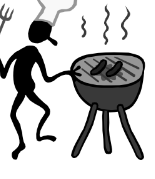
What kind of heat transfer is happening from the grill to the hotdogs (Choose all that apply)
Conduction
Convection
Radiation
Question 30
30.
How does convection move?
Straight up and down
Moving heat through a circular motion
It only forces heat up
Through direct contact
Question 31
31.
What does Conduction mean?
Transferring heat through direct contact
To guide musicians
Moving heat through a circular motion
Pulling the heat from an object
Question 32
32.
Conduction, Convection, and Radiation all need only atoms to work
True
False
Question 33
33.
What axis does the independent variable go on?
It doesn't belong on a graph
X-Axis
Dependent Variable
Y-Axis
Question 34
34.
What axis does the Dependent variable go on?
Y-Axis
It doesn't go on the graph
X-Axis
Independent Variable
Question 35
35.
When is a bar graph used?
When I choose to
When order matters
When using percentages
When order does not matter
Question 36
36.
When do you use a line graph?
When using percentages
When Order matters
When I want to
When Order doesn't matter
Question 37
37.
The Law of Conservation of Mass means that mass changes during chemical reactions.
True
False
Question 38
38.
What is a reactant?
Substances that are made of two or more different elements present in a fixed ratio.
the starting materials in a chemical reaction.
a substance that consists of only one type of atom.
the resulting substance(s) formed by a chemical reaction.
Question 39
39.
What is a product?
the resulting substance(s) formed by a chemical reaction.
the smallest unit of matter that retains all of the chemical properties of an element.
a substance that consists of only one type of atom.
the starting materials in a chemical reaction.
Question 40
40.
What is an element?
a process in which some substances change into different substances.
a substance that consists of only one type of atom.
substances that are made of two or more different elements present in a fixed ratio.
two or more atoms that have been chemically combined.
Question 41
41.
What is the process in which some substances change into different substances.
Product
Molecules
Compounds
Chemical Reaction
42
zoom_in
1
1
1
1
Question 46
46.
Elements protons are always different than the electrons
True
False
Question 47
47.
What tells us how much an element weighs?
Atomic Number
Atomic Mass
It doesn't tell us the mass of an element
Question 48
48.
What information does the atomic number give? (Select all that apply)
The amount of Neutrons in the atom
The amount of Protons in the atom
The amount of Electrons in the atom
The weight of the atom
Question 49
49.
In a chemical reaction, new atoms are created.
False
True
Question 50
50.
The properties of the reactants are always the same as the properties of the products.
False
True
Insulation
Question 42
42.
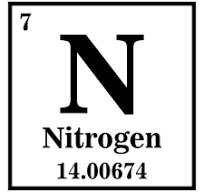
What is the Symbol for this element?
N
Ni
There is no Symbol
7
Question 43
43.
How Many Protons are in this element ?
7
14
0
14.00674
Question 44
44.
How many electrons are in this element?
7
14
0
14.00674
Question 45
45.
What is the Atomic Mass of this element?
7
0
14.00674
N